Free Real Estate Transfer Tax Calculator Online
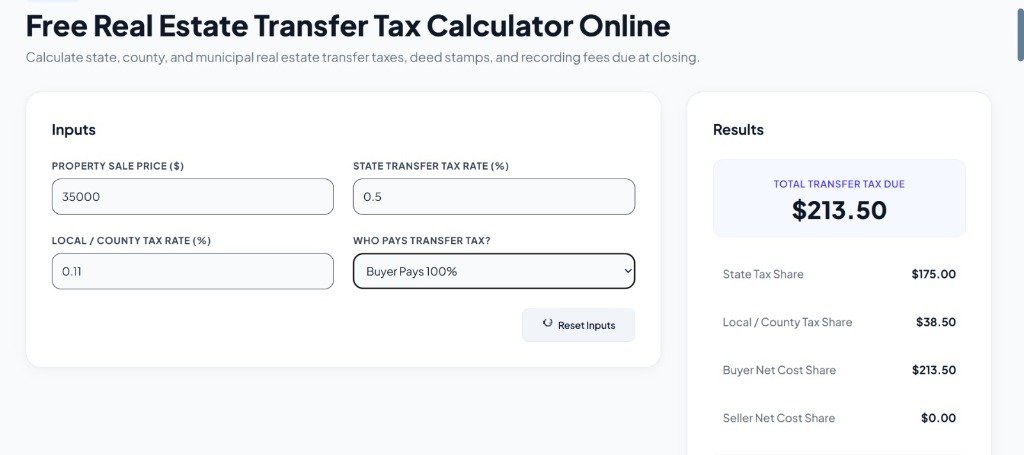
Calculate state, county, and municipal real estate transfer taxes, deed stamps, and recording fees due at closing.
Inputs
Results
Calculation History
No calculations saved yet.
Real Estate Transfer Tax Calculator: Calculate Property Transfer Taxes Easily
Buying or selling real estate involves more costs than just the property's purchase price. Along with the down payment, mortgage expenses, inspections, legal fees, and closing costs, buyers and sellers may also have to pay real estate transfer taxes. These taxes can represent a significant amount of money, especially when a property has a high purchase price.
A Real Estate Transfer Tax Calculator is a useful online tool that helps property buyers, sellers, investors, and real estate professionals estimate the transfer tax associated with a property transaction. By entering information such as the property value, sale price, location, and applicable tax rate, users can quickly estimate their potential transfer tax liability.
Because transfer tax rules vary significantly between states, counties, and municipalities, understanding how these taxes work is important when preparing a realistic real estate budget.
What Is Real Estate Transfer Tax?
Real estate transfer tax is a tax imposed by a government authority when ownership of real property is transferred from one person or entity to another.
The tax may be charged by:
- State governments
- Counties
- Cities
- Municipalities
- Other local jurisdictions
Depending on the location, the tax may be called a real estate transfer tax, property transfer tax, deed transfer tax, stamp duty, or another similar term.
The amount can be based on the property's sale price, assessed value, consideration paid, or another legally defined amount.
For example, if a jurisdiction applies a transfer tax rate of 1% and a property sells for $400,000, a basic estimate would be:
$400,000 × 1% = $4,000
However, actual transfer taxes may involve exemptions, thresholds, tiered rates, local taxes, or special rules.
What Is a Real Estate Transfer Tax Calculator?
A Real Estate Transfer Tax Calculator is a financial tool that estimates the amount of transfer tax that may apply to a property transaction.
A typical calculator may ask users to enter:
- Property sale price
- Property location
- Transfer tax rate
- Buyer or seller responsibility
- County or municipal tax
- Exemptions
- Tax thresholds
- Property type
- Other transaction details
The calculator then applies the relevant tax rate or rates to estimate the potential transfer tax.
It is particularly useful during the early stages of buying or selling a property because it gives users an idea of the additional costs they may need to budget for.
How Does a Real Estate Transfer Tax Calculator Work?
The simplest transfer tax calculation uses the following formula:
Transfer Tax = Taxable Property Value × Transfer Tax Rate
For example, suppose a property is sold for $350,000 and the applicable transfer tax is 0.75%.
The calculation would be:
$350,000 × 0.0075 = $2,625
The estimated transfer tax would therefore be $2,625.
However, not every jurisdiction uses a single flat rate. Some locations use progressive or tiered rates, while others may have separate state and local taxes.
A calculator designed for a specific jurisdiction can account for these rules more accurately.
Who Pays Real Estate Transfer Tax?
One of the most important questions during a property transaction is determining who is responsible for paying the transfer tax.
Depending on the jurisdiction and transaction agreement, transfer taxes may be paid by:
- The buyer
- The seller
- Both buyer and seller
- Another party specified by local law
In some markets, the customary practice may differ from the legal requirement.
For this reason, buyers and sellers should check the rules that apply to the specific property location and transaction.
Factors That Affect Real Estate Transfer Tax
Several factors can influence the amount of transfer tax.
Property Sale Price
The property's sale price is often one of the most important factors.
Generally, a higher taxable transaction value results in a higher transfer tax when the applicable rate is based on the transaction amount.
Location
Transfer tax rules vary widely by location.
A property transaction in one state or city may be subject to completely different taxes from an otherwise identical transaction in another location.
Some jurisdictions impose state-level taxes, while others add county or municipal taxes.
Tax Rate
The applicable transfer tax rate directly affects the final amount.
For example:
- 0.5% on $500,000 = $2,500
- 1% on $500,000 = $5,000
- 2% on $500,000 = $10,000
This demonstrates why identifying the correct local rate is important.
Property Type
Certain jurisdictions may apply different rules depending on the type of property.
The transaction may involve:
- Residential property
- Commercial property
- Vacant land
- Multifamily property
- Industrial property
- Mixed-use property
Special rules may apply to certain categories.
Exemptions and Discounts
Some property transactions may qualify for exemptions or reduced tax rates.
Potential exemptions can vary by jurisdiction and may apply to certain:
- First-time buyers
- Government transactions
- Transfers between specific parties
- Certain nonprofit organizations
- Family transfers
- Low-value transactions
- Other qualifying situations
Never assume an exemption applies without verifying the applicable local rules.
Why Use a Real Estate Transfer Tax Calculator?
Calculating transfer tax manually can become complicated when several taxes and exemptions are involved.
A calculator can provide several advantages.
Quick Estimates
Instead of performing calculations manually, users can enter their information and quickly receive an estimated tax amount.
Better Budget Planning
Transfer taxes are part of the broader costs associated with buying or selling property.
Estimating them early can help buyers prepare sufficient funds for closing.
Compare Properties
Investors evaluating properties in different locations can estimate transaction-related costs and incorporate them into their investment analysis.
Understand Closing Costs
Transfer taxes can be included in a broader closing-cost estimate. Knowing the potential tax amount helps users create a more complete financial picture.
Reduce Calculation Errors
A calculator can reduce basic mathematical mistakes, particularly when multiple tax rates or transaction values are involved.
Real Estate Transfer Tax vs. Property Tax
Transfer tax and property tax are not the same thing.
Real estate transfer tax is generally associated with the transfer of ownership from one party to another.
Property tax is typically an ongoing tax associated with owning real property.
For example, a homeowner might pay property taxes every year while only paying a transfer tax when a taxable ownership transfer occurs.
Understanding the difference is important when estimating both transaction costs and ongoing ownership expenses.
Real Estate Transfer Tax vs. Capital Gains Tax
Transfer tax should also be distinguished from capital gains tax.
Transfer tax is generally associated with the transaction or transfer of the property.
Capital gains tax, where applicable, relates to the gain realized from selling an asset.
For example, if someone purchased a property for $250,000 and later sold it for $400,000, the $150,000 difference may potentially represent a capital gain before considering applicable adjustments and tax rules.
The transfer tax calculation is a separate matter.
Because tax laws can be complex, professional tax advice may be appropriate for significant transactions.
Example of Using a Transfer Tax Calculator
Suppose an investor purchases a property for $600,000.
Assume, purely for illustration, that the applicable transfer tax rate is 1%.
The estimated transfer tax would be:
$600,000 × 1% = $6,000
If the buyer also has other closing costs, such as legal fees, recording fees, inspection costs, and lender charges, the total transaction cost would be higher.
This illustrates why investors should consider transfer tax as part of the overall acquisition budget rather than looking only at the property's purchase price.
Transfer Tax and Real Estate Investors
Transfer taxes can be particularly important for real estate investors.
Investors frequently evaluate properties based on expected:
- Purchase price
- Rental income
- Operating expenses
- Financing costs
- Appreciation
- Selling expenses
- Taxes
- Investment returns
An unexpected transaction cost can reduce the profitability of a deal.
For example, an investor who expects to make a $30,000 profit may have a substantially different net return after accounting for acquisition and selling costs.
A transfer tax calculator can therefore be incorporated into a broader real estate investment analysis.
Transfer Taxes and Closing Costs
Transfer taxes are often considered part of the transaction or closing costs associated with buying or selling property.
Other potential closing expenses may include:
- Loan origination fees
- Title fees
- Appraisal fees
- Inspection fees
- Recording fees
- Attorney fees
- Escrow charges
- Survey costs
- Brokerage commissions
- Prepaid taxes and insurance
Not every transaction includes all of these costs.
The exact expenses depend on the property, financing arrangement, location, and transaction structure.
How to Get More Accurate Results
A calculator is only as accurate as the information entered into it.
For better estimates:
- Use the correct property sale price.
- Select the correct state or jurisdiction.
- Check whether local taxes apply.
- Confirm the current transfer tax rate.
- Review applicable exemptions.
- Determine whether the buyer or seller is responsible.
- Check whether the jurisdiction uses thresholds or tiered rates.
- Include other transaction-related costs separately.
- Verify the final amount with the closing professional.
Tax rules can change, so users should avoid relying on outdated rates.
Transfer Tax for Buyers
Buyers should consider transfer tax when determining how much cash they need to complete a property purchase.
For example, a buyer may calculate:
Down Payment + Closing Costs + Transfer Tax + Other Required Funds = Estimated Cash Needed
Including transfer tax in the planning process can help prevent surprises at closing.
Transfer Tax for Sellers
Sellers should also determine whether they have a transfer tax obligation.
When selling property, sellers may have to account for:
- Transfer taxes
- Real estate commissions
- Legal expenses
- Mortgage payoff
- Repairs
- Closing expenses
- Potential capital gains tax
Understanding these costs can help sellers estimate their actual net proceeds from a sale.
Using a Calculator for Different Scenarios
One useful feature of a Real Estate Transfer Tax Calculator is the ability to test multiple purchase prices.
For example, an investor might compare:
| Property Price | Example 1% Transfer Tax |
|---|---|
| $200,000 | $2,000 |
| $300,000 | $3,000 |
| $400,000 | $4,000 |
| $500,000 | $5,000 |
| $750,000 | $7,500 |
| $1,000,000 | $10,000 |
These figures are simple illustrations using a hypothetical 1% rate. Actual transfer tax rates and calculation methods vary by jurisdiction.
Common Mistakes When Calculating Transfer Tax
Several mistakes can lead to inaccurate estimates.
Using the Wrong Tax Rate
A user may accidentally use a statewide rate when a local tax also applies.
Ignoring Exemptions
Some transactions may qualify for exemptions or reduced rates.
Confusing Transfer Tax With Property Tax
These are separate costs with different purposes and calculation methods.
Using Outdated Information
Tax rates and regulations can change. Always verify current requirements.
Forgetting Additional Local Taxes
Some cities or counties may impose additional taxes beyond a state-level transfer tax.
Frequently Asked Questions
What is a Real Estate Transfer Tax Calculator?
It is an online tool that estimates the tax associated with transferring real estate ownership based on factors such as property value, location, and applicable tax rates.
How is transfer tax calculated?
A basic calculation is the taxable transaction value multiplied by the applicable transfer tax rate. However, some jurisdictions use thresholds, progressive rates, exemptions, or additional local taxes.
Is transfer tax paid by the buyer or seller?
It depends on the jurisdiction and transaction. Some locations assign the tax to the buyer, some to the seller, and others may allow or require both parties to pay certain taxes.
Does every state have a real estate transfer tax?
No. Transfer tax systems differ significantly between jurisdictions. Some states have state-level transfer taxes, some have local taxes, and some transactions may be subject to different forms of transfer-related taxes.
Is transfer tax included in closing costs?
Transfer tax is commonly considered a transaction or closing expense, although the exact treatment depends on the jurisdiction and transaction.
Does transfer tax depend on the property price?
Often, yes. Many transfer taxes are calculated using the taxable value or consideration associated with the transaction. However, specific rules vary by jurisdiction.
Can transfer tax be waived?
Certain transactions may qualify for exemptions or special treatment. Eligibility depends on local law and the circumstances of the transfer.
Is transfer tax the same as capital gains tax?
No. Transfer tax is generally associated with transferring property ownership, while capital gains tax may apply to the profit realized from selling an investment or other capital asset.
Can investors use a transfer tax calculator?
Yes. Real estate investors can use transfer tax estimates when analyzing acquisition costs, potential profits, cash requirements, and investment returns.
Are online transfer tax calculations exact?
They can provide useful estimates, but the final amount may depend on jurisdiction-specific rules, exemptions, transaction structure, and current legislation. For an actual transaction, confirm the amount with a qualified real estate, tax, or closing professional.
Conclusion
A Real Estate Transfer Tax Calculator is a convenient tool for estimating one of the important costs associated with buying or selling property. By entering the property value and applicable tax information, users can quickly estimate potential transfer tax and include it in their overall transaction budget.
Transfer taxes vary considerably between jurisdictions, so there is no single rate that applies everywhere. Buyers and sellers should consider the property's location, transaction value, applicable state and local taxes, exemptions, and responsibility for payment.
For investors, incorporating transfer tax into a broader investment analysis can provide a more realistic understanding of acquisition costs and potential returns. For homeowners and buyers, estimating the tax in advance can make financial planning easier and reduce surprises during closing.
Use a Real Estate Transfer Tax Calculator as a starting point for planning, but always verify the final tax obligation with the relevant government authority or a qualified professional before completing a real estate transaction.