Free Real Estate Wholesaling Calculator Online
Calculate the Maximum Allowable Offer (MAO) for wholesale real estate deals based on the 70% rule, rehab costs, and assignment fees.
Inputs
Results
Calculation History
No calculations saved yet.
Related Calculators
Real Estate Wholesaling Calculator
Real estate wholesaling can be an effective strategy for investors who want to find discounted properties and earn profits by assigning purchase contracts to other buyers. However, determining whether a wholesale deal is actually profitable requires more than simply finding a property listed below market value.
A Real Estate Wholesaling Calculator helps investors estimate the potential profitability of a wholesale transaction by considering factors such as the property's estimated value, repair costs, purchase price, assignment fee, closing costs, and the maximum allowable offer.
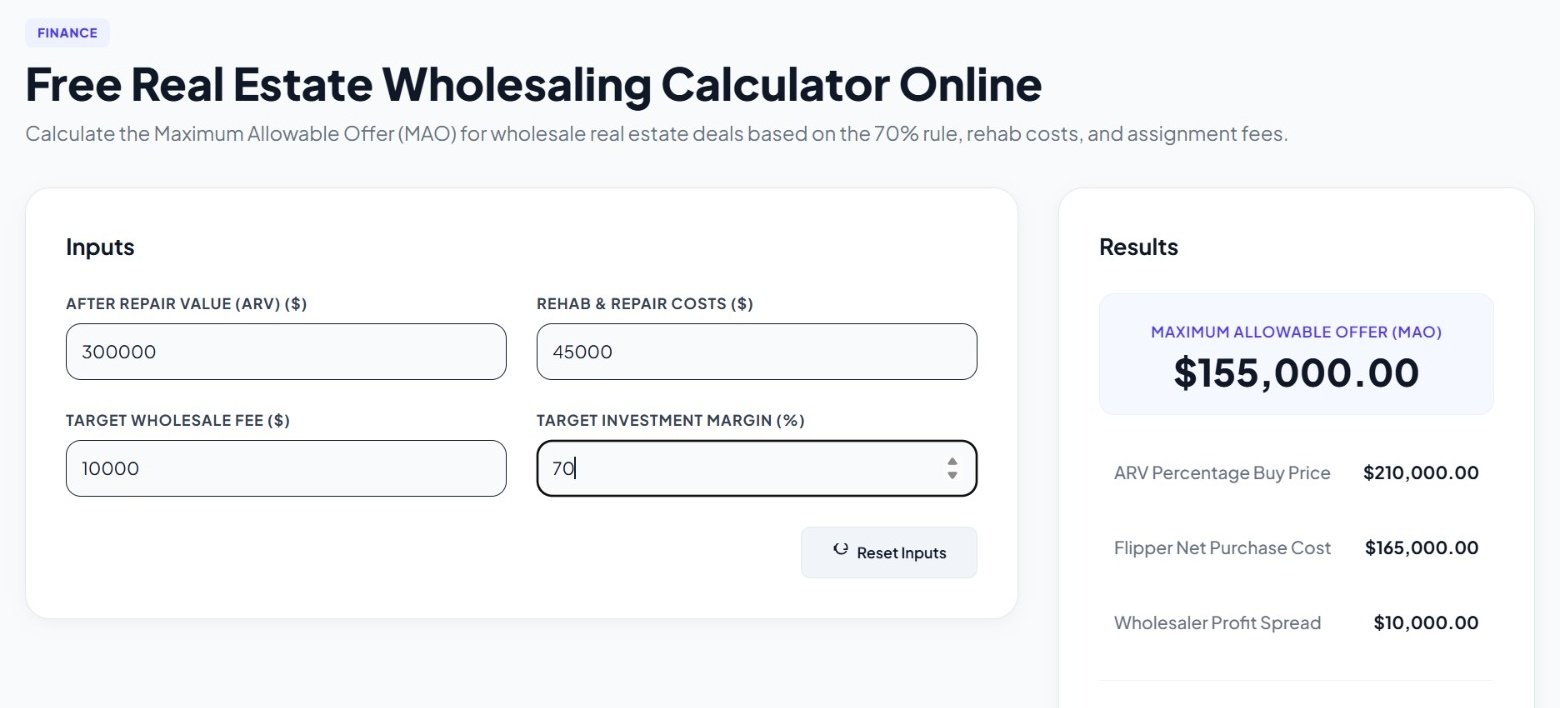
Whether you are an experienced real estate wholesaler or just learning how property wholesaling works, using a calculator can make deal analysis faster and more consistent.
What Is a Real Estate Wholesaling Calculator?
A Real Estate Wholesaling Calculator is an online tool designed to help investors evaluate potential wholesale real estate deals.
The calculator uses information about a property and the expected transaction costs to estimate important figures. These may include the property's after-repair value, estimated renovation costs, maximum allowable offer, potential assignment fee, and estimated profit.
Instead of manually performing several calculations, investors can enter their assumptions into the calculator and quickly review the potential numbers.
A wholesaling calculator does not guarantee that a deal will be profitable. Instead, it provides an estimate that can help investors make more informed decisions.
How Does Real Estate Wholesaling Work?
Real estate wholesaling generally involves finding a property at a price that leaves enough room for an investor or end buyer to make a profit.
The wholesaler typically enters into a purchase agreement with the property owner. Rather than purchasing and renovating the property themselves, the wholesaler may assign their contractual rights to another investor for an assignment fee.
For example, suppose a property could be worth $300,000 after renovations. If the property needs significant repairs, an investor may only be willing to pay a substantially lower price.
The wholesaler negotiates a purchase contract with the seller and then finds an end buyer willing to purchase the contract at a higher price.
The difference between the contract price and the assignment price can represent the wholesaler's gross assignment fee, although transaction expenses may reduce the final profit.
Why Use a Wholesaling Calculator?
Real estate deals involve multiple variables. Changing one number can significantly affect the profitability of a transaction.
A calculator makes it easier to analyze these variables and compare different properties.
Faster Deal Analysis
Investors may review dozens of properties while searching for wholesale opportunities. Manually calculating every deal can take considerable time.
A calculator allows investors to enter the property's numbers and quickly estimate whether the opportunity deserves further investigation.
Better Offer Decisions
One of the biggest challenges in wholesaling is determining an appropriate offer price.
A calculator can help investors estimate the maximum price they should consider based on the property's expected value, repairs, costs, and desired profit.
Understanding Profit Margins
A deal may look attractive because the purchase price is low, but high renovation expenses or transaction costs can reduce the potential profit.
A wholesaling calculator helps investors consider these costs before making an offer.
Important Inputs in a Real Estate Wholesaling Calculator
Different calculators may use different inputs. However, several figures are commonly important when evaluating a wholesale deal.
Property Purchase Price
The purchase price is the amount agreed upon with the seller under the purchase contract.
A lower acquisition price generally creates more room for the wholesaler and end buyer, assuming the property's value and repair estimates are accurate.
After Repair Value
The After Repair Value (ARV) is the estimated market value of the property after necessary renovations have been completed.
ARV is one of the most important numbers in wholesale deal analysis because it helps investors determine how much the finished property could potentially be worth.
ARV should ideally be based on comparable properties rather than an unsupported estimate.
Estimated Repair Costs
Repair costs can include everything required to bring the property to the expected condition.
Potential expenses may include:
- Roofing
- Flooring
- Plumbing
- Electrical work
- Kitchen renovation
- Bathroom renovation
- Painting
- HVAC repairs
- Windows
- Landscaping
- Structural work
Underestimating repairs can make a seemingly profitable deal unattractive.
Closing Costs
Closing costs may include title fees, recording fees, legal expenses, escrow charges, and other transaction-related costs.
The exact costs depend on the transaction structure and location.
Holding Costs
Holding costs are expenses associated with owning a property while it is being renovated or prepared for resale.
These may include:
- Property taxes
- Insurance
- Utilities
- Loan interest
- Maintenance
- HOA fees
For a wholesaler assigning a contract before closing, holding costs may be limited or structured differently. However, the end buyer may still consider these costs when determining the maximum purchase price.
Assignment Fee
The assignment fee is the amount a wholesaler earns for assigning their contractual rights to an end buyer.
For example, if a wholesaler has a contract to purchase a property for $150,000 and assigns that contract for $165,000, the gross assignment fee would be $15,000 before applicable expenses.
Desired Profit
Investors can establish a target profit or minimum spread when evaluating potential deals.
Having a predefined investment objective can help prevent emotional decisions and encourage consistent deal analysis.
Understanding the Maximum Allowable Offer
The Maximum Allowable Offer (MAO) is an estimated maximum price an investor may be willing to pay for a property while still leaving enough room for renovation expenses, transaction costs, financing, risk, and desired profit.
There is no universal MAO formula that works for every investor or property.
One commonly discussed approach uses a percentage of ARV and subtracts estimated repairs and other costs. However, the appropriate percentage can vary based on market conditions, property type, financing, buyer strategy, and expected profit.
A calculator can help investors test different assumptions instead of relying on one fixed formula.
Example of a Wholesale Deal Calculation
Consider a hypothetical property with the following estimates:
- After Repair Value: $300,000
- Estimated Repairs: $50,000
- Estimated transaction and other costs: $25,000
- Target profit and risk allowance: $35,000
An investor could use these figures to determine how much room remains for the purchase price.
The exact maximum offer will depend on the investor's strategy and the expected end-buyer economics.
The important lesson is that ARV alone should never determine the offer price. The investor should consider repairs, transaction expenses, market conditions, financing, and the required profit margin.
Real Estate Wholesaling Calculator vs. Flip Calculator
A wholesaling calculator and a house-flipping calculator serve related but different purposes.
A wholesaling calculator focuses primarily on evaluating the purchase contract, assignment opportunity, and potential wholesale spread.
A flipping calculator generally focuses on the complete investment, including acquisition, renovation, financing, holding costs, selling costs, and expected resale value.
A wholesaler may therefore be interested in whether there is enough margin for an end buyer to purchase the contract and still achieve their investment goals.
How Accurate Is a Real Estate Wholesaling Calculator?
A calculator is only as accurate as the information entered into it.
If the ARV is overstated or repair costs are underestimated, the calculator may produce an overly optimistic result.
For better analysis, investors should use realistic comparable sales, obtain contractor estimates where appropriate, and account for transaction expenses.
A calculator should be treated as a decision-support tool rather than a guarantee of investment performance.
Benefits for New Real Estate Investors
New investors can find real estate deal analysis confusing because there are many numbers to consider.
A wholesaling calculator provides a structured way to understand the relationship between:
- Purchase price
- ARV
- Repairs
- Transaction costs
- Assignment fee
- Investor profit
- End-buyer margin
By experimenting with different numbers, beginners can learn how changes in purchase price or repair costs affect the potential deal.
Benefits for Experienced Wholesalers
Experienced investors can also benefit from calculators because speed is important in competitive markets.
A wholesaler may need to evaluate multiple leads every day. A calculator can provide a consistent framework for quickly screening opportunities.
Experienced investors can also create their own assumptions based on their market, buyer network, property types, and business model.
How to Analyze a Wholesale Deal
A calculator should be part of a broader due diligence process.
Step 1: Estimate the Property's Current Value
Research comparable properties and determine a realistic current market value.
Step 2: Estimate the ARV
Analyze recently sold comparable properties that are similar in location, size, condition, and features.
Step 3: Estimate Repairs
Create a detailed repair list and obtain professional estimates when possible.
Step 4: Calculate Transaction Costs
Consider closing expenses, financing costs, title-related charges, and other applicable expenses.
Step 5: Determine the End-Buyer Economics
Ask whether another investor could purchase the property and still achieve an acceptable return.
Step 6: Calculate the Potential Assignment Fee
Determine whether there is enough spread between the contract price and the price an end buyer may reasonably accept.
Step 7: Review the Deal
Use the calculator to test conservative, moderate, and optimistic assumptions.
Common Mistakes When Using a Wholesaling Calculator
Overestimating ARV
One of the most common mistakes is assuming that a property will sell for the highest possible comparable price.
ARV should be supported by appropriate market data.
Underestimating Repairs
Minor-looking problems can become expensive during renovation. Investors should avoid using unrealistically low repair estimates.
Ignoring Transaction Costs
A deal that appears profitable before closing costs may have a much smaller actual margin after all expenses are considered.
Focusing Only on the Assignment Fee
A large assignment fee does not automatically mean the transaction is good for the end buyer.
A sustainable wholesale deal should leave sufficient room for the buyer's expenses, risks, and expected return.
Using Outdated Market Information
Real estate markets can change. Recent comparable sales and current market conditions are generally more useful than old data.
Tips for Using a Real Estate Wholesaling Calculator
For better results, consider the following practices:
- Use realistic property values.
- Research recent comparable sales.
- Get accurate repair estimates.
- Include transaction expenses.
- Consider financing and holding costs when relevant.
- Test conservative assumptions.
- Compare multiple properties.
- Consider the end buyer's potential return.
- Review local market conditions.
- Avoid relying on a single calculation.
Who Can Use a Real Estate Wholesaling Calculator?
The tool can be useful for different types of real estate professionals and investors, including:
- Real estate wholesalers
- Real estate agents
- House flippers
- Property investors
- Real estate entrepreneurs
- Investment groups
- Beginners learning real estate investing
It can also be useful for comparing potential acquisitions before spending significant time on detailed due diligence.
Final Thoughts
A Real Estate Wholesaling Calculator can make property deal analysis faster and easier by organizing the numbers that influence a potential wholesale transaction.
By considering ARV, purchase price, repair costs, transaction expenses, assignment fees, and investor profit, users can gain a clearer understanding of the potential economics of a deal.
However, a calculator should not replace proper real estate research or professional advice. Property values, renovation costs, financing conditions, taxes, closing expenses, and local regulations can vary significantly.
The best approach is to use the calculator as an initial screening tool and then perform thorough due diligence before entering into a transaction.
When accurate assumptions are combined with careful market research, a wholesaling calculator can become a valuable part of a real estate investor's deal-analysis process.
Frequently Asked Questions
What is a Real Estate Wholesaling Calculator?
A Real Estate Wholesaling Calculator is a tool that helps investors estimate the potential profitability of a wholesale property transaction by analyzing factors such as ARV, purchase price, repair costs, transaction expenses, and assignment fees.
How does a real estate wholesaling calculator work?
Users enter property information and estimated costs into the calculator. The tool then uses those figures to estimate potential margins, maximum offer amounts, assignment fees, or other deal-analysis metrics.
What does ARV mean in real estate wholesaling?
ARV stands for After Repair Value. It represents the estimated market value of a property after planned renovations and improvements have been completed.
What is MAO in real estate?
MAO stands for Maximum Allowable Offer. It is an estimated maximum purchase price that an investor may consider based on the property's expected value, expenses, risk, and desired profit.
Is there one standard MAO formula?
No. Different investors use different formulas and assumptions. Market conditions, property type, financing, renovation requirements, transaction costs, and investment objectives can all affect the appropriate maximum offer.
Can a wholesaling calculator guarantee a profit?
No. A calculator provides estimates based on the information entered by the user. Changes in property value, repair costs, market conditions, financing, or selling expenses can affect the actual outcome.
What information do I need to analyze a wholesale property?
Common information includes the purchase price, estimated ARV, repair costs, closing costs, financing expenses, holding costs where applicable, and desired profit or assignment fee.
How do I estimate ARV?
ARV is commonly estimated by analyzing comparable recently sold properties that are similar in location, size, condition, layout, and features. Professional real estate valuation advice may also be appropriate for certain situations.
Should repair costs be included in a wholesaling calculation?
Yes. Repair costs can have a major impact on the economics of a deal and should be estimated as realistically as possible.
What is an assignment fee?
An assignment fee is compensation earned by a wholesaler when they assign their contractual rights in a purchase agreement to another buyer. The amount depends on the specific transaction.
Can beginners use a Real Estate Wholesaling Calculator?
Yes. Beginners can use a calculator as a learning and deal-screening tool. Understanding the underlying numbers is still important because the calculator does not replace market research or due diligence.
Is a wholesaling calculator the same as a house-flipping calculator?
No. A wholesaling calculator generally focuses on the economics of acquiring and assigning a contract, while a flipping calculator typically analyzes the full renovation and resale process.
What can make a wholesale deal less profitable?
High repair costs, an inaccurate ARV, unexpected closing expenses, financing costs, market changes, delays, and an overly high purchase price can all reduce potential profitability.
Can I use a wholesaling calculator for different property types?
Yes, the basic concept can be applied to many property types. However, different properties can have very different repair, valuation, financing, and transaction requirements.
Should I use conservative estimates?
Using conservative assumptions can provide a more cautious view of a potential deal. Investors may want to test multiple scenarios to understand how changes in ARV, repairs, and costs affect the outcome.
Does a wholesaling calculator replace due diligence?
No. A calculator is an initial analysis tool. Investors should still conduct appropriate property inspections, title research, market analysis, legal review, and other due diligence before completing a transaction.
Why is the end buyer important in wholesaling?
The end buyer needs sufficient room to cover renovation, financing, transaction, and resale costs while achieving their investment objectives. A wholesale deal needs to make economic sense for the buyer as well as the wholesaler.