Free Real Estate Profit Calculator Online
Calculate house flipping and rehab profits, factoring in purchase pricing, renovation budgets, holding costs, and sales commissions.
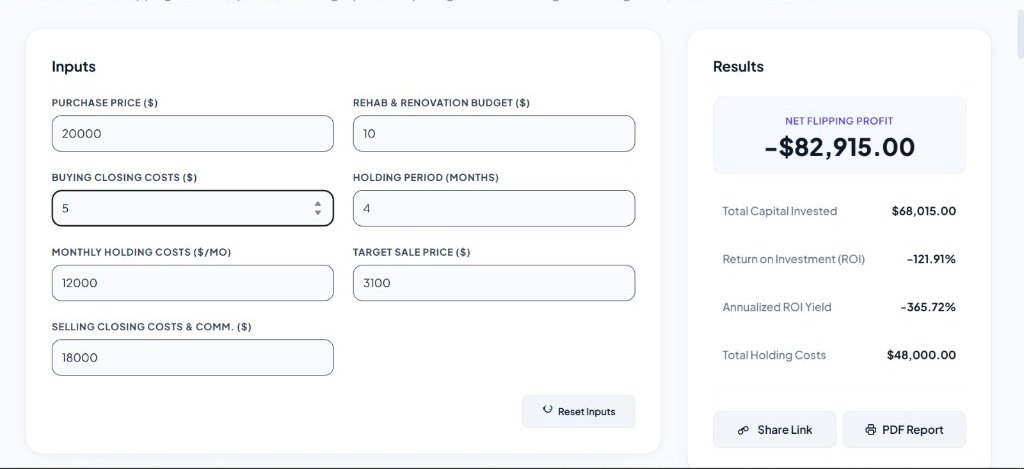
Inputs
Results
Calculation History
No calculations saved yet.
Real Estate Profit Calculator
Real estate investing can provide opportunities to generate income and build long-term wealth, but understanding the actual profitability of a property is essential before making an investment decision. A property may appear profitable based on its purchase price and expected selling price, but expenses such as renovations, financing, taxes, commissions, closing costs, and holding expenses can significantly affect the final result.
A Real Estate Profit Calculator is a useful tool for estimating the potential profit from buying, improving, holding, and selling a property. By entering important financial information, investors can get a clearer picture of their expected return and determine whether a potential transaction makes financial sense.
Whether you are a house flipper, rental property investor, real estate wholesaler, or homeowner planning to sell, a real estate profit calculator can help organize the numbers involved in a property transaction.
What Is a Real Estate Profit Calculator?
A Real Estate Profit Calculator is an online financial tool that estimates the potential profit or loss from a real estate transaction.
The calculator typically compares the expected selling price with the property's acquisition costs and other expenses. Depending on the calculator, users may enter the purchase price, renovation expenses, closing costs, financing costs, selling expenses, property taxes, holding costs, and expected sale price.
A basic calculation can be represented as:
Real Estate Profit = Sale Price − Total Investment Cost
However, a realistic analysis usually involves many additional expenses.
A more detailed calculation may include:
- Purchase price
- Down payment
- Renovation costs
- Financing costs
- Property taxes
- Insurance
- Utilities
- Maintenance
- Closing costs
- Real estate commissions
- Selling expenses
- Holding costs
By including these expenses, investors can obtain a more realistic estimate of their potential profit.
Why Use a Real Estate Profit Calculator?
Real estate transactions involve substantial amounts of money, making accurate financial analysis important.
Quickly Analyze Properties
Investors often compare multiple properties before choosing one. A calculator allows them to estimate potential profitability quickly.
Understand Total Costs
The purchase price is only one part of the investment. Additional costs can substantially reduce the final profit.
A calculator helps investors account for expenses that might otherwise be overlooked.
Estimate Potential Profit
By entering the expected purchase and sale prices along with estimated expenses, investors can calculate a potential profit before committing significant capital.
Compare Investment Opportunities
Two properties may have similar purchase prices but very different renovation requirements, holding costs, and potential selling prices.
A profit calculator can help investors compare these opportunities more objectively.
Key Inputs in a Real Estate Profit Calculator
Different calculators may require different information, but several inputs are commonly used.
Purchase Price
The purchase price is the amount paid to acquire the property.
It is one of the most important figures in the calculation because buying at an attractive price can create more room for profit.
Estimated Sale Price
The estimated sale price represents the amount the investor expects to receive when selling the property.
This estimate should be based on realistic market research and comparable properties rather than an overly optimistic assumption.
Renovation Costs
For properties that require improvements, renovation costs can represent a significant portion of the total investment.
Potential renovation expenses include:
- Kitchen improvements
- Bathroom remodeling
- Flooring
- Painting
- Roofing
- Plumbing
- Electrical work
- HVAC repairs
- Windows and doors
- Landscaping
- Structural repairs
Accurate renovation estimates are particularly important for house-flipping projects.
Closing Costs
Both purchasing and selling property can involve closing expenses.
Depending on the transaction, these may include title-related charges, recording fees, legal expenses, lender fees, escrow costs, and other transaction expenses.
Real Estate Commission
When selling through a real estate agent, the seller may incur real estate commission expenses.
The actual amount and structure can vary depending on the transaction and agreement.
Financing Costs
If a property is financed, investors may incur interest and other borrowing costs.
Short-term loans used for investment properties can have different costs from traditional residential mortgages.
Holding Costs
Holding costs are expenses incurred while the investor owns the property.
These can include:
- Mortgage interest
- Property taxes
- Insurance
- Utilities
- HOA fees
- Maintenance
- Landscaping
- Security
- Property management
For a property that takes longer to sell than expected, holding costs can significantly affect profitability.
How to Calculate Real Estate Profit
A simplified real estate profit calculation can be performed by subtracting total investment costs from the final sale price.
For example, imagine an investor purchases a property for $220,000 and spends $40,000 on renovations.
The investor also estimates $15,000 in purchasing, holding, and selling expenses.
The total investment cost would be:
$220,000 + $40,000 + $15,000 = $275,000
If the property is eventually sold for $330,000, the estimated profit would be:
$330,000 − $275,000 = $55,000
This is a simplified example. Actual transactions can involve additional expenses and tax considerations.
Real Estate Profit Margin
Profit margin provides another way to evaluate a property investment.
A basic profit margin can be calculated as:
Profit Margin = Profit ÷ Total Investment Cost × 100
Using the example above:
$55,000 ÷ $275,000 × 100 = 20%
This means the estimated profit is equivalent to approximately 20% of the total investment cost.
Profit margin can be useful when comparing different investment opportunities with different levels of required capital.
Return on Investment
Return on Investment, commonly called ROI, helps investors understand how much profit they may generate relative to the money invested.
A simple ROI formula is:
ROI = Net Profit ÷ Total Investment × 100
For example, if an investor spends $250,000 in total and earns a $50,000 profit:
ROI = $50,000 ÷ $250,000 × 100 = 20%
Investors should distinguish between simple ROI and more advanced measures that account for financing, time, taxes, and cash flow.
Real Estate Profit for House Flipping
House flipping is one of the situations where a real estate profit calculator can be particularly useful.
A flipper generally purchases a property, renovates it, and sells it for a higher price.
The potential profit depends on several factors:
- Purchase price
- Renovation costs
- Financing costs
- Holding period
- Taxes and insurance
- Selling costs
- Final sale price
An investor should analyze all these factors before purchasing a property.
A higher resale price does not necessarily mean a higher profit if renovation and holding costs are also high.
Real Estate Profit for Rental Properties
A profit calculator can also assist rental property investors, although rental investments require a broader analysis.
For rental properties, investors may consider:
- Purchase price
- Down payment
- Mortgage payment
- Monthly rent
- Property taxes
- Insurance
- Maintenance
- Vacancy
- Property management
- Utilities
- Capital expenditures
Instead of focusing only on the eventual sale profit, rental investors may also analyze monthly cash flow and long-term appreciation.
Factors That Can Affect Real Estate Profit
Several factors can influence the actual profitability of an investment.
Market Conditions
Property prices can rise or fall depending on economic conditions, supply and demand, interest rates, employment, and local market trends.
Renovation Overruns
Renovation projects frequently encounter unexpected expenses. Structural problems, outdated electrical systems, plumbing issues, or hidden damage can increase the total investment.
Longer Holding Period
If a property takes longer to sell, mortgage interest, utilities, insurance, taxes, and maintenance can continue accumulating.
Changes in Selling Price
If the property sells for less than expected, the profit can decrease substantially.
Financing Costs
Interest rates and loan fees can have a significant impact on the final investment return.
How to Use a Real Estate Profit Calculator
Using a calculator is generally straightforward.
Step 1: Enter the Purchase Price
Enter the expected acquisition price of the property.
Step 2: Add Renovation Costs
Estimate the cost of necessary repairs and improvements.
Step 3: Include Financing Costs
If the property is financed, enter estimated interest and other borrowing expenses where applicable.
Step 4: Add Holding Costs
Include taxes, insurance, utilities, maintenance, mortgage payments, and other expenses expected during the holding period.
Step 5: Enter Selling Expenses
Add estimated real estate commissions, closing costs, marketing expenses, and other selling costs.
Step 6: Enter the Expected Sale Price
Use a realistic estimate based on market research and comparable properties.
Step 7: Review the Estimated Profit
The calculator can then estimate the potential profit, margin, and sometimes ROI.
Benefits for Real Estate Investors
A Real Estate Profit Calculator can offer several advantages.
Better Financial Planning
Investors can understand how much capital may be required before purchasing a property.
Faster Decision Making
Calculating expenses manually can take time. A calculator can provide a quick preliminary assessment.
Improved Deal Comparison
Investors can evaluate multiple properties using consistent assumptions.
Risk Awareness
Testing different scenarios can show how the investment performs if the sale price decreases or renovation costs increase.
Scenario Analysis
One of the best ways to use a profit calculator is to analyze multiple scenarios.
Conservative Scenario
Assume a lower sale price and higher renovation and holding costs.
Expected Scenario
Use realistic estimates based on current market information.
Optimistic Scenario
Use favorable assumptions, while recognizing that the outcome is not guaranteed.
Comparing these scenarios can help investors understand the potential range of outcomes rather than relying on a single number.
Common Mistakes When Calculating Real Estate Profit
Ignoring Selling Costs
Some investors focus on purchase price and renovation costs while forgetting commissions and other selling expenses.
Underestimating Repairs
Small repair estimates can result in major financial surprises.
Overestimating Sale Price
Using the highest comparable sale as the expected selling price may produce unrealistic results.
Ignoring Holding Costs
Every additional month of ownership can create additional expenses.
Forgetting Financing Expenses
Interest and loan fees can materially affect the final return.
Failing to Account for Taxes
Tax consequences vary by individual circumstances and jurisdiction. Investors should consider appropriate professional tax advice when necessary.
Real Estate Profit Calculator vs. ROI Calculator
Although these tools are related, they serve different purposes.
A Real Estate Profit Calculator focuses primarily on the dollar amount of potential profit after considering the relevant costs.
An ROI Calculator focuses on the return generated relative to the amount invested.
Using both metrics can provide a more complete picture of a potential investment.
Real Estate Profit Calculator vs. Cash Flow Calculator
A profit calculator is generally focused on the overall profit from a transaction, particularly when buying and selling property.
A cash flow calculator is more focused on ongoing income and expenses associated with owning an investment property.
For rental investments, investors may want to evaluate both long-term profitability and recurring cash flow.
How Accurate Is a Real Estate Profit Calculator?
A calculator can provide useful estimates, but its results depend entirely on the accuracy of the information entered.
Property values, renovation costs, interest rates, taxes, commissions, and other expenses can change.
For this reason, calculator results should be treated as estimates rather than guaranteed financial outcomes.
Investors should conduct appropriate due diligence and consider advice from qualified real estate, legal, tax, and financial professionals when appropriate.
Tips for Getting Better Results
For more meaningful calculations:
- Use recent comparable property sales.
- Obtain realistic renovation estimates.
- Include all known transaction expenses.
- Consider financing costs.
- Estimate a realistic holding period.
- Include property taxes and insurance.
- Test multiple sale-price scenarios.
- Allow for unexpected expenses.
- Compare several investment opportunities.
- Review the assumptions before making a final decision.
Final Thoughts
A Real Estate Profit Calculator is a valuable tool for investors who want to estimate the financial potential of a property transaction.
By combining purchase price, renovation costs, financing, holding expenses, selling costs, and expected sale price, investors can develop a clearer understanding of potential profit and return.
Whether you are analyzing a house flip, evaluating an investment property, or comparing potential real estate opportunities, a calculator can provide a useful starting point for financial analysis.
However, no calculator can predict the future with certainty. Real estate markets change, renovation costs can increase, and properties may sell for more or less than expected.
The most effective approach is to use a profit calculator alongside market research, realistic cost estimates, professional inspections, and appropriate due diligence. This can help investors make better-informed decisions and identify potential risks before committing substantial capital.
Frequently Asked Questions
What is a Real Estate Profit Calculator?
A Real Estate Profit Calculator is a tool that estimates the potential profit from a property transaction by comparing the expected sale price with purchase costs, renovation expenses, financing costs, holding costs, selling expenses, and other applicable costs.
How do you calculate real estate profit?
A basic calculation is to subtract the total investment costs from the final sale price. Total costs may include the purchase price, renovation expenses, financing, taxes, insurance, holding costs, commissions, and closing expenses.
What expenses should be included in a real estate profit calculation?
Common expenses include the purchase price, renovations, financing, property taxes, insurance, utilities, maintenance, closing costs, real estate commissions, and other selling expenses.
Can a Real Estate Profit Calculator be used for house flipping?
Yes. House flippers can use it to estimate potential profit by entering the purchase price, renovation costs, holding expenses, selling costs, and expected resale value.
Does a profit calculator include taxes?
Some calculators may include tax-related expenses, while others do not. Tax treatment can vary based on the investor and transaction, so users should review the calculator's assumptions and seek professional tax advice when necessary.
What is the difference between profit and ROI?
Profit is the amount of money remaining after applicable costs are subtracted from revenue. ROI measures the profit relative to the amount invested and is usually expressed as a percentage.
Why is the expected sale price important?
The expected sale price directly affects potential profit. If a property sells for less than expected, the investor's profit may decrease or the transaction could result in a loss.
Should I include renovation costs?
Yes. Renovation costs can have a major impact on the profitability of a property, especially for house flips and properties requiring significant repairs.
What are holding costs in real estate?
Holding costs are expenses incurred while owning a property before selling or refinancing it. They may include mortgage interest, taxes, insurance, utilities, maintenance, and HOA fees.
Can a calculator tell me whether I should buy a property?
A calculator can help evaluate the financial assumptions of a potential deal, but it cannot make the investment decision for you. Market conditions, property condition, legal considerations, financing, and personal investment objectives should also be considered.
How can I make my real estate profit estimate more accurate?
Use realistic comparable sales, detailed repair estimates, current financing costs, accurate holding expenses, and conservative assumptions. Running multiple scenarios can also provide a better understanding of potential outcomes.
Can I use the calculator for rental properties?
Yes, but rental properties require additional analysis. Investors may need to consider rental income, vacancy, operating expenses, financing, cash flow, appreciation, and long-term investment returns.
What happens if renovation costs increase?
Higher renovation costs reduce the potential profit unless the property's final sale price also increases enough to offset the additional expense.
Why should I calculate profit before buying a property?
Calculating potential profit before purchasing allows investors to identify possible risks, compare opportunities, estimate required capital, and avoid relying solely on assumptions about future property values.
Is a Real Estate Profit Calculator accurate?
It can provide a useful estimate when accurate information is entered, but it cannot guarantee the actual profit from a transaction. Real-world costs and property values can change.
Can I compare multiple properties with a Real Estate Profit Calculator?
Yes. Investors can use the same calculation method for different properties and compare estimated profit, profit margin, ROI, required investment, and risk factors.
What is a good real estate profit margin?
There is no universal profit margin that is appropriate for every property or investor. The acceptable margin depends on the market, investment strategy, risk, financing, property condition, and investor objectives.