Free Real Estate Appreciation Calculator Online
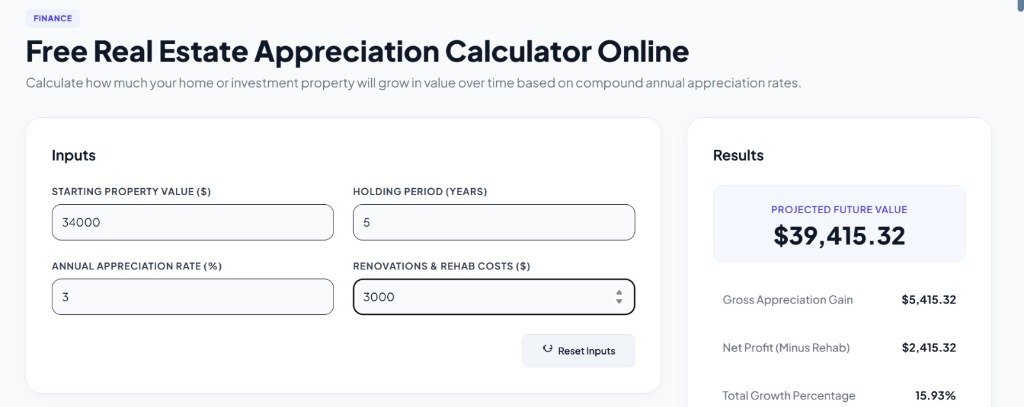
Calculate how much your home or investment property will grow in value over time based on compound annual appreciation rates.
Inputs
Results
Calculation History
No calculations saved yet.
Real Estate Appreciation Calculator: How to Calculate Property Value Growth
Real estate is one of the most popular long-term investments because property values can increase over time. Whether you own a home, apartment, commercial building, or rental property, understanding how much your property may appreciate can help you make smarter financial decisions. A Real Estate Appreciation Calculator makes this process easier by estimating how much a property could be worth in the future based on its current value and expected annual appreciation rate.
Instead of manually performing complex calculations, property owners and investors can enter a few basic details and quickly estimate future property values. This can be useful when planning to sell a property, evaluating an investment, comparing real estate opportunities, or estimating long-term wealth.
What Is a Real Estate Appreciation Calculator?
A Real Estate Appreciation Calculator is an online financial tool designed to estimate the future value of a property after a certain period of time. It uses the property's current value, estimated annual appreciation rate, and investment period to calculate potential growth.
For example, suppose you purchase a property for $300,000 and expect it to appreciate by 5% annually. If you hold the property for 10 years, the calculator can estimate its potential future value.
The calculation generally uses compound growth, meaning each year's appreciation is added to the property's value before the next year's appreciation is calculated.
The basic formula is:
Future Property Value = Current Property Value × (1 + Appreciation Rate) ^ Number of Years
Using a calculator makes this calculation quick and reduces the possibility of mathematical errors.
Why Property Appreciation Matters
Property appreciation is an important part of real estate investing. When a property becomes more valuable over time, the owner may build equity and potentially earn a profit when selling.
For example, if a property purchased for $250,000 increases in value to $350,000, the owner has experienced $100,000 in gross appreciation. This doesn't necessarily represent the final profit because expenses such as taxes, maintenance, mortgage interest, selling costs, and improvements may affect the actual return.
Understanding appreciation can help property owners:
- Estimate future property value
- Calculate potential investment returns
- Plan when to sell
- Compare different properties
- Estimate long-term equity growth
- Evaluate rental property investments
- Plan retirement or other financial goals
- Understand the impact of market growth
How Does a Real Estate Appreciation Calculator Work?
Most appreciation calculators require three primary inputs:
1. Current Property Value
The first input is the property's current market value or purchase price, depending on the purpose of the calculation.
For example:
Current property value = $400,000
Using the most accurate current market value can produce a more useful estimate.
2. Annual Appreciation Rate
The second input is the expected annual appreciation rate. This represents the percentage by which the property is expected to increase in value each year.
For example, an annual appreciation rate of 4% means the property's estimated value increases by 4% each year.
It is important to remember that real estate appreciation isn't guaranteed. Property values can increase, remain stable, or decrease depending on market conditions.
3. Number of Years
The final major input is the expected holding period.
For example:
Investment period = 15 years
The calculator then applies the appreciation rate over the selected period to estimate the future value.
Example of Property Appreciation
Let's consider a property currently worth $300,000, with an estimated annual appreciation rate of 5%, held for 10 years.
The formula is:
Future Value = $300,000 × (1.05)^10
The estimated future value is approximately $488,668.
This means the property could potentially increase by around $188,668 over 10 years if it appreciates at a consistent 5% annual rate.
However, this is only a projection. Actual property values can be significantly different because real estate markets do not normally grow at exactly the same rate every year.
Compound Appreciation vs. Simple Appreciation
A Real Estate Appreciation Calculator generally uses compound appreciation.
With compound appreciation, each year's growth becomes part of the property's value for the following year.
For example, if a $200,000 property appreciates by 5%:
- Year 1: $210,000
- Year 2: $220,500
- Year 3: $231,525
- Year 4: $243,101
- Year 5: Approximately $255,256
The appreciation amount increases over time because the percentage is applied to the growing property value.
Simple appreciation, by comparison, calculates growth using the original property value. Compound appreciation is generally more appropriate for long-term property value projections.
Factors That Affect Real Estate Appreciation
A calculator can provide a mathematical estimate, but many real-world factors influence property appreciation.
Location
Location is one of the most important factors affecting property values. Properties near employment centers, schools, transportation, shopping areas, parks, and other amenities may experience stronger demand.
Economic Conditions
Interest rates, employment levels, inflation, economic growth, and consumer confidence can all influence the real estate market.
Supply and Demand
When demand for homes is high and available properties are limited, prices may increase. Conversely, an oversupply of properties can put downward pressure on prices.
Property Improvements
Renovations and improvements can potentially increase a property's market value. Kitchen upgrades, bathroom remodeling, landscaping, energy-efficient systems, and additional living space may improve the property's appeal.
Population Growth
Areas experiencing population growth may have increasing demand for housing. New businesses, infrastructure projects, universities, and employment opportunities can also influence local property values.
Neighborhood Development
New roads, shopping centers, schools, hospitals, public transportation, and commercial developments may contribute to changes in nearby property values.
How to Use a Real Estate Appreciation Calculator
Using an appreciation calculator is usually straightforward.
Step 1: Enter the current property value.
Enter the property's current estimated value or purchase price.
Step 2: Enter the expected annual appreciation rate.
Choose a realistic percentage based on historical trends, market research, or your own investment assumptions.
Step 3: Enter the investment period.
Specify how many years you expect to own the property.
Step 4: Calculate the future value.
The calculator applies the appreciation formula and provides an estimated future property value.
Step 5: Compare different scenarios.
Try different appreciation rates and holding periods to understand how changes in assumptions affect the potential outcome.
Why Use Different Appreciation Scenarios?
Because future real estate performance is uncertain, it can be useful to calculate multiple scenarios.
For example, an investor could compare:
- 3% annual appreciation
- 5% annual appreciation
- 7% annual appreciation
This creates a conservative, moderate, and optimistic projection.
Scenario analysis is often more useful than relying on one fixed forecast. It helps investors understand the potential range of outcomes and prepare for different market conditions.
Real Estate Appreciation and Equity
Property appreciation can contribute to increased home equity.
Equity is generally the difference between the property's market value and the amount owed on the mortgage.
For example, suppose a property is worth $500,000 and the remaining mortgage balance is $300,000.
Equity = $500,000 − $300,000 = $200,000
If the property's value rises to $600,000 while the mortgage balance remains unchanged, the owner's equity could increase to $300,000.
In reality, mortgage payments also change the loan balance over time, so total equity growth can come from both property appreciation and mortgage principal reduction.
Appreciation vs. Rental Income
Real estate investors often earn returns in two major ways: property appreciation and rental income.
Appreciation refers to an increase in the property's value.
Rental income is money earned from tenants.
An investment property can potentially provide both. For example, an investor may receive monthly rental income while the property's market value increases over several years.
However, rental income must be evaluated alongside expenses such as maintenance, insurance, property taxes, vacancies, property management, utilities, and mortgage payments.
A Real Estate Appreciation Calculator focuses primarily on property value growth rather than complete investment profitability.
Limitations of a Real Estate Appreciation Calculator
Although an appreciation calculator is useful, its results should not be considered a guarantee.
The calculator typically assumes that the annual appreciation rate remains consistent. Real estate markets rarely behave that way.
A property may appreciate quickly during one period and experience little or no growth during another. In some circumstances, property values may decline.
The calculator also may not account for:
- Mortgage interest
- Property taxes
- Insurance
- Maintenance expenses
- Renovation costs
- Inflation
- Selling costs
- Real estate commissions
- Rental income
- Vacancy periods
- Market downturns
Therefore, the calculated future value should be treated as an estimate rather than a prediction.
Real Estate Appreciation Calculator for Investors
Real estate investors can use appreciation calculations when evaluating potential purchases.
Suppose an investor is comparing two properties:
Property A: $250,000 purchase price with an estimated 4% annual appreciation.
Property B: $350,000 purchase price with an estimated 3% annual appreciation.
The investor can calculate the projected future value of both properties over five, ten, or twenty years. This provides a starting point for comparing potential long-term growth.
However, investors should also consider rental yield, operating expenses, financing costs, taxes, neighborhood conditions, and the property's potential resale demand.
Using Historical Appreciation Rates
Historical property appreciation data can help establish reasonable assumptions, but past performance does not guarantee future results.
Local markets can behave very differently. A national average may not accurately represent a specific city, neighborhood, or property type.
When choosing an appreciation rate, consider:
- Local historical property prices
- Current market conditions
- Population trends
- Employment growth
- Infrastructure development
- Interest rates
- Housing supply
- Local economic conditions
Using several reasonable assumptions rather than one aggressive estimate can make your financial planning more realistic.
Real Estate Appreciation and Inflation
Inflation can affect the relationship between nominal property appreciation and real purchasing power.
For example, if a property increases in value by 5% per year but inflation averages 3%, the property's nominal value is growing faster than inflation. However, the real increase in purchasing power is smaller than the 5% headline growth.
Investors should therefore distinguish between nominal appreciation and real appreciation when evaluating long-term investment performance.
Who Can Benefit From a Real Estate Appreciation Calculator?
This tool can be useful for many people, including:
- Homeowners: Estimate what their property might be worth in the future.
- First-time buyers: Compare potential long-term property value growth.
- Real estate investors: Evaluate possible appreciation as part of an investment strategy.
- Landlords: Estimate potential long-term asset growth alongside rental income.
- Property sellers: Understand how the property's value may have changed over time.
- Financial planners: Use estimated property growth when creating long-term financial projections.
- Real estate professionals: Provide clients with simple growth scenarios for educational purposes.
Frequently Asked Questions
What is a Real Estate Appreciation Calculator?
A Real Estate Appreciation Calculator estimates a property's future value using its current value, expected annual appreciation rate, and holding period.
What is a good annual appreciation rate for real estate?
There is no universal rate that applies to every property. Appreciation varies by location, property type, economic conditions, and market cycle. A calculator is most useful when you test several realistic rates rather than assuming one guaranteed percentage.
How accurate is a real estate appreciation calculator?
The mathematical calculation can be accurate based on the information entered, but the future appreciation rate is only an assumption. Actual property values may be higher or lower.
Does appreciation include rental income?
No. Property appreciation measures the increase in property value. Rental income is a separate component of real estate investment returns.
Can property values decrease?
Yes. Real estate values can decline because of economic downturns, rising interest rates, oversupply, local problems, or changes in buyer demand.
Is property appreciation compounded?
Most long-term appreciation calculators use compound growth, where each year's increase becomes part of the property's value for the following year.
Can I use the calculator for commercial property?
Yes, the basic appreciation concept can be used for residential and commercial properties. However, commercial property valuation can involve additional factors such as rental income, capitalization rates, occupancy, and operating expenses.
Should I use the purchase price or current value?
It depends on what you want to calculate. To estimate future growth from today's market position, use the current estimated value. To analyze growth from your original investment, use the purchase price.
Can renovations increase property appreciation?
Renovations can potentially increase market value, but the amount added depends on the type and quality of improvements, local buyer demand, and comparable properties.
Final Thoughts
A Real Estate Appreciation Calculator is a simple but valuable tool for estimating how property values may change over time. By entering the current property value, expected annual appreciation rate, and investment period, homeowners and investors can quickly create future-value projections.
The most important point is to remember that appreciation estimates are not guarantees. Real estate markets are influenced by interest rates, economic conditions, supply and demand, location, population growth, infrastructure, and many other factors.
For better financial planning, consider running several scenarios using conservative, moderate, and optimistic appreciation rates. Combine those estimates with mortgage costs, rental income, taxes, maintenance, and other expenses to create a more complete picture of your potential real estate investment.
Whether you are buying your first home, managing a rental property, or evaluating a long-term investment, a Real Estate Appreciation Calculator can provide a useful starting point for understanding potential property value growth.