Free Commercial Real Estate Valuation Calculator Online
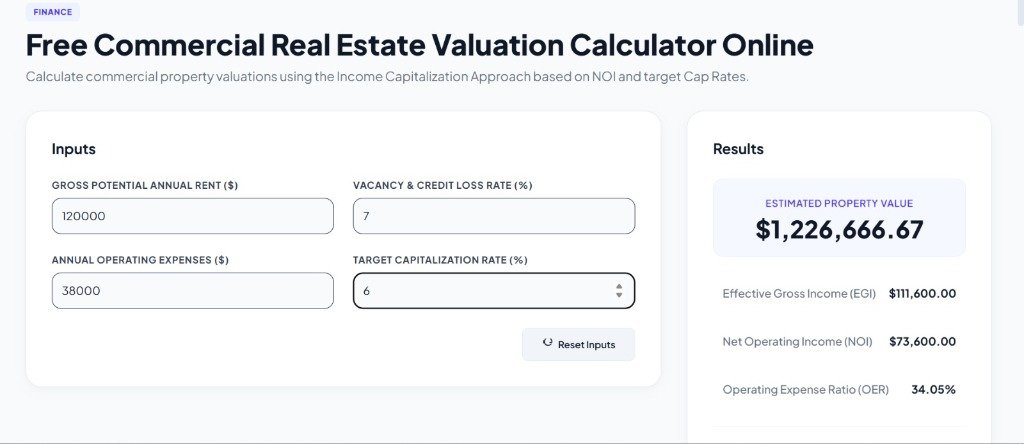
Calculate commercial property valuations using the Income Capitalization Approach based on NOI and target Cap Rates.
Inputs
Results
Calculation History
No calculations saved yet.
Commercial Real Estate Valuation Calculator: A Complete Guide
Commercial real estate is a major investment category that includes office buildings, retail centers, warehouses, industrial properties, hotels, apartment complexes, and other income-producing properties. Unlike residential properties, commercial real estate is often valued based heavily on its ability to generate income. This makes valuation an important part of buying, selling, refinancing, and managing commercial property.
A Commercial Real Estate Valuation Calculator is a useful tool that helps investors estimate the potential market value of a commercial property using financial information such as rental income, operating expenses, net operating income, capitalization rate, and sometimes financing details.
Understanding how commercial property valuation works can help investors make better decisions and compare different investment opportunities. While a calculator can provide a quick estimate, it should be used alongside professional market research, property inspections, comparable sales, and expert advice.
What Is a Commercial Real Estate Valuation Calculator?
A Commercial Real Estate Valuation Calculator is an online tool designed to estimate the value of an income-producing commercial property. Instead of relying only on the property's size or appearance, the calculator can use financial performance to determine an estimated value.
One of the most common methods is the income capitalization approach, which uses net operating income and a capitalization rate.
The basic formula is:
Property Value = Net Operating Income ÷ Capitalization Rate
For example, if a commercial property generates $100,000 in annual net operating income and the applicable capitalization rate is 8%, the estimated value would be:
$100,000 ÷ 0.08 = $1,250,000
This calculation provides a simplified estimate of the property's value based on its income-producing potential.
Why Commercial Property Valuation Matters
Determining the value of commercial property is important for both investors and property owners. An accurate valuation can help determine whether a property is reasonably priced and whether an investment may provide an acceptable return.
Commercial property valuation can be useful when:
- Buying a commercial property
- Selling an investment property
- Refinancing a property
- Applying for commercial financing
- Evaluating investment returns
- Comparing multiple properties
- Estimating potential equity
- Planning an investment strategy
- Reviewing an existing real estate portfolio
A valuation calculator can make the initial analysis faster and easier.
How Does a Commercial Real Estate Valuation Calculator Work?
The exact inputs depend on the calculator, but many tools use several important financial figures.
Property Income
The calculator may require annual rental income or gross potential income. This represents the money the property can generate from tenants.
For example:
Annual rental income = $180,000
Additional income may come from parking fees, storage, service charges, signage, laundry facilities, or other sources.
Vacancy and Collection Loss
Not every property generates 100% of its potential rent throughout the year. Some units may remain vacant, or tenants may fail to pay on time.
A calculator may subtract an estimated vacancy and collection loss to determine effective gross income.
For example, if annual potential rental income is $200,000 and vacancy is estimated at 5%, the vacancy loss would be approximately $10,000.
Operating Expenses
Commercial properties have ongoing expenses. These can include:
- Property taxes
- Insurance
- Repairs
- Maintenance
- Utilities
- Property management
- Landscaping
- Security
- Cleaning
- Administrative expenses
Operating expenses are deducted from effective gross income to calculate net operating income.
Net Operating Income
Net Operating Income (NOI) is one of the most important figures in commercial real estate valuation.
The simplified formula is:
NOI = Effective Gross Income − Operating Expenses
For example:
Annual rental income: $200,000
Other income: $10,000
Vacancy loss: $10,000
Operating expenses: $70,000
Effective gross income would be:
$200,000 + $10,000 − $10,000 = $200,000
Then:
NOI = $200,000 − $70,000 = $130,000
The $130,000 NOI can then be used with a capitalization rate to estimate property value.
Understanding the Capitalization Rate
The capitalization rate, commonly called the cap rate, is a key component of commercial real estate valuation.
The formula is:
Cap Rate = NOI ÷ Property Value
It can also be rearranged to estimate property value:
Property Value = NOI ÷ Cap Rate
For example, a property with $120,000 NOI and a 6% cap rate would have an estimated value of:
$120,000 ÷ 0.06 = $2,000,000
Cap rates vary depending on property type, location, tenant quality, lease terms, market conditions, risk, interest rates, and other factors.
Why Cap Rate Matters
Cap rate provides investors with a way to compare the income-producing potential of different properties.
A lower cap rate often corresponds to properties perceived as lower risk or located in highly desirable markets. A higher cap rate may indicate greater perceived risk, weaker locations, shorter leases, or other investment considerations.
However, a higher cap rate does not automatically mean a better investment. Investors should evaluate the quality and sustainability of the property's income.
Example of Commercial Real Estate Valuation
Consider a small retail property with the following financial information:
- Annual rental income: $300,000
- Other income: $20,000
- Vacancy allowance: $20,000
- Operating expenses: $100,000
- NOI: $200,000
- Cap rate: 7%
Using the income capitalization formula:
Property Value = $200,000 ÷ 0.07
Estimated property value:
Approximately $2,857,143
This is an income-based estimate. The actual market value could differ depending on comparable sales, property condition, location, lease quality, and other factors.
Gross Rent Multiplier Method
Another simple method used in commercial real estate analysis is the Gross Rent Multiplier (GRM).
The basic formula is:
GRM = Property Price ÷ Gross Rental Income
To estimate value:
Property Value = Gross Rental Income × GRM
For example, if annual gross rental income is $150,000 and comparable properties have a GRM of 8:
$150,000 × 8 = $1,200,000
The GRM method is relatively simple, but it doesn't account for operating expenses as directly as the income capitalization method.
Sales Comparison Approach
Commercial properties can also be valued by comparing them with recently sold properties that are similar in terms of:
- Location
- Property type
- Size
- Age
- Condition
- Occupancy
- Income
- Amenities
For example, an investor may compare a warehouse with other recently sold warehouses in the same market.
Comparable sales can help establish a market-based valuation, although finding truly comparable commercial properties can sometimes be difficult.
Cost Approach
The cost approach estimates how much it would cost to replace or reproduce the property, adjusted for depreciation and land value.
The basic concept is:
Estimated Value = Land Value + Replacement Cost − Depreciation
This method may be particularly useful for newer properties or specialized buildings where comparable sales are limited.
However, the cost approach may not fully reflect the income-producing potential of an investment property.
Discounted Cash Flow Analysis
More advanced commercial real estate valuation may use a Discounted Cash Flow (DCF) analysis.
DCF considers expected future cash flows and discounts them back to their present value.
An investor may estimate:
- Future rental income
- Operating expenses
- Capital expenditures
- Vacancy
- Financing costs
- Property sale proceeds
- Expected holding period
The goal is to determine the present value of expected future cash flows.
DCF analysis can provide a more detailed view than a simple cap-rate calculation, but it requires more assumptions and financial data.
Important Factors That Affect Commercial Property Value
Several factors can influence the market value of a commercial property.
Location
Location has a major impact on commercial property value. Properties near major transportation routes, business districts, population centers, and established commercial areas may attract stronger demand.
Tenant Quality
The financial strength and reliability of tenants can influence investment risk.
A property leased to a financially strong tenant under a long-term lease may be viewed differently from a property with several short-term leases and uncertain occupancy.
Lease Terms
Lease duration, rent increases, renewal options, tenant responsibilities, and other lease provisions can affect the property's income potential.
Occupancy
High occupancy generally supports stronger income, while significant vacancy can reduce NOI and property value.
Property Condition
A building requiring major repairs or renovations may have a lower effective value than a well-maintained property.
Interest Rates
Interest rates can influence borrowing costs and investor demand. Changes in financing conditions can affect commercial property pricing and investment returns.
Market Conditions
Local supply and demand, employment growth, economic conditions, construction activity, and business expansion can all influence commercial real estate values.
Commercial Real Estate Valuation and Financing
Banks and other lenders often evaluate commercial properties before approving financing.
The property's income, value, debt structure, and ability to support loan payments can all be important.
Two commonly discussed financing metrics are Loan-to-Value (LTV) and Debt Service Coverage Ratio (DSCR).
Loan-to-Value Ratio
The formula is:
LTV = Loan Amount ÷ Property Value × 100
For example, if a property is worth $2 million and the loan is $1.2 million:
LTV = $1.2 million ÷ $2 million × 100 = 60%
Debt Service Coverage Ratio
DSCR compares property income with debt obligations.
A simplified formula is:
DSCR = NOI ÷ Annual Debt Service
For example, if NOI is $200,000 and annual debt service is $150,000:
DSCR = 1.33
A higher DSCR generally indicates greater ability to cover debt payments, although lender requirements vary.
Benefits of Using a Commercial Real Estate Valuation Calculator
A calculator can provide several advantages.
Saves Time
Instead of manually calculating NOI, cap rates, and estimated values, investors can enter information and receive results quickly.
Helps Compare Properties
Investors can evaluate multiple properties using consistent assumptions.
Supports Investment Planning
Estimated property values can be incorporated into broader investment analysis.
Makes Financial Concepts Easier
A calculator can help beginners understand how income and capitalization rates affect property value.
Supports Scenario Analysis
Users can change rental income, expenses, cap rates, and other assumptions to see how the estimated value changes.
Limitations of a Commercial Real Estate Valuation Calculator
A calculator provides an estimate, not a guaranteed market value.
The result depends heavily on the quality of the information entered. If rental income, expenses, vacancy assumptions, or cap rates are inaccurate, the estimated valuation can also be inaccurate.
A calculator may not fully account for:
- Building defects
- Environmental problems
- Local zoning restrictions
- Lease-specific risks
- Future capital expenditures
- Market competition
- Economic changes
- Tenant credit risk
- Unexpected vacancies
- Legal issues
- Major renovation requirements
For major transactions, investors should consider obtaining a professional appraisal and conducting appropriate due diligence.
Who Should Use a Commercial Real Estate Valuation Calculator?
The tool can be useful for:
- Commercial property investors: Estimate potential values before making an offer.
- Property owners: Monitor changes in estimated property value.
- Landlords: Analyze how rental income affects property valuation.
- Real estate agents: Create preliminary valuation estimates for clients.
- Developers: Evaluate potential development opportunities.
- Business owners: Assess commercial properties for potential purchase or lease decisions.
- Financial analysts: Build preliminary investment models.
Frequently Asked Questions
What is a Commercial Real Estate Valuation Calculator?
It is a financial tool that estimates the value of commercial property using information such as income, operating expenses, NOI, cap rate, and other investment metrics.
What is the most common formula for commercial property valuation?
A commonly used income-based formula is:
Property Value = NOI ÷ Cap Rate
However, professional valuation may involve multiple methods.
What is NOI in commercial real estate?
NOI, or Net Operating Income, is the income a property generates after operating expenses are deducted, before financing costs and income taxes.
What is a good cap rate?
There is no single cap rate that is considered good for every commercial property. Appropriate cap rates vary based on property type, location, risk, tenant quality, market conditions, and other factors.
Does a valuation calculator provide an official property appraisal?
No. A calculator generally provides an estimate. A professional appraisal may be required for lending, legal, tax, or transaction purposes.
Can I use the calculator for an office building?
Yes. Commercial valuation calculators can be used for many property types, including office buildings, retail properties, warehouses, industrial buildings, and other income-producing assets.
Does higher NOI mean higher property value?
Generally, if the cap rate remains unchanged, higher NOI results in a higher estimated property value. However, market conditions can affect the appropriate cap rate.
Can commercial property values decrease?
Yes. Commercial property values can decline due to lower rental income, increased vacancies, higher operating expenses, rising interest rates, economic downturns, or changes in market demand.
Final Thoughts
A Commercial Real Estate Valuation Calculator is a practical starting point for estimating the value of income-producing property. By analyzing rental income, operating expenses, NOI, cap rates, and other financial information, investors can quickly develop preliminary property valuations.
The income capitalization approach is especially useful because it connects a property's income-producing ability with its estimated market value. However, no calculator can perfectly predict what a commercial property is worth. Local market conditions, comparable sales, lease agreements, property condition, tenant quality, financing conditions, and future income expectations all matter.
For the best results, use a valuation calculator as an initial analysis tool and combine its results with market research, comparable properties, financial statements, property inspections, and professional valuation advice when appropriate. With careful analysis, commercial property valuation can become a powerful part of making informed real estate investment decisions.