Free Commercial Real Estate Rent Calculator Online
Calculate commercial rent payments based on square footage, annual rates, and lease types like NNN, Gross, or Modified Gross.
Inputs
Results
Calculation History
No calculations saved yet.
Commercial Real Estate Rent Calculator: Estimate Your Global Commercial Property Costs
A Commercial Real Estate Rent Calculator is a useful online tool for business owners, tenants, landlords, investors, and real estate professionals who want to estimate the cost of renting commercial property. Whether you are leasing an office in New York, a retail store in London, a warehouse in Dubai, or an industrial facility in Singapore, understanding your potential rental expenses is essential before signing a commercial lease.
Commercial property costs can involve much more than the advertised rental rate. Depending on the country and lease agreement, tenants may also be responsible for operating expenses, maintenance charges, property taxes, insurance, utilities, common-area maintenance, service charges, and other costs.
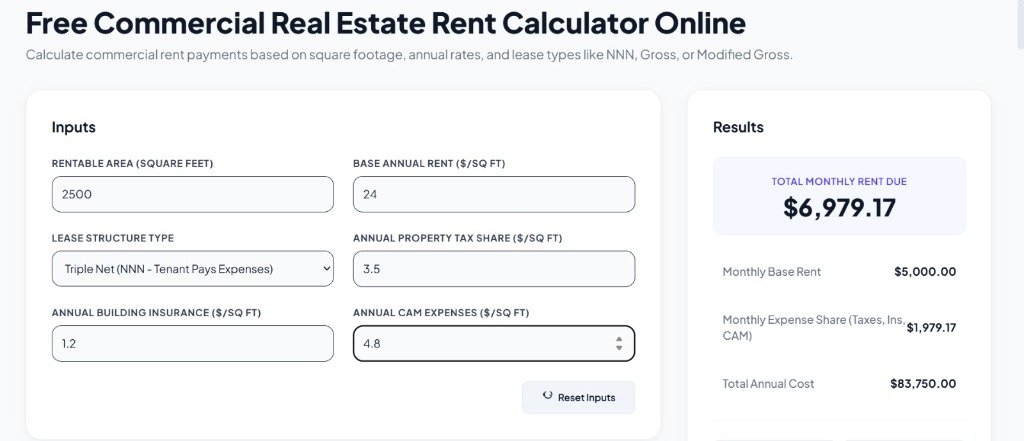
Our Commercial Real Estate Rent Calculator makes it easier to estimate these expenses by allowing you to enter important property and lease details and calculate your estimated monthly, annual, and total rental costs.
What Is a Commercial Real Estate Rent Calculator?
A Commercial Real Estate Rent Calculator is an online financial tool that helps users estimate the cost of leasing commercial property.
It can be useful for calculating rent for:
- Office buildings
- Retail stores
- Shopping centers
- Warehouses
- Industrial properties
- Restaurants
- Medical offices
- Commercial land
- Business centers
- Mixed-use properties
- Distribution facilities
Depending on the calculator's features, users can enter the property's size, rental rate, lease duration, operating expenses, rent increases, and other applicable charges.
The calculator then provides an estimated cost that can help users compare different commercial properties and plan their budgets.
Why Use Our Commercial Real Estate Rent Calculator?
Commercial leases can represent one of the largest ongoing expenses for a business. Even a small difference in rental rates can result in thousands of dollars in additional costs over a multi-year lease.
Our calculator can help you:
- Estimate monthly commercial rent
- Calculate annual rental expenses
- Estimate total lease costs
- Compare different properties
- Understand additional occupancy expenses
- Plan your business budget
- Estimate rent increases
- Evaluate different lease terms
Instead of relying only on the advertised rental price, you can use the calculator to create a broader estimate of your potential commercial property expenses.
How Does a Commercial Real Estate Rent Calculator Work?
The basic calculation is simple.
If a property is advertised using an annual rental rate per square foot, the basic formula is:
Annual Base Rent = Property Size × Annual Rent Per Square Foot
For example, suppose you are considering a 5,000-square-foot commercial property with an annual rental rate of $30 per square foot.
5,000 × $30 = $150,000 annual base rent
Monthly base rent would be:
$150,000 ÷ 12 = $12,500 per month
This calculation represents the base rent only. Your actual commercial occupancy cost may be higher if the lease includes additional expenses.
Understanding Commercial Rental Rates
Commercial property can be advertised using different rental structures depending on the country, market, property type, and lease agreement.
Common pricing methods include:
- Monthly rent
- Annual rent
- Rent per square foot per month
- Rent per square foot per year
- Rent per square meter
- Base rent plus operating expenses
- Gross rent
- Net rent
Because commercial rental terminology varies internationally, always check whether the quoted rate is monthly or annual and whether additional expenses are included.
For example, $5 per square foot per month is significantly different from $5 per square foot per year.
Our calculator can help simplify the calculation once you know the applicable rental rate and property size.
Key Information Needed for the Calculator
Property Size
The first important input is the size of the commercial property.
Depending on the market, property size may be measured in:
- Square feet
- Square meters
- Acres
- Other local units
For example, you might be evaluating a 2,000-square-foot office or a 10,000-square-meter warehouse.
Rental Rate
Enter the property's advertised rental rate.
Make sure you know whether the rate is:
- Monthly
- Annual
- Per square foot
- Per square meter
Lease Duration
Enter the length of your proposed lease.
Commercial leases can range from short-term agreements to contracts lasting several years.
Additional Expenses
If applicable, include expenses such as:
- Maintenance
- Service charges
- Common-area maintenance
- Property taxes
- Insurance
- Operating expenses
- Management fees
These costs can vary significantly depending on the country and lease structure.
Gross Lease vs Net Lease
Understanding the type of commercial lease is important when estimating rental costs.
Gross Lease
With a gross lease, the tenant typically pays an agreed rental amount while the landlord covers some property-related expenses, subject to the specific agreement.
Net Lease
With a net lease, the tenant may pay the base rent plus some or all property-related expenses.
There are several variations of net leases, and the exact responsibilities depend on the contract and local market.
Because of these differences, comparing only the advertised base rent may not provide an accurate picture of the total cost.
Commercial Rent Calculation Example
Suppose a company is considering a 4,000-square-foot office.
The annual rental rate is $25 per square foot.
The base annual rent would be:
4,000 × $25 = $100,000
Monthly base rent:
$100,000 ÷ 12 = $8,333.33
Now assume additional annual operating expenses of $20,000.
Total estimated annual occupancy cost:
$100,000 + $20,000 = $120,000
Estimated monthly occupancy cost:
$120,000 ÷ 12 = $10,000
This example shows why businesses should consider additional expenses when calculating the true cost of commercial property.
Commercial Rent Escalation Calculator
Many commercial leases include scheduled rent increases.
For example, a lease might specify a 3% annual increase.
If the starting annual rent is $100,000:
Year 1: $100,000
Year 2: $103,000
Year 3: $106,090
Year 4: $109,273
Year 5: $112,551
Over a long-term lease, rent escalation can have a significant effect on total occupancy costs.
A commercial real estate rent calculator with an escalation feature can help businesses understand how rental expenses may change over time.
Commercial Office Rent Calculator
Businesses searching for office space can use a commercial office rent calculator to compare different locations.
Consider two properties:
Property A: 2,000 sq ft at $6/sq ft/month
Property B: 3,000 sq ft at $4.50/sq ft/month
Property A:
2,000 × $6 = $12,000/month
Property B:
3,000 × $4.50 = $13,500/month
Although Property B has a lower rental rate per square foot, its larger size results in a higher monthly base rent.
A calculator makes these comparisons much easier.
Commercial Retail Rent Calculator
Retail businesses often need to evaluate more than just the rental price.
Important factors can include:
- Property size
- Rental rate
- Location
- Customer traffic
- Parking
- Visibility
- Operating expenses
- Service charges
- Lease duration
- Rent increases
A commercial rent calculator can estimate the financial component of the decision, while businesses should separately evaluate factors such as expected sales, customer demographics, and location suitability.
Commercial Warehouse Rent Calculator
Warehouses and distribution facilities are commonly priced according to their size and location.
A warehouse rent calculation may include:
- Building size
- Rental rate
- Lease period
- Maintenance costs
- Service charges
- Operating expenses
Businesses should also evaluate loading facilities, truck access, ceiling height, storage configuration, security, transportation connections, and proximity to customers.
Factors That Affect Commercial Real Estate Rent
Commercial rental prices can vary considerably from one market to another.
Location
Prime business districts generally command higher rents than less central areas.
Property Type
Office, retail, industrial, warehouse, hospitality, and mixed-use properties have different rental structures.
Property Size
Larger properties generally have higher total rental costs.
Building Quality
Modern buildings with premium facilities may command higher rents.
Accessibility
Properties close to airports, highways, public transportation, ports, or major business districts may have different rental values.
Demand
Local supply and demand can significantly affect commercial rental rates.
Lease Terms
Longer leases may have different pricing and escalation structures compared with short-term agreements.
Additional Commercial Property Costs
When estimating your total commercial property expenses, consider costs beyond basic rent.
Security Deposit
Many landlords require a deposit before the tenant takes possession of the property.
Utilities
Electricity, water, gas, internet, and other services may be separate from rent.
Maintenance
Depending on the lease, tenants may be responsible for maintaining certain parts of the property.
Insurance
Some commercial leases require tenants to maintain specific insurance coverage.
Property Taxes
Depending on the country and lease structure, property-related taxes may be paid by the landlord, tenant, or shared between both parties.
Renovation and Fit-Out
A new business may need to spend money modifying the property before opening.
Legal and Professional Fees
Lease negotiations, legal reviews, inspections, and other professional services may create additional costs.
Commercial Rent Calculator for International Businesses
Our calculator can be useful for businesses evaluating commercial properties in different countries.
For international comparisons, remember that rental rates may be quoted in different currencies and measurement units.
For example:
- USD
- GBP
- EUR
- CAD
- AUD
- SGD
- AED
- MYR
- INR
Similarly, property sizes may be quoted in square feet or square meters.
When comparing international properties, make sure you convert the figures consistently before making a financial comparison.
Renting vs Buying Commercial Real Estate
A commercial rent calculator can also help businesses begin comparing leasing with purchasing.
Renting may require less initial capital and can provide flexibility for growing businesses.
Purchasing property may provide long-term ownership and potential appreciation, but it can involve significant upfront capital and financing costs.
A proper rent-versus-buy analysis should consider:
- Purchase price
- Financing
- Interest
- Rent
- Maintenance
- Taxes
- Insurance
- Property appreciation
- Opportunity cost
- Expected holding period
The best option depends on the business's financial situation and long-term objectives.
How to Use Our Commercial Real Estate Rent Calculator
Using our calculator is simple.
Step 1: Enter the property size.
Enter the total rentable area.
Step 2: Enter the rental rate.
Add the monthly or annual rental rate.
Step 3: Select the appropriate measurement.
Choose square feet or square meters where applicable.
Step 4: Enter the lease duration.
Specify the number of months or years.
Step 5: Add additional expenses.
Include maintenance, operating expenses, service charges, or other applicable costs.
Step 6: Add annual rent increases.
If your lease includes escalation, enter the expected percentage.
Step 7: Review the results.
The calculator can help you estimate your monthly, annual, and overall lease costs.
How to Reduce Commercial Rental Costs
Businesses can potentially reduce their occupancy expenses by negotiating the lease terms.
Possible negotiation points include:
- Base rent
- Lease duration
- Rent-free periods
- Renewal options
- Rent escalation
- Maintenance responsibilities
- Service charges
- Tenant improvement allowances
- Parking arrangements
Before signing, carefully review all terms and conditions in the lease agreement.
Who Can Use a Commercial Real Estate Rent Calculator?
Our calculator can be useful for:
- Small business owners
- Entrepreneurs
- Startups
- Retailers
- Office tenants
- Warehouse operators
- Property investors
- Landlords
- Real estate agents
- Property managers
- Corporate businesses
- International companies
It can be particularly helpful when comparing multiple properties or preparing a business expansion plan.
Final Thoughts
A Commercial Real Estate Rent Calculator provides a quick and convenient way to estimate the cost of leasing commercial property anywhere in the world.
Instead of looking only at the advertised rental price, businesses should consider the complete occupancy cost, including rent, maintenance, service charges, operating expenses, taxes, insurance, utilities, rent increases, and other lease-specific costs.
Our calculator can help you estimate potential costs, compare properties, plan your business budget, and better understand the financial commitment associated with a commercial lease.
Remember that calculator results are estimates. Actual costs depend on the property, local market, currency, lease structure, landlord, and applicable laws and fees. Always review the final lease agreement and obtain professional advice where appropriate.
FAQs About Commercial Real Estate Rent Calculator
1. What is a Commercial Real Estate Rent Calculator?
It is an online tool that helps estimate the cost of renting commercial property based on factors such as property size, rental rate, lease duration, and additional expenses.
2. How is commercial property rent calculated?
A basic calculation is:
Property Size × Rental Rate = Base Rent
The rental rate must be correctly identified as monthly or annual and per square foot or square meter.
3. Can I calculate a five-year commercial lease?
Yes. A calculator can estimate rental expenses over several years, particularly when annual rent increases are included.
4. What is rent per square foot?
Rent per square foot expresses the cost of leasing commercial space according to its size. Some international markets instead use rent per square meter.
5. Does commercial rent include maintenance?
Not necessarily. Maintenance and operating expenses depend on the lease structure and agreement.
6. Can I calculate rent increases?
Yes. If the calculator supports rent escalation, you can enter an expected annual increase to estimate future rental costs.
7. What additional commercial property costs should I consider?
Depending on the location and lease, consider maintenance, service charges, property taxes, insurance, utilities, deposits, legal fees, renovation, and other operating expenses.
8. Can I use the calculator for properties outside my country?
Yes. The calculation principles can be applied internationally. However, you should ensure that currency, measurement units, taxes, and local lease conventions are correctly accounted for.
9. Can landlords use a commercial rent calculator?
Yes. Landlords and property investors can use rental calculations to estimate potential rental income and compare different lease scenarios.
10. Is a Commercial Real Estate Rent Calculator accurate?
A calculator provides an estimate, not a guaranteed final rental cost. Actual expenses depend on the specific property, lease agreement, local market conditions, taxes, fees, and other applicable costs.