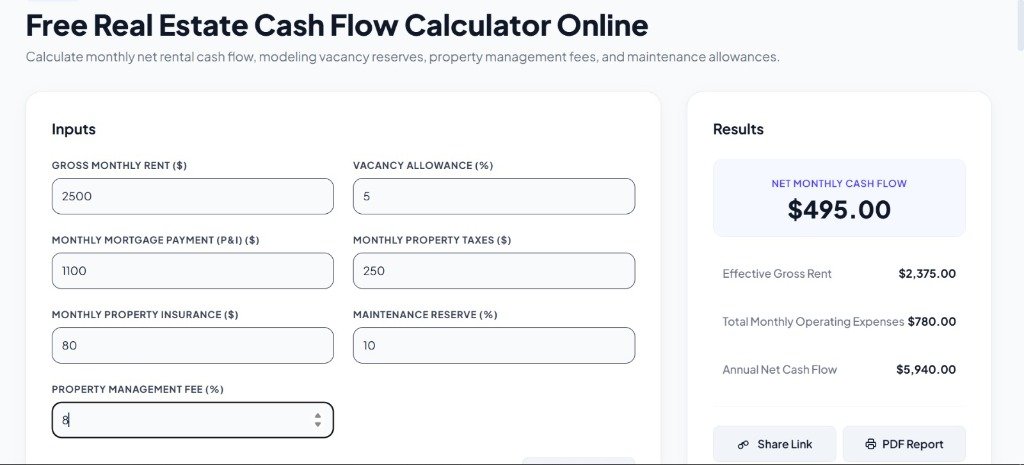
Free Real Estate Cash Flow Calculator Online
Calculate monthly net rental cash flow, modeling vacancy reserves, property management fees, and maintenance allowances.
Inputs
Results
Calculation History
No calculations saved yet.
Related Calculators
Real Estate Cash Flow Calculator: Estimate Your Property Investment Returns
Investing in real estate can provide rental income, long-term appreciation, and potential tax benefits. However, a property's purchase price or expected rental income alone does not tell you whether an investment is financially worthwhile. Investors need to understand how much money a property is expected to generate after expenses.
A Real Estate Cash Flow Calculator helps property investors estimate the amount of cash a rental property may generate or lose over a specific period. By entering rental income, operating expenses, mortgage payments, vacancy rates, property taxes, insurance, and other costs, investors can develop a clearer picture of a property's potential financial performance.
Whether you are evaluating an apartment in the United States, a rental property in the United Kingdom, an investment property in Australia, or commercial real estate in another country, understanding cash flow is an important part of property investment analysis.
What Is a Real Estate Cash Flow Calculator?
A Real Estate Cash Flow Calculator is an online tool designed to estimate the income and expenses associated with an investment property.
The calculator can help investors determine whether a property is likely to produce:
- Positive cash flow
- Negative cash flow
- Break-even cash flow
The basic concept is simple:
Cash Flow = Total Property Income − Total Property Expenses
However, real estate cash flow analysis can become more detailed when you include financing, vacancies, maintenance, management fees, taxes, utilities, capital expenditures, and other costs.
A calculator simplifies this process by bringing the relevant figures together in one place.
Why Is Real Estate Cash Flow Important?
Cash flow is one of the most important metrics for rental property investors.
A property may increase in value over time but still produce negative monthly cash flow. Conversely, a property with modest appreciation may generate strong rental income.
Positive cash flow can help an investor:
- Cover property expenses
- Pay mortgage obligations
- Build reserves
- Reinvest in additional properties
- Generate recurring income
Understanding cash flow before purchasing a property can help investors make more informed decisions.
How Does a Real Estate Cash Flow Calculator Work?
A basic cash flow calculation starts with rental income and subtracts property expenses.
For example:
Monthly Rental Income: $2,500
Operating Expenses: $700
Mortgage Payment: $1,200
Estimated monthly cash flow:
$2,500 − $700 − $1,200 = $600
The property would generate an estimated $600 per month in cash flow before considering other potential costs not included in the example.
Annual cash flow would be:
$600 × 12 = $7,200
A more advanced calculator can include additional variables to create a more comprehensive estimate.
Key Inputs in a Real Estate Cash Flow Calculator
Rental Income
Rental income is generally the starting point for a rental property cash flow calculation.
Enter the expected monthly or annual rent received from tenants.
If a property has multiple units, you can calculate the combined rental income.
For example:
- Unit 1: $1,500/month
- Unit 2: $1,400/month
- Unit 3: $1,600/month
Total monthly rental income:
$4,500
Vacancy Rate
Rental properties are not necessarily occupied 100% of the time.
A vacancy rate allows investors to account for periods when the property is empty or rent is not collected.
For example, if annual potential rental income is $30,000 and the estimated vacancy rate is 5%:
$30,000 × 5% = $1,500
Estimated effective rental income:
$30,000 − $1,500 = $28,500
Property Management
If you hire a property manager, management fees should be included in the cash flow calculation.
Management fees may be structured as a percentage of rent or a fixed amount depending on the market and service agreement.
Property Taxes
Property taxes vary significantly between countries, states, provinces, and municipalities.
Depending on the location and ownership structure, property taxes can represent a significant annual expense.
Insurance
Insurance costs should also be included when estimating property expenses.
Depending on the property and location, coverage may include building insurance, landlord insurance, liability coverage, or other policies.
Maintenance and Repairs
Every property requires ongoing maintenance.
Potential expenses include:
- Plumbing repairs
- Electrical work
- Painting
- Appliance repairs
- HVAC maintenance
- Roof repairs
- Landscaping
- General repairs
A cash flow calculator can include a monthly or annual maintenance allowance.
Mortgage Payment
If the property is financed, mortgage payments can have a major impact on cash flow.
The calculation may include:
- Loan amount
- Interest rate
- Loan term
- Monthly payment
- Principal
- Interest
Investors should understand whether the calculator's cash-flow figure is calculated before or after debt service.
Operating Expenses vs Capital Expenditures
It is important to distinguish normal operating expenses from major capital expenditures.
Operating Expenses
These are recurring costs associated with owning and operating the property.
Examples include:
- Property management
- Routine maintenance
- Insurance
- Property taxes
- Utilities paid by the owner
- Advertising
- Cleaning
Capital Expenditures
Capital expenditures are larger investments in the property.
Examples include:
- Roof replacement
- Major renovations
- New HVAC systems
- Structural improvements
- Major plumbing replacement
Although these expenses may not occur every month, investors should account for them when evaluating long-term cash flow.
Real Estate Cash Flow Example
Suppose you purchase a rental property that generates $3,000 per month in rent.
Annual rental income:
$3,000 × 12 = $36,000
Assume annual expenses are:
- Property taxes: $4,000
- Insurance: $1,500
- Maintenance: $2,000
- Property management: $3,000
- Vacancy allowance: $1,500
- Other expenses: $1,000
Total annual operating expenses:
$13,000
Estimated net operating income:
$36,000 − $13,000 = $23,000
If annual mortgage payments are $15,000:
$23,000 − $15,000 = $8,000
Estimated annual cash flow:
$8,000
Estimated monthly cash flow:
$8,000 ÷ 12 = $666.67
This simplified example demonstrates how rental income alone does not determine an investment property's cash flow.
Positive vs Negative Cash Flow
Positive Cash Flow
A property has positive cash flow when income exceeds expenses.
For example:
Income: $3,000/month
Expenses: $2,400/month
Cash flow:
+$600/month
Negative Cash Flow
A property has negative cash flow when expenses exceed income.
For example:
Income: $2,500/month
Expenses: $2,900/month
Cash flow:
−$400/month
Negative cash flow does not automatically mean an investment is bad. An investor may accept negative cash flow because of expected appreciation, tax considerations, strategic location, or other factors.
However, the investor should understand the financial commitment before purchasing.
Real Estate Cash Flow and Cap Rate
Cash flow is related to several other real estate investment metrics.
One important metric is the capitalization rate, or cap rate.
The basic formula is:
Cap Rate = Net Operating Income ÷ Property Value × 100
For example:
Property value: $400,000
Net operating income: $28,000
Cap rate:
$28,000 ÷ $400,000 × 100 = 7%
Cap rate and cash flow provide different information, so investors should not use one metric alone when evaluating a property.
Cash-on-Cash Return
Another important investment metric is cash-on-cash return.
It compares annual pre-tax cash flow with the amount of cash invested.
The basic formula is:
Cash-on-Cash Return = Annual Cash Flow ÷ Total Cash Invested × 100
For example:
Annual cash flow: $8,000
Cash invested: $100,000
Cash-on-cash return:
$8,000 ÷ $100,000 × 100 = 8%
This can be particularly useful for comparing leveraged rental investments.
Real Estate Cash Flow for Different Property Types
A cash flow calculator can be used for many types of real estate.
Residential Properties
Examples include:
- Single-family homes
- Apartments
- Condominiums
- Townhouses
- Duplexes
- Multi-family properties
Commercial Properties
Examples include:
- Offices
- Retail properties
- Warehouses
- Industrial buildings
- Shopping centers
Commercial properties may use different lease structures and expense arrangements, so users should understand the applicable lease terms.
Vacation Rentals
Short-term rental properties may have additional expenses such as:
- Cleaning
- Booking platform fees
- Furnishings
- Utilities
- Marketing
- Property management
These should be considered when estimating cash flow.
Real Estate Cash Flow Calculator for Global Investors
Real estate investment markets differ around the world.
Investors may analyze properties in:
- United States
- Canada
- United Kingdom
- Australia
- New Zealand
- Singapore
- Malaysia
- United Arab Emirates
- Europe
- Other international markets
Rental income, property taxes, financing costs, insurance, transaction costs, and regulations vary by location.
Our Real Estate Cash Flow Calculator can help organize the financial calculations, but users should enter figures appropriate to their specific market and property.
How to Improve Rental Property Cash Flow
Investors can potentially improve cash flow by increasing income or controlling expenses.
Increase Rental Income
Market conditions may allow landlords to increase rent when legally and commercially appropriate.
Reduce Vacancy
Keeping a property occupied can improve effective rental income.
Control Operating Expenses
Regular maintenance and competitive service contracts may help control expenses.
Review Financing
Refinancing or obtaining better financing terms may affect debt service and cash flow, subject to costs and eligibility.
Add Additional Income
Depending on the property, additional income could come from:
- Parking
- Storage
- Laundry
- Pet fees
- Other permitted services
Always follow local laws and lease requirements.
Common Mistakes When Calculating Real Estate Cash Flow
Ignoring Vacancy
Assuming a property will always be occupied can make projected cash flow look unrealistically high.
Underestimating Maintenance
Unexpected repairs can significantly affect annual cash flow.
Forgetting Management Fees
Even if you plan to manage the property yourself initially, understanding the potential cost of professional management can help when comparing investments.
Ignoring Capital Expenditures
Major future repairs can create substantial expenses.
Using Gross Rent Instead of Effective Income
Gross scheduled rent does not necessarily equal the actual income collected.
Forgetting Financing Costs
If a property is financed, debt service can dramatically change the cash flow result.
How to Use Our Real Estate Cash Flow Calculator
Using our calculator is straightforward.
Step 1: Enter the property value or purchase price.
Add the property's expected purchase price.
Step 2: Enter rental income.
Add monthly or annual expected rental income.
Step 3: Enter vacancy assumptions.
Add an estimated vacancy rate.
Step 4: Add operating expenses.
Include taxes, insurance, maintenance, management, utilities, and other costs.
Step 5: Enter financing information.
If applicable, enter loan amount, interest rate, and loan term.
Step 6: Add other income and expenses.
Include additional property income or recurring expenses.
Step 7: Review estimated cash flow.
The calculator can help estimate monthly and annual cash flow based on the information provided.
Is Real Estate Cash Flow the Same as Profit?
Not necessarily.
Cash flow is a measure of money moving in and out of the investment based on the assumptions and expenses included in the calculation.
Accounting profit can be different because accounting may include non-cash expenses such as depreciation.
Taxes can also affect an investor's final after-tax return.
For this reason, investors should distinguish between:
- Gross rental income
- Net operating income
- Cash flow
- Taxable income
- Total investment return
Final Thoughts
A Real Estate Cash Flow Calculator is a valuable tool for anyone evaluating rental property investments.
By considering rental income, vacancy, property management, taxes, insurance, maintenance, financing, and other expenses, investors can develop a more realistic estimate of a property's potential cash flow.
Whether you are evaluating a residential rental, commercial property, vacation rental, or international investment, cash flow analysis can help you compare opportunities and understand the financial commitment involved.
However, calculator results are estimates rather than guarantees. Actual rental income and expenses can change because of market conditions, vacancies, repairs, interest rates, taxes, insurance, regulations, and other factors.
Use the calculator as an initial investment-analysis tool, then conduct thorough due diligence and consider professional financial, tax, legal, and real estate advice before making a major investment decision.
FAQs About Real Estate Cash Flow Calculator
1. What is a Real Estate Cash Flow Calculator?
It is an online tool that estimates the income and expenses of an investment property to determine potential monthly or annual cash flow.
2. What is the basic real estate cash flow formula?
The basic formula is:
Cash Flow = Property Income − Property Expenses
For financed properties, debt service is generally included when calculating cash flow after financing.
3. What expenses should I include?
Common expenses include property taxes, insurance, maintenance, management fees, utilities, vacancy allowance, financing costs, and other property-related expenses.
4. What is positive cash flow?
Positive cash flow occurs when the property's income exceeds its expenses for the period being analyzed.
5. What is negative cash flow?
Negative cash flow occurs when property expenses exceed rental and other property income.
6. Should mortgage payments be included?
If you want to calculate cash flow after debt service, yes. Mortgage payments can have a major impact on the amount of cash generated by an investment property.
7. Does the calculator include vacancy?
A calculator may include a vacancy-rate input. Including vacancy can produce a more realistic estimate than assuming the property is rented continuously.
8. Can I use the calculator for commercial real estate?
Yes. Commercial properties can be analyzed using cash flow calculations, although commercial leases may have different income and expense structures.
9. Can I use the calculator for international properties?
Yes. You can use it for properties in different countries, but you should use the appropriate local currency, taxes, rental rates, financing costs, and expenses.
10. Is positive cash flow enough to make a property a good investment?
Not necessarily. Investors should also consider purchase price, appreciation potential, cash-on-cash return, cap rate, financing, taxes, risk, location, market conditions, and long-term investment objectives.