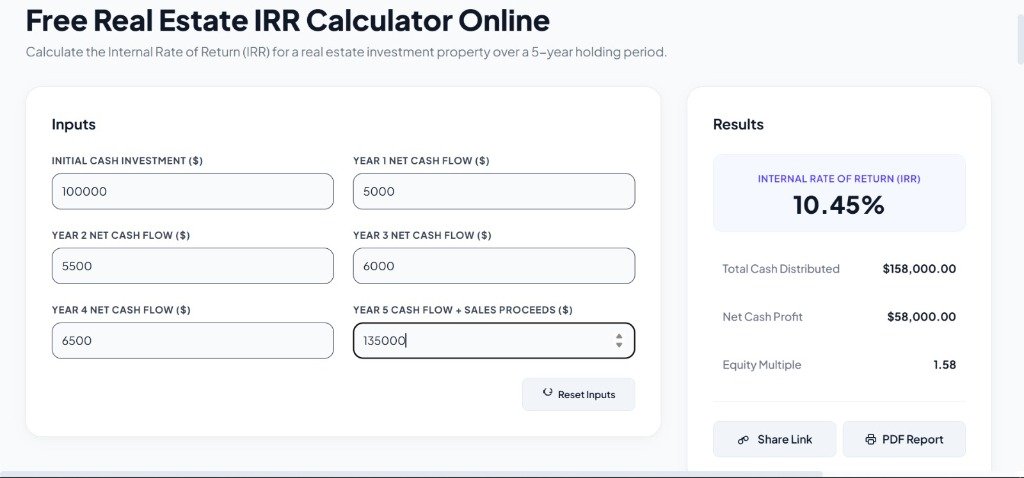
Free Real Estate IRR Calculator Online
Calculate the Internal Rate of Return (IRR) for a real estate investment property over a 5-year holding period.
Inputs
Results
Calculation History
No calculations saved yet.
Related Calculators
Real Estate IRR Calculator: A Complete Guide to Measuring Investment Returns
Real estate investing is one of the most popular ways to build long-term wealth, generate passive income, and diversify an investment portfolio. However, purchasing a property is only the beginning. Investors need reliable financial metrics to determine whether a property is actually producing an attractive return. One of the most useful metrics for evaluating real estate investments is Internal Rate of Return (IRR).
A Real Estate IRR Calculator helps investors estimate the annualized rate of return generated by a property over its entire investment period. Unlike simple ROI calculations, IRR considers the timing of cash flows, including the initial investment, rental income, operating expenses, refinancing, additional investments, and the final proceeds from selling the property.
Whether you are evaluating a rental house, apartment building, commercial property, multifamily investment, land development project, or real estate partnership, an IRR calculator can make financial analysis easier and more consistent.
What Is a Real Estate IRR Calculator?
A Real Estate IRR Calculator is a financial tool designed to calculate the internal rate of return on a real estate investment based on a series of cash flows occurring at different points in time.
The calculator typically considers:
- Initial property purchase price
- Down payment
- Closing costs
- Mortgage financing
- Rental income
- Vacancy
- Property management expenses
- Maintenance and repairs
- Property taxes
- Insurance
- Capital expenditures
- Loan payments
- Refinancing proceeds
- Additional investments
- Tax-related cash flows
- Property appreciation
- Sale price
- Selling costs
- Final loan balance
The calculator then determines the discount rate at which the net present value (NPV) of all investment cash flows equals zero.
In simple terms, IRR answers an important question:
“What annualized return did this investment generate based on when money was invested and received?”
Why IRR Is Important in Real Estate Investing
Real estate investments rarely produce the same cash flow every year. An investor may spend a large amount of money at the beginning, receive rental income throughout the holding period, invest additional money for renovations, refinance the property, and eventually receive a large amount from selling the property.
Because the timing and size of these cash flows vary, simple return calculations may not provide a complete picture.
For example, imagine two investments:
- Investment A produces a 20% return over five years.
- Investment B produces a 20% return over ten years.
Although the total return appears identical, Investment A may be substantially more attractive because the investor generated the return in half the time.
IRR incorporates this timing factor, making it particularly useful for comparing investments with different holding periods and cash-flow patterns.
How Does a Real Estate IRR Calculator Work?
A Real Estate IRR Calculator starts by organizing an investment's cash flows according to time.
For example:
| Year | Cash Flow |
|---|---|
| 0 | -$100,000 |
| 1 | $8,000 |
| 2 | $9,000 |
| 3 | $10,000 |
| 4 | $11,000 |
| 5 | $150,000 |
The negative amount in Year 0 represents the initial investment. The following positive amounts represent cash received from the property, including operating cash flow and potentially the sale proceeds.
The calculator uses these cash flows to determine the IRR.
The mathematical equation is:
NPV = Σ [CFₜ / (1 + IRR)ᵗ] = 0
Where:
- CFₜ = cash flow at time t
- IRR = internal rate of return
- t = time period
- NPV = net present value
You generally do not need to solve this equation manually. An online IRR calculator can perform the calculation automatically.
What Information Do You Need to Use the Calculator?
To obtain a useful result, you should enter realistic investment assumptions.
1. Purchase Price
Start with the property's purchase price.
For example, if a rental property costs $300,000, enter $300,000 as the purchase price.
2. Initial Investment
Your initial investment may include more than the down payment.
It can include:
- Down payment
- Closing costs
- Legal fees
- Inspection costs
- Initial repairs
- Renovation expenses
- Financing fees
For example, a $300,000 property might require a $60,000 down payment plus $10,000 in closing and renovation costs.
3. Rental Income
Enter expected rental income for each relevant period.
Rental income may change over time because of:
- Rent increases
- Vacancy
- New tenants
- Lease renewals
- Market conditions
Using realistic rental-growth assumptions can make the IRR calculation more useful.
4. Operating Expenses
Real estate expenses can significantly affect investment returns.
Common expenses include:
- Property taxes
- Insurance
- Maintenance
- Repairs
- Property management
- Utilities
- HOA fees
- Landscaping
- Accounting
- Advertising
A good IRR analysis should account for these costs rather than focusing only on gross rental income.
5. Financing
If the property is financed, include the relevant loan information.
This may include:
- Loan amount
- Interest rate
- Loan term
- Monthly payment
- Principal repayment
- Refinancing
- Remaining loan balance
Debt can increase an investor's equity IRR, but it can also increase financial risk.
6. Holding Period
Enter the expected investment period.
Common holding periods include:
- 3 years
- 5 years
- 7 years
- 10 years
- 20 years
The longer the holding period, the more important it becomes to consider changes in rental income, expenses, property value, and financing.
7. Expected Sale Price
Most real estate investments eventually involve selling the property.
Estimate the expected future value based on reasonable assumptions rather than simply assuming a large appreciation rate.
8. Selling Costs
The final sale proceeds should account for expenses such as:
- Brokerage commissions
- Legal costs
- Transfer costs
- Closing expenses
- Taxes where applicable
- Outstanding mortgage balance
Ignoring selling costs can make the projected IRR appear higher than the actual investment return.
Real Estate IRR vs. ROI
ROI and IRR are both useful, but they measure investment performance differently.
ROI, or Return on Investment, generally measures the total gain relative to the amount invested.
For example:
ROI = (Total Gain ÷ Initial Investment) × 100
IRR, on the other hand, considers when the cash flows occur.
This makes IRR particularly useful when comparing investments with different cash-flow schedules.
Consider two properties that each generate a 50% total return. If one produces that return in three years and the other takes eight years, their annualized performance is very different.
That is where IRR provides additional insight.
Real Estate IRR vs. Cash-on-Cash Return
Cash-on-cash return measures the annual cash income generated relative to the investor's cash invested.
The basic formula is:
Cash-on-Cash Return = Annual Pre-Tax Cash Flow ÷ Total Cash Invested
This metric is useful for evaluating the property's annual income performance.
However, it generally does not capture the full investment lifecycle.
IRR can incorporate:
- Annual rental cash flow
- Appreciation
- Sale proceeds
- Additional investments
- Refinancing
- Timing of cash flows
Therefore, cash-on-cash return and IRR can complement each other rather than being treated as competing metrics.
How Property Appreciation Affects IRR
Property appreciation can have a major impact on real estate IRR.
Suppose an investor purchases a property for $400,000 and sells it several years later for $500,000.
The $100,000 increase in value contributes to the investment's overall return.
However, appreciation should be modeled carefully. Real estate prices do not necessarily increase at a constant rate.
Factors that can influence appreciation include:
- Local employment
- Population growth
- Interest rates
- Housing supply
- Infrastructure development
- Neighborhood improvements
- Economic conditions
- Property demand
Investors should consider conservative, moderate, and optimistic appreciation scenarios instead of relying on a single assumption.
How Rental Income Affects IRR
Rental income provides recurring cash flow during the holding period.
Higher and more stable rental income can increase IRR, while vacancies and unexpected expenses can reduce it.
When using a calculator, consider:
- Current market rent
- Expected rent increases
- Vacancy rate
- Tenant turnover
- Collection losses
- Maintenance costs
- Property management fees
For example, assuming 100% occupancy for ten years may create an unrealistic IRR if the property is likely to experience periods without tenants.
The Impact of Leverage on Real Estate IRR
Leverage means using borrowed money to purchase an investment property.
For example, instead of paying $500,000 entirely in cash, an investor might contribute $100,000 and finance the remaining $400,000.
Leverage can potentially increase the investor's equity IRR because the investor controls a larger asset with less personal capital.
However, leverage also increases risk.
Mortgage payments must be made regardless of whether the property is occupied. Higher interest rates, declining property values, unexpected repairs, and reduced rental income can put pressure on the investment.
Therefore, a high IRR generated through heavy leverage should not automatically be considered a low-risk investment.
Equity IRR and Property-Level IRR
Real estate investors may encounter different types of IRR.
Equity IRR
Equity IRR measures returns specifically to the investor's equity.
It typically considers:
- Initial equity contribution
- Operating distributions
- Additional equity contributions
- Refinancing distributions
- Sale proceeds
Property-Level IRR
Property-level IRR evaluates the property's overall performance before considering certain financing effects.
This can be useful when comparing properties independently of different financing structures.
Understanding which IRR is being calculated is important because two investments can have very different equity IRRs depending on their financing arrangements.
Example of a Real Estate IRR Calculation
Suppose an investor purchases a property for $250,000.
The investor contributes $75,000 in initial cash, while the remaining amount is financed.
Over five years, the investor receives the following net cash flows:
- Year 0: -$75,000
- Year 1: $5,000
- Year 2: $6,000
- Year 3: $7,000
- Year 4: $8,000
- Year 5: $100,000
The Year 5 amount could include the final operating cash flow plus the investor's net proceeds from selling the property.
The IRR calculator uses all these cash flows and their timing to estimate the annualized return.
This approach provides more information than simply adding the cash flows and comparing them with the original investment.
What Is a Good Real Estate IRR?
There is no universal IRR that qualifies as “good.”
The appropriate target depends on factors such as:
- Investment risk
- Location
- Property type
- Financing
- Holding period
- Market conditions
- Investor objectives
- Alternative investment opportunities
A higher projected IRR can indicate greater potential return, but it may also reflect greater risk or more aggressive assumptions.
Investors should therefore evaluate IRR alongside other metrics instead of making decisions based on one percentage.
Limitations of a Real Estate IRR Calculator
Although IRR is powerful, it has limitations.
IRR Depends on Assumptions
The calculator does not predict the future. Its output depends on the assumptions you provide.
If you overestimate rental growth or property appreciation, the resulting IRR may be unrealistic.
Multiple IRRs Can Occur
Certain investments with alternating positive and negative cash flows can produce multiple IRRs. This can make interpretation more complicated.
IRR Does Not Show Absolute Wealth
A 25% IRR on a small investment does not necessarily generate more money than a 15% IRR on a very large investment.
Therefore, investors should also consider total profit and equity created.
IRR Can Favor Early Cash Flows
Because IRR accounts for the timing of money, investments that return capital earlier can sometimes appear particularly attractive.
For more advanced analysis, investors may also examine Modified Internal Rate of Return (MIRR) and equity multiple.
IRR and Equity Multiple
Equity multiple measures how much total cash an investor receives compared with the amount invested.
For example:
Equity Multiple = Total Cash Distributions ÷ Total Equity Invested
An investment with a 2.0x equity multiple means that the investor received total distributions equal to twice the invested capital.
IRR and equity multiple answer different questions:
- IRR: How quickly did the investment generate its return?
- Equity multiple: How much total money did the investment generate relative to invested capital?
Using both metrics provides a more complete picture.
How Investors Can Use IRR for Property Comparison
One of the biggest advantages of an IRR calculator is that it can help investors compare multiple opportunities.
For example:
| Investment | Holding Period | Projected IRR |
|---|---|---|
| Property A | 5 years | 14% |
| Property B | 7 years | 17% |
| Property C | 10 years | 12% |
An investor can use these results as a starting point for further analysis.
However, the highest IRR should not automatically win. Investors should also compare risk, leverage, location, cash flow stability, required capital, exit assumptions, and potential downside.
Sensitivity Analysis
A useful Real Estate IRR Calculator can also be used for sensitivity analysis.
Instead of calculating only one scenario, investors can test different assumptions.
For example:
Conservative scenario
- Lower rent growth
- Higher vacancy
- Higher expenses
- Lower appreciation
Base scenario
- Moderate rent growth
- Normal vacancy
- Expected expenses
- Moderate appreciation
Optimistic scenario
- Strong rent growth
- Low vacancy
- Controlled expenses
- Higher appreciation
Comparing these scenarios can help investors understand how sensitive the investment is to changes in market conditions.
Who Should Use a Real Estate IRR Calculator?
A Real Estate IRR Calculator can be useful for:
- First-time property investors
- Experienced landlords
- Real estate developers
- Commercial property investors
- Multifamily investors
- Real estate agents
- Investment analysts
- Property managers
- Real estate investment companies
- Private equity investors
It can also be useful for people considering whether to purchase a rental property or invest their capital elsewhere.
Tips for Getting More Accurate IRR Results
To improve the quality of your analysis:
- Use realistic rental estimates.
- Include vacancy and collection losses.
- Account for maintenance and capital expenses.
- Include financing costs.
- Consider realistic property appreciation.
- Include transaction and selling costs.
- Model major renovation expenses.
- Run multiple scenarios.
- Compare IRR with equity multiple.
- Review cash flow separately from appreciation.
The goal is not to create the highest possible IRR. The goal is to create a realistic financial model that helps you understand potential outcomes.
Frequently Asked Questions About Real Estate IRR Calculator
What does a Real Estate IRR Calculator calculate?
It estimates the annualized rate of return on a real estate investment by analyzing the timing and amount of cash flows throughout the investment period.
Is IRR better than ROI for real estate?
IRR can provide more detailed information because it considers the timing of cash flows. ROI is still useful for understanding the overall gain relative to the investment. Many investors use both.
Can I calculate IRR for a rental property?
Yes. You can use rental income, operating expenses, financing, initial investment, additional contributions, and eventual sale proceeds to calculate a rental property's IRR.
Does IRR include property appreciation?
It can. If the expected sale price is included in the final cash flow, appreciation can be reflected in the calculated IRR.
Does a higher IRR always mean a better investment?
No. A higher IRR may involve greater risk, aggressive assumptions, or substantial leverage. Investors should evaluate risk, cash flow, total profit, and assumptions alongside IRR.
What is the difference between equity IRR and property IRR?
Equity IRR focuses on the returns received by the investor's equity, while property-level IRR evaluates the property's investment performance more broadly.
Can IRR be negative?
Yes. If the investment loses money based on the modeled cash flows, the IRR can be negative.
Should I include mortgage payments in an IRR calculation?
For an equity IRR calculation, financing-related cash flows should generally be incorporated into the investment's cash-flow schedule. The exact treatment depends on the type of IRR model being used.
How accurate is an online IRR calculator?
The mathematical calculation can be accurate, but the final result is only as reliable as the assumptions entered. Property values, rental income, expenses, vacancy, financing, and selling costs should be estimated carefully.
Can I use IRR to compare different real estate properties?
Yes. IRR can be a useful comparison metric when evaluating properties with different purchase prices, holding periods, and cash-flow patterns. It should be combined with other financial metrics for a complete analysis.
Conclusion
A Real Estate IRR Calculator is a valuable tool for understanding the potential performance of a property investment. By considering the timing of initial investment, rental income, expenses, financing, additional capital contributions, appreciation, and eventual sale proceeds, IRR provides a more comprehensive view of investment performance than a simple return calculation.
However, IRR should never be viewed in isolation. A strong real estate analysis should also examine cash-on-cash return, equity multiple, net operating income, cap rate, total profit, debt structure, and investment risk.
Most importantly, use realistic assumptions. A calculator can quickly produce an impressive percentage, but the quality of that percentage depends entirely on the numbers entered. By combining conservative assumptions with multiple scenarios and complementary investment metrics, investors can use a Real Estate IRR Calculator to make more informed property investment decisions.