Free IRA Withdrawal Tax Calculator Online
Calculate the federal and state income tax liability and withholding requirements for Traditional and Roth IRA distributions.
Inputs
Results
Related Calculators
IRA Withdrawal Tax Calculator: Estimate Taxes and Early Withdrawal Costs
An IRA Withdrawal Tax Calculator is a useful financial planning tool that helps estimate how much tax you may owe when withdrawing money from an Individual Retirement Account (IRA). Depending on the type of IRA, your age, withdrawal amount, income, and whether an exception applies, an IRA withdrawal can be partially or fully taxable and may also be subject to an additional early-distribution tax.
For traditional IRAs, taxable withdrawals are generally included in ordinary income. If you take a taxable distribution before age 59½, an additional 10% tax generally applies unless you qualify for an exception.
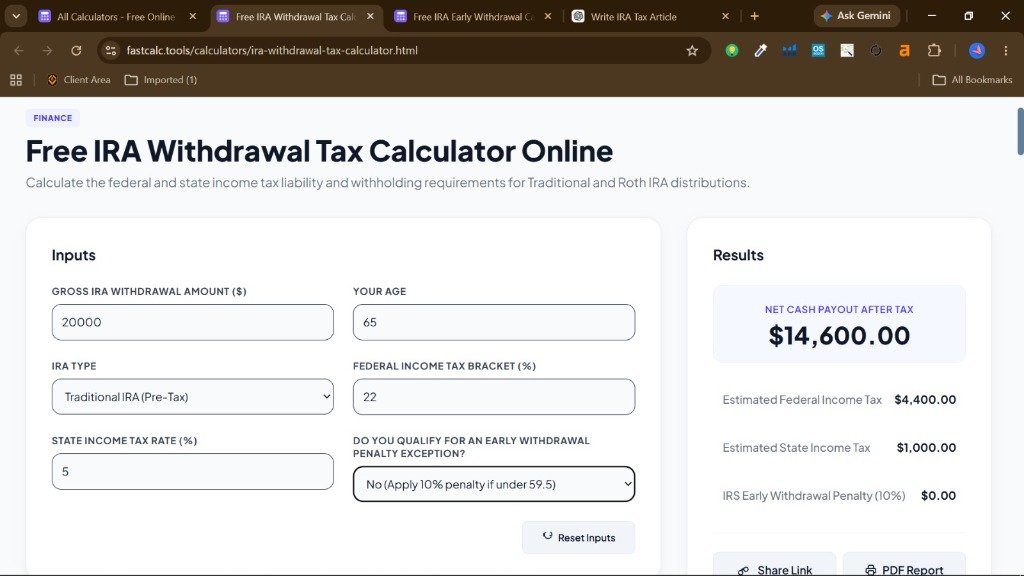
An IRA withdrawal calculator can provide an estimate before you request a distribution, allowing you to understand the potential tax impact and the amount you may have left after estimated taxes.
What Is an IRA Withdrawal Tax Calculator?
An IRA Withdrawal Tax Calculator is an online tool designed to estimate the potential taxes and penalties associated with taking money from an IRA.
A calculator may consider information such as:
- IRA account balance
- Withdrawal amount
- IRA type
- Current age
- Filing status
- Annual income
- Estimated federal tax rate
- State tax rate
- Whether the withdrawal is early
- Whether an exception applies
- Whether the withdrawal is taxable
- Estimated withholding
The calculator can then provide an approximate breakdown of the withdrawal, including the estimated taxable amount, potential early-withdrawal tax, estimated income tax, and approximate amount remaining.
Because individual tax circumstances can be complicated, the result should be treated as an estimate rather than a tax return calculation.
Why Use an IRA Withdrawal Tax Calculator?
Taking money from a retirement account can affect your taxes significantly. Simply looking at the amount you receive from your IRA does not necessarily tell you the total financial cost of the withdrawal.
For example, suppose you withdraw $20,000 from a traditional IRA. If the entire distribution is taxable and you are below age 59½, the withdrawal could potentially be subject to both ordinary income tax and the additional 10% early-distribution tax, unless an exception applies.
An IRA withdrawal tax calculator helps you estimate these costs before making a decision.
It can help answer questions such as:
- How much of my IRA withdrawal may be taxable?
- Will I owe the 10% additional tax?
- How much money could I receive after estimated taxes?
- How might a large withdrawal affect my taxable income?
- Should I consider withdrawing a smaller amount?
- What happens if I withdraw money before age 59½?
- How are Roth IRA withdrawals different?
- How much might be withheld from my distribution?
How IRA Withdrawal Taxes Work
The tax treatment depends heavily on the type of IRA.
Traditional IRA Withdrawals
Traditional IRA contributions may have received a tax deduction, meaning taxes were generally deferred until money was distributed.
Deductible contributions and earnings withdrawn from a traditional IRA are generally taxable. If you are younger than 59½, an additional 10% tax may also apply unless you qualify for an exception.
For example, if you withdraw $15,000 from a traditional IRA and the entire amount is taxable, the $15,000 generally becomes part of your taxable income for the year.
The actual federal tax depends on your overall tax situation and marginal tax rate.
Roth IRA Withdrawals
Roth IRA withdrawals work differently.
Qualified Roth IRA distributions are generally tax-free. However, nonqualified withdrawals can have different tax consequences depending on whether the money represents contributions, conversions, or investment earnings.
Therefore, an IRA withdrawal calculator should distinguish between traditional and Roth accounts rather than applying the same formula to both.
Early IRA Withdrawals and the 59½ Rule
Age is one of the most important inputs in an IRA withdrawal tax calculation.
Generally, distributions from traditional and Roth IRAs taken before age 59½ are considered early distributions. A 10% additional tax generally applies to the taxable portion unless an exception applies.
For example, imagine someone who is 45 years old withdraws $30,000 from a traditional IRA, and the full amount is taxable.
A simplified calculation could look like this:
Withdrawal: $30,000
Potential additional tax: 10%
Potential early-distribution tax: $3,000
This $3,000 is separate from ordinary federal income tax that may apply to the taxable distribution.
The actual tax liability can vary based on the individual's circumstances.
Common Inputs in an IRA Withdrawal Tax Calculator
A useful calculator may ask for several pieces of information.
1. IRA Balance
Enter the current value of the IRA account.
This helps provide context for the withdrawal and can be useful when comparing different withdrawal amounts.
2. Withdrawal Amount
Enter the amount you intend to withdraw.
For example:
- $5,000
- $10,000
- $25,000
- $50,000
You can compare different amounts to see how the estimated tax consequences change.
3. Age
Your age can affect whether an early-distribution tax applies.
A withdrawal before age 59½ generally requires additional consideration because the 10% additional tax may apply.
4. IRA Type
The calculator should allow you to select:
- Traditional IRA
- Roth IRA
- SEP IRA
- SIMPLE IRA
The rules can differ between account types.
5. Taxable Income
Your other taxable income may affect your federal income tax rate.
A large IRA withdrawal can increase taxable income for the year, so considering the withdrawal separately from your other income may give you an incomplete picture.
6. Filing Status
A more detailed calculator may ask whether you are:
- Single
- Married filing jointly
- Married filing separately
- Head of household
- Qualifying surviving spouse
Filing status can affect applicable federal tax brackets.
7. State
State income taxes vary by location. A calculator designed to estimate total taxes may therefore include a state-tax field.
IRA Withdrawal Tax Calculation Example
Consider a hypothetical taxpayer who is 50 years old and withdraws $20,000 from a traditional IRA.
Assume, purely for illustration, that:
- Withdrawal = $20,000
- Entire withdrawal is taxable
- Age = 50
- Additional-tax exception = No
- Estimated federal marginal tax rate = 22%
A simplified estimate could be:
Estimated ordinary income tax:
$20,000 × 22% = $4,400
Potential additional early-distribution tax:
$20,000 × 10% = $2,000
Estimated total federal taxes:
$4,400 + $2,000 = $6,400
Approximate amount after these estimated taxes:
$20,000 − $6,400 = $13,600
This is only a simplified example. Actual tax calculations depend on total taxable income, deductions, credits, IRA basis, applicable exceptions, and other factors.
What Is the 10% Additional Tax?
The 10% early-distribution tax is an additional tax that may apply when you take an early distribution from an IRA.
An early IRA distribution generally means one received before age 59½. The additional tax applies to the portion of the distribution that must be included in gross income.
It is important to understand that this is in addition to ordinary income tax.
For example, a taxable $10,000 early distribution could potentially have:
- Ordinary income tax
- 10% additional early-distribution tax
The 10% tax does not automatically apply to every withdrawal. Certain exceptions exist.
Exceptions to the 10% Additional Tax
There are circumstances in which an early IRA distribution may qualify for an exception to the additional 10% tax.
Examples can include certain unreimbursed medical expenses, qualified higher education expenses, certain first-time homebuyer distributions, and substantially equal periodic payments, among other situations.
Because exceptions have specific requirements, you should not assume that a withdrawal qualifies simply because it is being used for a particular purpose.
A calculator can include an "exception applies" option, but the final determination should be based on the applicable rules.
IRA Withdrawals After Age 59½
Once you reach age 59½, the additional 10% early-distribution tax generally no longer applies to IRA withdrawals.
However, this does not mean that all IRA withdrawals become tax-free.
For example, withdrawals from a traditional IRA can still generally be taxable as ordinary income even after age 59½.
This distinction is important:
Age 59½: Generally removes the early-distribution additional tax.
Age 73: Generally marks the beginning of required minimum distributions for traditional IRAs.
These are two different rules.
Required Minimum Distributions and IRA Taxes
Traditional IRA owners generally must begin taking required minimum distributions, or RMDs, at age 73 under current federal rules.
An RMD is the minimum amount that must be withdrawn from a retirement account each year.
RMDs from traditional IRAs are generally taxable except to the extent they represent basis or otherwise qualify for tax-free treatment.
Roth IRA owners generally do not have lifetime RMDs while they are alive, although beneficiaries can be subject to distribution rules.
IRA Withdrawal vs. IRA Rollover
Not every movement of retirement money is treated as a taxable withdrawal.
If funds are properly rolled over or transferred to another eligible retirement account, the transaction may not be taxable in the same way as a cash distribution.
Certain qualifying rollovers and transfers can avoid the additional tax that would otherwise apply to an early taxable distribution.
This is why an IRA withdrawal tax calculator should clearly distinguish between:
- Cash withdrawal
- Direct transfer
- Rollover
- Roth conversion
- Required minimum distribution
These transactions can have different tax consequences.
IRA Tax Withholding
When you receive an IRA distribution, tax withholding may occur.
IRA distributions paid to you are generally subject to federal withholding unless you elect out of withholding or choose a different amount.
Withholding is not necessarily the same as your final tax liability.
For example, if $20,000 is distributed and $2,000 is withheld, you receive $18,000 initially. However, your final tax bill or refund depends on your complete tax return.
A calculator can therefore show both:
- Gross withdrawal
- Estimated taxes
- Withholding
- Estimated net amount
Benefits of Using an IRA Withdrawal Tax Calculator
An IRA withdrawal calculator can be useful for retirement planning because it gives you an estimate before taking money from your account.
Estimate Potential Taxes
You can estimate the potential federal tax associated with a withdrawal.
Understand Early Withdrawal Costs
If you are under 59½, the calculator can illustrate the possible impact of the additional 10% tax.
Compare Withdrawal Amounts
You can compare $10,000, $20,000, or $30,000 withdrawals to understand how the estimated tax impact changes.
Plan Retirement Income
Retirees can use withdrawal estimates when developing an income strategy.
Avoid Surprises
Understanding the potential tax consequences before requesting a distribution can make financial planning easier.
Limitations of an IRA Withdrawal Tax Calculator
An online calculator cannot replace personalized tax advice.
Actual taxes may depend on:
- Total annual income
- Filing status
- Tax deductions
- Tax credits
- IRA basis
- State taxes
- Roth IRA ordering rules
- Early-distribution exceptions
- RMD requirements
- Other retirement accounts
- Other taxable distributions
- Changes in tax law
For complicated situations, consult a qualified tax professional or review current tax rules.
How to Use an IRA Withdrawal Tax Calculator
Using the calculator is generally straightforward.
Step 1: Enter your IRA balance.
Step 2: Enter the amount you plan to withdraw.
Step 3: Enter your current age.
Step 4: Select your IRA type.
Step 5: Enter estimated annual taxable income.
Step 6: Select your tax filing status.
Step 7: Enter your state if the calculator supports state taxes.
Step 8: Indicate whether an early-distribution exception may apply.
Step 9: Review the estimated income tax and additional tax.
Step 10: Compare the gross withdrawal with the estimated amount remaining after taxes.
The result should be used for planning rather than treated as an exact tax bill.
IRA Withdrawal Tax Calculator for Retirement Planning
An IRA withdrawal should be considered as part of your overall retirement strategy.
Taking a large distribution in a single year can potentially increase taxable income, while spreading withdrawals over multiple years may produce different results. The appropriate approach depends on individual circumstances.
A calculator allows you to test different scenarios.
For example, you could compare:
- $10,000 withdrawal this year
- $20,000 withdrawal this year
- $10,000 annually for two years
- Withdrawal after age 59½
- Traditional IRA withdrawal
- Roth IRA withdrawal
These comparisons can help demonstrate how timing and account type can affect estimated taxes.
Final Thoughts
An IRA Withdrawal Tax Calculator provides a convenient way to estimate the potential tax consequences of withdrawing money from an IRA. The most important factors include the type of IRA, withdrawal amount, age, taxable income, filing status, and whether an exception to the early-distribution tax applies.
Traditional IRA withdrawals that are taxable are generally included in income, while early taxable distributions can potentially face an additional 10% tax. Roth IRA withdrawals have different rules, particularly for qualified distributions.
A calculator can help you compare scenarios before taking a distribution, but it should not be considered a substitute for professional tax advice or current tax guidance.
Frequently Asked Questions
1. What is an IRA Withdrawal Tax Calculator?
An IRA Withdrawal Tax Calculator estimates potential taxes and additional early-distribution costs associated with withdrawing money from an IRA.
2. Are IRA withdrawals taxable?
Traditional IRA withdrawals are generally taxable to the extent they represent taxable amounts. Roth IRA withdrawals have different rules, and qualified Roth distributions are generally tax-free.
3. Is there a 10% tax on IRA withdrawals?
A 10% additional tax generally applies to taxable IRA distributions taken before age 59½ unless an exception applies.
4. Can I withdraw money from an IRA before age 59½?
Yes. You can generally take a distribution, but the taxable portion may be subject to ordinary income tax and the additional 10% early-distribution tax unless an exception applies.
5. Are IRA withdrawals after age 59½ tax-free?
Not necessarily. Reaching age 59½ generally removes the additional early-distribution tax, but taxable traditional IRA distributions can still be subject to income tax.
6. When do required minimum distributions begin?
Under current rules, traditional IRA owners generally must begin taking RMDs at age 73.
7. Do Roth IRAs have RMDs?
Original Roth IRA owners generally do not have to take lifetime RMDs while alive. Beneficiaries of Roth IRAs can be subject to RMD rules.
8. What information does an IRA withdrawal calculator need?
Common inputs include your age, IRA type, withdrawal amount, taxable income, filing status, and sometimes your state and applicable early-withdrawal exception.
9. Does IRA withholding equal the final tax I owe?
No. Withholding is an amount paid toward your tax liability. Your final tax depends on your complete tax return.
10. Can I avoid the 10% additional tax?
Certain exceptions may allow an eligible early distribution to avoid the additional 10% tax. Each exception has specific requirements.
11. Can I roll an IRA distribution into another retirement account?
Certain eligible distributions can be rolled over or transferred without being treated as a taxable distribution, provided the applicable requirements are met.
12. Is an IRA Withdrawal Tax Calculator accurate?
It can provide a useful estimate, but it cannot account for every individual tax circumstance. For a precise tax calculation, use your complete tax information and consult a qualified tax professional when necessary.