Free Traditional IRA Calculator Online
Calculate your deductible Traditional IRA contributions, phase-out limits, current tax savings, and future taxable retirement balances.
Inputs
Results
Related Calculators
Traditional IRA Calculator: Estimate Your Retirement Savings
Planning for retirement requires more than simply deciding how much money to save. You also need to understand how your contributions, investment returns, taxes, retirement age, and withdrawals can affect your future financial position. A Traditional IRA Calculator can help you estimate how much your retirement savings may grow over time and how much income your account could potentially provide during retirement.
A Traditional IRA is an individual retirement account that may provide tax advantages for eligible savers. Depending on your circumstances, contributions may be deductible, while investment earnings generally grow tax-deferred until money is withdrawn.
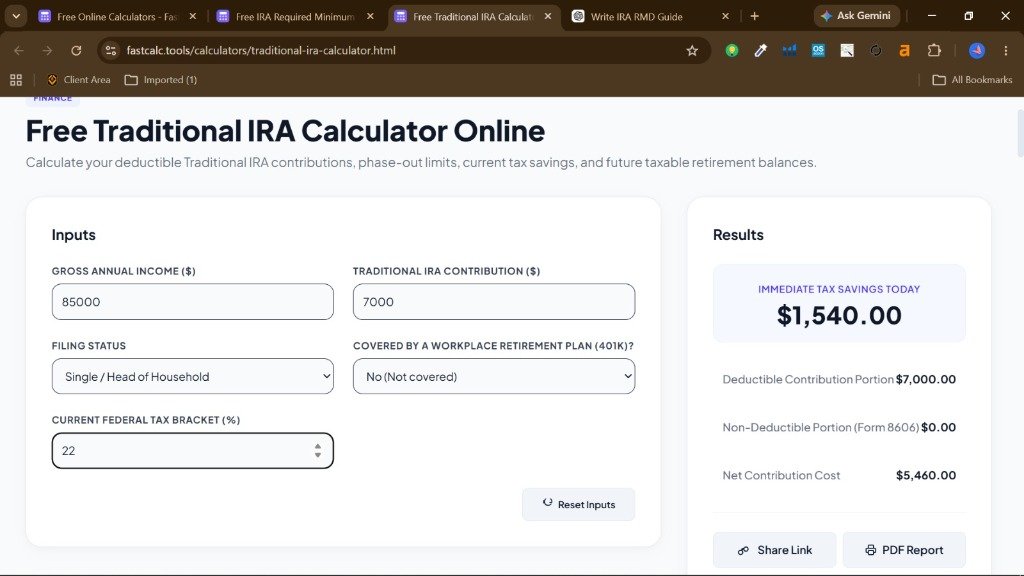
A calculator can turn these different variables into an easy-to-understand estimate. By entering information such as your current age, starting balance, annual contribution, expected investment return, and retirement age, you can see how your savings could develop over the years.
What Is a Traditional IRA Calculator?
A Traditional IRA Calculator is an online financial planning tool designed to estimate the future value of savings held in a Traditional IRA.
The calculator typically considers several factors, including:
- Current IRA balance
- Annual contribution
- Current age
- Retirement age
- Expected investment return
- Tax information
- Contribution growth
- Inflation assumptions
- Years until retirement
The result can show an estimated account balance at retirement and how much of that balance may come from your original contributions versus investment growth.
It is important to remember that calculator results are estimates. Investment returns are not guaranteed, and actual retirement results can differ significantly from projections.
What Is a Traditional IRA?
A Traditional IRA is a tax-advantaged individual retirement account that allows eligible individuals to save for retirement.
One of the key characteristics of a Traditional IRA is that contributions may be tax-deductible depending on factors such as income, filing status, and participation in an employer-sponsored retirement plan.
Investment earnings inside the account generally receive tax-deferred treatment. This means taxes on investment gains are generally not paid each year while the money remains in the account.
Instead, withdrawals are generally taxed as ordinary income, subject to applicable rules and exceptions.
Because of these tax characteristics, a Traditional IRA can be an important part of a long-term retirement strategy.
Why Use a Traditional IRA Calculator?
Retirement planning can involve complicated calculations. A calculator simplifies the process by allowing you to change important assumptions and immediately see how the estimated outcome changes.
For example, you can compare scenarios involving:
- Different annual contributions
- Different retirement ages
- Different investment returns
- Different starting balances
- Different contribution periods
- Different tax assumptions
This makes it easier to understand the potential long-term impact of saving consistently.
A calculator can also demonstrate the effect of compound growth. Even relatively small annual contributions can potentially grow substantially over several decades when investment returns are reinvested.
Starting Balance
The starting balance is the amount currently held in your Traditional IRA.
For example, suppose your current IRA balance is $25,000. You would enter $25,000 as the starting balance.
If you do not currently have an IRA, your starting balance may be $0.
The starting balance can have a significant effect on the final projection because existing savings have more time to potentially generate investment returns.
Annual Contribution
Annual contribution refers to the amount you plan to contribute to your IRA each year.
For example, you might enter $5,000 if you expect to contribute approximately $5,000 annually.
Your actual contribution limit depends on applicable federal rules and can change over time. Some individuals may also have eligibility limitations or other considerations.
A calculator may allow you to assume a fixed contribution each year or increase contributions over time.
Current Age
Your current age helps determine how many years your money could potentially remain invested before retirement.
For example, someone who is 30 and plans to retire at 65 has approximately 35 years for potential investment growth.
Someone who is 55 and plans to retire at 65 has approximately 10 years.
This difference can have a major effect on projected results because compound growth becomes more significant over longer periods.
Retirement Age
Retirement age determines the length of the accumulation period.
If you plan to retire at 67 and are currently 35, the calculator can estimate growth over approximately 32 years.
Changing your retirement age can significantly change the projection.
For example, delaying retirement by several years may provide additional time for contributions and investment growth. It may also reduce the number of years during which you need to rely on retirement savings.
Investment Return
Expected investment return is another important calculator input.
For example, a calculator might allow you to enter an assumed annual return such as 5%, 7%, or 8%.
However, investment returns are uncertain. Markets can rise and fall, and actual results may be substantially different from the assumed rate.
For better planning, it can be useful to test multiple return assumptions rather than relying on a single projection.
Compound Growth
Compound growth occurs when investment earnings remain invested and generate potential additional earnings.
For example, suppose an account earns a return on its investments. If those earnings remain in the account, they can become part of the balance that participates in future growth.
Over a long period, this compounding effect can become significant.
This is one reason starting retirement savings early can be valuable. More time gives contributions and investment earnings additional opportunity to compound.
Tax Benefits of a Traditional IRA
Traditional IRAs can provide tax advantages, but the exact benefits depend on individual circumstances.
Eligible contributions may be deductible from taxable income. However, deductibility can depend on income, filing status, and whether you or your spouse participate in certain employer-sponsored retirement plans.
Investment growth is generally tax-deferred.
This means that taxes generally are not paid annually on investment gains inside the IRA. Instead, distributions are generally subject to taxation under applicable rules.
A calculator may therefore include separate fields for tax assumptions to help estimate the impact of taxation on retirement savings.
Traditional IRA Deduction
One important factor when evaluating a Traditional IRA is whether your contribution is deductible.
The deduction rules can depend on several factors, including:
- Filing status
- Modified adjusted gross income
- Workplace retirement plan participation
- Whether you are covered by an employer retirement plan
- Whether your spouse is covered by such a plan
Because deduction limits can change, calculator users should verify the current-year IRS rules.
A calculator can provide an estimate, but it should not replace official tax guidance.
Traditional IRA Contributions
Contributing consistently can be an important part of retirement planning.
Suppose an individual contributes $6,000 per year for many years. Those contributions can potentially grow through investment returns.
If contributions increase over time, the projected retirement balance may be higher.
However, you should never enter a contribution amount that exceeds applicable annual limits simply because it produces a larger calculator result.
Always check the contribution limits that apply to the relevant tax year.
Total Contributions
A Traditional IRA Calculator may show the total amount you contributed during the projected savings period.
For example, if you contribute $5,000 annually for 20 years, your total contributions would be:
$5,000 × 20 = $100,000
The final account balance could be higher because of investment growth.
Seeing total contributions separately from investment growth helps demonstrate how much of your projected retirement balance comes from savings and how much comes from assumed investment returns.
Investment Growth
Investment growth represents the estimated increase in your account resulting from investment returns.
For example, if you contribute $100,000 over many years but your projected retirement account reaches $250,000, the difference is largely attributable to investment growth under the calculator's assumptions.
The exact result will depend on the investment return assumption, timing of contributions, fees, taxes, and market performance.
Inflation and Purchasing Power
A retirement balance that looks large today may have significantly different purchasing power in the future.
Inflation gradually reduces the amount of goods and services that a dollar can purchase.
For this reason, some retirement calculators include an inflation adjustment.
For example, $1 million several decades from now will not necessarily have the same purchasing power as $1 million today.
Including inflation assumptions can provide a more realistic way to understand future retirement needs.
Traditional IRA Withdrawals
Traditional IRA withdrawals are generally subject to income tax, although exceptions and special rules can apply.
Withdrawals taken before the applicable retirement age may also potentially be subject to an additional tax unless an exception applies.
Because Traditional IRA distributions can affect taxable income, retirement planning should consider both the account balance and the amount that may ultimately be available after taxes.
A calculator may allow you to estimate retirement withdrawals, but actual tax treatment depends on your personal circumstances.
Required Minimum Distributions
Traditional IRA owners generally become subject to Required Minimum Distribution rules after reaching the applicable age under federal law.
RMD rules determine the minimum amount that must generally be withdrawn from the account each year.
The starting age and calculation rules depend on current federal law and individual circumstances.
RMDs can affect retirement income planning because required withdrawals may increase taxable income.
A Traditional IRA Calculator can be used alongside an RMD calculator to understand different stages of retirement planning.
Traditional IRA Calculator Example
Consider an individual who is:
- 35 years old
- Starting IRA balance: $20,000
- Annual contribution: $6,000
- Retirement age: 65
- Expected annual return: 7%
The individual has approximately 30 years for potential growth.
The calculator would estimate the future account value based on these assumptions.
The final amount should not be treated as a guaranteed result because investment returns fluctuate. Nevertheless, the example demonstrates how age, contributions, time, and investment growth interact.
Changing the annual contribution or retirement age can produce substantially different projections.
How to Use a Traditional IRA Calculator
Using a calculator is generally straightforward.
Step 1: Enter Your Current Age
Enter your current age so the calculator can determine the estimated investment period.
Step 2: Enter Your Starting Balance
Enter your existing Traditional IRA balance.
Step 3: Add Your Annual Contribution
Enter the amount you expect to contribute each year.
Step 4: Enter Your Retirement Age
Choose the age at which you expect to retire or begin using your retirement savings.
Step 5: Select an Expected Return
Enter a reasonable estimated investment return.
Step 6: Review the Results
Review the estimated retirement balance, total contributions, investment growth, and other available calculations.
Step 7: Compare Different Scenarios
Try changing one variable at a time. For example, compare retiring at 62 versus 67 or contributing $5,000 versus $7,000.
This can help you understand how different assumptions affect the projection.
Traditional IRA vs. Roth IRA
Traditional and Roth IRAs have different tax structures.
With a Traditional IRA, eligible contributions may be deductible, while withdrawals are generally taxable.
With a Roth IRA, contributions are generally made with after-tax money, and qualified withdrawals can generally be tax-free.
Roth IRA eligibility and contribution rules can also depend on income.
The choice between account types depends on individual circumstances, including current and expected future tax situations.
A calculator can help estimate the long-term effect of different contribution and growth assumptions, but tax planning may require professional advice.
Limitations of a Traditional IRA Calculator
A calculator cannot predict the future with certainty.
Its results depend on assumptions about:
- Investment returns
- Inflation
- Contributions
- Retirement age
- Taxes
- Fees
- Account growth
- Withdrawal patterns
Actual investment returns may be higher or lower than projected.
The calculator also may not account for every personal factor, such as Social Security, pensions, healthcare costs, other investment accounts, debt, or changing income.
Therefore, calculator results should be viewed as estimates rather than guarantees.
Tips for Better Retirement Planning
Consider reviewing your retirement calculations regularly.
Increase contributions when your financial situation allows and stay aware of current contribution limits.
Review investment assumptions rather than automatically assuming a constant return every year.
Consider inflation when estimating future expenses.
Keep track of your Traditional IRA and other retirement accounts.
Also consider how taxes may affect the amount of money available during retirement.
Most importantly, update your retirement plan when your income, retirement date, family circumstances, or financial goals change.
Frequently Asked Questions
What does a Traditional IRA Calculator do?
A Traditional IRA Calculator estimates how much your retirement account could potentially grow based on factors such as your current balance, annual contributions, investment return, and retirement age.
Is a Traditional IRA Calculator accurate?
It can provide useful estimates, but it cannot guarantee future results. Actual investment returns, taxes, inflation, contributions, and expenses can differ from calculator assumptions.
How much should I contribute to a Traditional IRA?
The appropriate contribution depends on your income, financial goals, retirement timeline, applicable contribution limits, and overall financial situation.
Are Traditional IRA contributions tax deductible?
They may be deductible for eligible taxpayers. Deductibility depends on factors such as income, filing status, and participation in an employer-sponsored retirement plan.
Are Traditional IRA withdrawals taxable?
Traditional IRA withdrawals are generally taxable as ordinary income to the extent they represent taxable amounts, although exceptions and special rules may apply.
Can I use the calculator if I have no IRA savings?
Yes. You can generally enter a starting balance of $0 and then add your expected annual contributions.
Does compound interest affect a Traditional IRA?
Yes. Investment earnings that remain invested can potentially generate additional earnings over time, creating a compounding effect.
Does inflation matter in retirement planning?
Yes. Inflation can reduce purchasing power over time, so considering inflation can provide a more realistic estimate of future retirement needs.
Can I retire early with a Traditional IRA?
A Traditional IRA can be part of an early-retirement plan, but withdrawals before the applicable age may have tax consequences and potentially additional taxes unless an exception applies.
Should I rely entirely on a Traditional IRA Calculator?
No. A calculator is a planning tool. Retirement planning should also consider Social Security, pensions, other investments, taxes, healthcare expenses, inflation, and your personal financial circumstances.
Conclusion
A Traditional IRA Calculator can be a useful tool for understanding how retirement savings may grow over time. By entering your current balance, annual contributions, age, retirement date, and expected investment return, you can create a projection of your potential retirement savings.
The calculator can also help you compare different savings scenarios and understand the potential impact of compound growth.
However, projections are based on assumptions rather than guarantees. Investment performance, tax rules, inflation, contribution limits, and personal circumstances can change over time.
For the most useful retirement plan, review your assumptions regularly and verify current IRA rules with reliable tax and retirement-planning resources. When making significant financial decisions, consider speaking with a qualified financial or tax professional.