Free IRA Early Withdrawal Calculator Online
Calculate the 10% IRS penalty, income taxes, and net payout when taking early distributions from your IRA before age 59½.
Inputs
Results
Related Calculators
IRA Early Withdrawal Calculator: Estimate Taxes, Penalties, and Your Net Withdrawal
An IRA Early Withdrawal Calculator is a useful financial planning tool that estimates the potential taxes, penalties, and amount you may receive when taking money from an Individual Retirement Account before reaching retirement age. Early IRA withdrawals can have financial consequences because taxable distributions may be subject to ordinary income tax and, in many cases, an additional 10% early-distribution tax.
Understanding the potential cost before withdrawing money can help you make informed financial decisions. An IRA early withdrawal calculator allows you to enter information such as your age, IRA balance, withdrawal amount, account type, income, and applicable tax rate. It then provides an estimate of potential taxes, penalties, and the amount remaining after estimated costs.
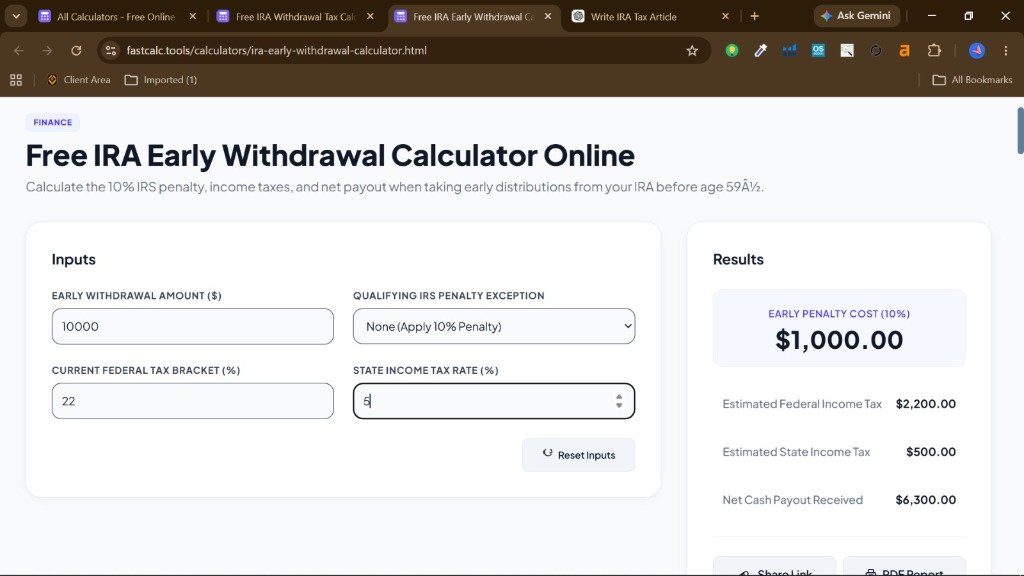
The actual tax treatment depends on your individual circumstances, so calculator results should be considered estimates rather than a final tax calculation.
What Is an IRA Early Withdrawal Calculator?
An IRA Early Withdrawal Calculator is an online financial calculator designed to estimate the potential cost of withdrawing money from an IRA before age 59½.
The calculator may consider several factors, including:
- Current IRA balance
- Withdrawal amount
- Your age
- Type of IRA
- Taxable income
- Federal tax rate
- State tax rate
- Filing status
- Early withdrawal exception
- Estimated withholding
- Taxable portion of the distribution
After entering these details, the calculator can estimate the potential income tax, additional early-distribution tax, and net amount you may receive.
For example, if you withdraw $20,000 from a traditional IRA before age 59½ and the entire distribution is taxable, you could potentially owe ordinary income tax plus an additional 10% tax unless an exception applies.
Why Use an IRA Early Withdrawal Calculator?
Retirement accounts are generally intended to help people save for the future. Taking money out early can affect both your current taxes and your long-term retirement savings.
An IRA Early Withdrawal Calculator helps you understand these potential consequences before requesting a distribution.
It can help you estimate:
- Potential income taxes
- Potential 10% additional tax
- Total estimated withdrawal costs
- Estimated amount you may receive
- Possible tax withholding
- Effect of different withdrawal amounts
- Difference between withdrawing now and later
For example, you could compare a $10,000 withdrawal with a $25,000 withdrawal and see how the estimated tax consequences change.
How Does an IRA Early Withdrawal Work?
An IRA early withdrawal generally refers to taking money from an IRA before age 59½.
The tax consequences depend on the account type and the nature of the distribution.
For a traditional IRA, taxable withdrawals are generally included in your income. If the distribution occurs before age 59½, an additional 10% tax may apply unless you qualify for an exception.
For Roth IRAs, the rules are different because contributions, conversions, and earnings may receive different tax treatment.
This is why an early withdrawal calculator should ask you to select the type of IRA you have.
Understanding the 59½ Age Rule
Age 59½ is an important milestone for retirement accounts.
Generally, taxable IRA distributions taken before age 59½ may be subject to an additional 10% tax unless an exception applies.
Reaching age 59½ generally eliminates the additional early-distribution tax, but it does not automatically make every IRA withdrawal tax-free.
For example, a taxable traditional IRA distribution after age 59½ can still be included in your taxable income.
Therefore, the calculator should consider your age separately from your income tax rate.
Traditional IRA Early Withdrawal
Traditional IRA withdrawals can generally be taxable when distributed.
If you made deductible contributions, the amount withdrawn may generally be included in taxable income. Investment earnings and other taxable amounts can also be subject to income tax.
If you take a taxable distribution before age 59½, an additional 10% tax may apply unless an exception is available.
For example, assume you withdraw $15,000 from a traditional IRA at age 45.
If the entire $15,000 is taxable, a simplified calculation might show:
Withdrawal: $15,000
Potential additional tax: 10%
Potential early-distribution tax: $1,500
This $1,500 would be separate from any ordinary income tax that may apply.
Roth IRA Early Withdrawal
Roth IRA withdrawals can be more complicated.
Roth IRAs are funded with after-tax contributions, so qualified withdrawals can generally be tax-free. However, the treatment of an early nonqualified distribution can depend on whether the money comes from regular contributions, conversions, or investment earnings.
A calculator should therefore avoid treating every Roth IRA withdrawal as taxable.
For example, a person withdrawing an amount equal to their eligible Roth IRA contributions may have a different tax result from someone withdrawing investment earnings.
Understanding the source of the withdrawal is therefore important.
How the IRA Early Withdrawal Penalty Is Calculated
A common simplified calculation for an early taxable distribution is:
Potential additional tax = Taxable early distribution × 10%
For example:
Taxable withdrawal: $10,000
Additional tax rate: 10%
Potential additional tax: $1,000
However, this is not necessarily the total tax cost.
You may also owe ordinary federal income tax on the taxable distribution.
If your estimated federal tax rate were 22%, a simplified example could be:
Withdrawal: $10,000
Estimated income tax: $2,200
Potential additional tax: $1,000
Estimated total federal cost: $3,200
Estimated amount remaining: $6,800
This example is for illustration only. Actual taxes can be different because federal tax is based on your overall taxable income and other factors.
IRA Early Withdrawal Calculator Inputs
A comprehensive calculator may require several inputs.
IRA Balance
Enter your current IRA account balance.
This allows you to understand how the withdrawal affects the remaining retirement account.
Withdrawal Amount
Enter the amount you intend to withdraw.
You can use different amounts to compare potential outcomes.
For example:
- $5,000
- $10,000
- $20,000
- $30,000
- $50,000
Current Age
Your age is important because the additional early-distribution tax generally applies to taxable distributions before age 59½ unless an exception applies.
IRA Type
Select the account type, such as:
- Traditional IRA
- Roth IRA
- SEP IRA
- SIMPLE IRA
Different retirement accounts can have different distribution rules.
Annual Income
Your current income can affect your overall tax situation.
A large IRA distribution may increase your taxable income and potentially affect the amount of federal income tax you owe.
Filing Status
Your filing status can also affect your tax calculation.
Common options include:
- Single
- Married filing jointly
- Married filing separately
- Head of household
- Qualifying surviving spouse
State
Some states impose income taxes while others do not. A more detailed calculator may therefore include state information.
IRA Early Withdrawal Tax Example
Consider a hypothetical 40-year-old taxpayer who withdraws $25,000 from a traditional IRA.
Assume:
- Withdrawal = $25,000
- Entire amount is taxable
- Age = 40
- No exception applies
- Estimated marginal federal tax rate = 22%
A simplified estimate would be:
Estimated income tax:
$25,000 × 22% = $5,500
Potential additional early-distribution tax:
$25,000 × 10% = $2,500
Estimated total federal taxes:
$5,500 + $2,500 = $8,000
Estimated amount remaining:
$25,000 − $8,000 = $17,000
This is a simplified illustration rather than a calculation of an actual tax bill. Your actual tax could differ depending on your complete financial and tax situation.
Exceptions to the Early Withdrawal Tax
The additional 10% tax does not necessarily apply to every early IRA distribution.
There are specific situations where an exception may be available.
Examples can include certain:
- Medical expenses
- Higher education expenses
- First-time homebuyer distributions
- Disability-related distributions
- Substantially equal periodic payments
- Certain unreimbursed expenses
- Other qualifying circumstances
The requirements for each exception are specific.
For this reason, an IRA Early Withdrawal Calculator may include an option asking whether you qualify for an exception.
Do not select an exception unless you meet the applicable requirements.
IRA Early Withdrawal and Taxes
One of the most important things to understand is that the additional 10% early-distribution tax and ordinary income tax are separate.
A person might therefore have both:
Ordinary income tax
plus
Additional early-distribution tax
For example, a taxable $20,000 withdrawal could potentially generate both types of tax.
The calculator can help separate these amounts so you can understand where the estimated costs come from.
Does Withholding Reduce the Early Withdrawal Penalty?
Withholding and tax liability are different concepts.
When an IRA distribution is made, federal income tax may be withheld from the amount paid to you. The amount withheld is generally a payment toward your eventual tax liability.
For example:
Gross withdrawal: $20,000
Estimated withholding: $2,000
Amount initially received: $18,000
The $2,000 withholding does not necessarily represent the total tax you will owe.
Your final tax liability depends on your complete tax return.
An IRA Early Withdrawal Calculator can therefore display the gross withdrawal separately from estimated taxes and withholding.
How an IRA Early Withdrawal Calculator Helps With Planning
An early withdrawal calculator can help you compare different financial scenarios.
For example, you might compare:
Scenario 1: Withdraw $10,000
Estimate the taxes and potential additional tax associated with a $10,000 distribution.
Scenario 2: Withdraw $20,000
Compare the estimated costs with the first scenario.
Scenario 3: Wait Until Age 59½
Compare the potential additional-tax consequences of an early distribution with a later withdrawal.
Scenario 4: Withdraw From a Roth IRA
Review how the potential tax treatment differs from a traditional IRA.
These comparisons can help you understand the financial impact of different withdrawal decisions.
Effect of Early Withdrawals on Retirement Savings
Taxes and penalties are not the only potential costs of an early IRA withdrawal.
Removing money from a retirement account also means that the withdrawn funds may no longer have the opportunity to grow inside the account.
For example, withdrawing $20,000 today means that $20,000 is no longer invested in the retirement account.
If the money could otherwise have generated investment returns over many years, the long-term opportunity cost could be significant.
Therefore, an IRA Early Withdrawal Calculator can be useful as part of a broader retirement planning process.
IRA Withdrawal vs. Rollover
An IRA distribution is not necessarily the same as transferring retirement money between eligible accounts.
A qualifying rollover or direct transfer may receive different tax treatment from taking the money as cash.
Before taking a distribution, it is important to understand whether you actually need the funds personally or whether you are simply moving retirement assets to another account.
A calculator designed specifically for early withdrawals should make this distinction clear.
Early Withdrawal From a Traditional IRA vs. Roth IRA
The account type can significantly affect the potential tax treatment.
| Feature | Traditional IRA | Roth IRA |
|---|---|---|
| Contributions | May be deductible | Generally made with after-tax money |
| Qualified withdrawals | Generally taxable | Generally tax-free |
| Early taxable withdrawal | May face additional tax | Depends on the portion and circumstances |
| Earnings | Generally taxable when distributed | Qualified earnings can generally be tax-free |
| Calculator complexity | Moderate | Often more detailed |
The actual rules can depend on your individual circumstances.
How to Use an IRA Early Withdrawal Calculator
Using the calculator generally involves the following steps:
Step 1: Enter your current IRA balance.
Step 2: Enter the amount you want to withdraw.
Step 3: Enter your age.
Step 4: Select your IRA type.
Step 5: Enter your estimated annual income.
Step 6: Select your filing status.
Step 7: Enter your state if required.
Step 8: Indicate whether an early-distribution exception applies.
Step 9: Review estimated income taxes.
Step 10: Review the potential additional 10% tax.
Step 11: Review estimated withholding.
Step 12: Check the estimated amount remaining after taxes.
The result can then be used to compare different withdrawal scenarios.
Advantages of an IRA Early Withdrawal Calculator
Quick Estimates
A calculator can provide an estimate within seconds.
Easy Scenario Comparison
You can change the withdrawal amount and compare different results.
Better Financial Planning
Understanding potential taxes can help you plan for the amount you actually need to withdraw.
Understand Potential Penalties
The calculator can show how an additional early-distribution tax could affect your withdrawal.
Compare IRA Types
It can help illustrate why traditional and Roth IRA withdrawals may have different tax consequences.
Limitations of an IRA Early Withdrawal Calculator
An online calculator is an estimation tool rather than a replacement for professional tax advice.
The actual tax outcome may depend on:
- Total taxable income
- Filing status
- IRA basis
- Deductible contributions
- Roth IRA contribution history
- Roth conversions
- Tax deductions
- Tax credits
- State taxes
- Early-distribution exceptions
- Other retirement distributions
- Required minimum distributions
- Changes in tax rules
For complicated situations, consider consulting a qualified tax professional.
Final Thoughts
An IRA Early Withdrawal Calculator can help estimate the potential financial consequences of taking money from an IRA before age 59½. By entering your age, withdrawal amount, IRA type, income, filing status, and other relevant information, you can estimate potential income taxes and the additional 10% early-distribution tax.
The most important point is that an early withdrawal may involve more than one type of cost. A taxable traditional IRA distribution can potentially be subject to ordinary income tax as well as the additional early-distribution tax.
Roth IRA withdrawals have different rules, and the tax treatment can depend on whether the withdrawal consists of contributions, conversions, or earnings.
Using a calculator before taking money out can help you understand the potential impact and compare different scenarios. However, calculator results are estimates, and your actual tax liability depends on your complete financial situation.
Frequently Asked Questions
1. What is an IRA Early Withdrawal Calculator?
An IRA Early Withdrawal Calculator estimates the potential taxes, additional early-distribution tax, and net amount associated with taking money from an IRA before age 59½.
2. What is the IRA early withdrawal penalty?
A taxable IRA distribution taken before age 59½ may generally be subject to an additional 10% tax unless an exception applies.
3. Can I withdraw money from my IRA before age 59½?
Yes, you can generally take money from an IRA before age 59½, but the distribution may be subject to income tax and an additional 10% tax depending on your circumstances.
4. Is the 10% early withdrawal tax the only tax I pay?
No. If the distribution is taxable, ordinary income tax may also apply. The additional 10% tax is separate from regular income tax.
5. Are all IRA withdrawals before age 59½ penalized?
No. Certain qualifying exceptions may allow you to avoid the additional 10% tax.
6. Are traditional IRA withdrawals taxable?
Traditional IRA withdrawals are generally taxable to the extent that the distribution represents taxable amounts.
7. Are Roth IRA early withdrawals taxable?
Not necessarily. Roth IRA withdrawals can have different treatment depending on whether the money represents contributions, conversions, or earnings and whether the distribution is qualified.
8. What age can I withdraw from an IRA without the early withdrawal tax?
Generally, reaching age 59½ means the additional 10% early-distribution tax no longer applies to otherwise eligible IRA distributions.
9. Does an IRA withdrawal increase my taxable income?
A taxable traditional IRA distribution generally becomes part of your taxable income for the year.
10. Can I avoid the IRA early withdrawal tax?
Certain exceptions may allow you to avoid the additional 10% tax. The requirements depend on the specific exception.
11. Does IRA withholding equal my final tax?
No. Withholding is generally a payment toward your tax liability. Your final tax depends on your complete tax return.
12. Can an IRA Early Withdrawal Calculator calculate my exact tax?
No. It can provide an estimate based on the information entered. Your actual tax liability can depend on many additional factors.
13. Does withdrawing money early reduce my retirement savings?
Yes. Money removed from an IRA is no longer available in that account for potential future investment growth.
14. Can I compare different withdrawal amounts with an IRA calculator?
Yes. You can generally enter different withdrawal amounts to compare estimated taxes, additional taxes, and net proceeds.
15. Should I use an IRA Early Withdrawal Calculator before withdrawing money?
Using a calculator can help you understand the potential financial impact before requesting a distribution. For complex tax situations, professional tax advice may also be appropriate.