Introduction
Money has the unique ability to grow over time when invested wisely. Whether you are saving for retirement, building an emergency fund, planning for your child's education, or investing for long-term financial goals, understanding how your money can increase is essential. One of the most powerful concepts in personal finance and investing is compound interest, often referred to as the "eighth wonder of the world" because of its remarkable ability to accelerate wealth growth.
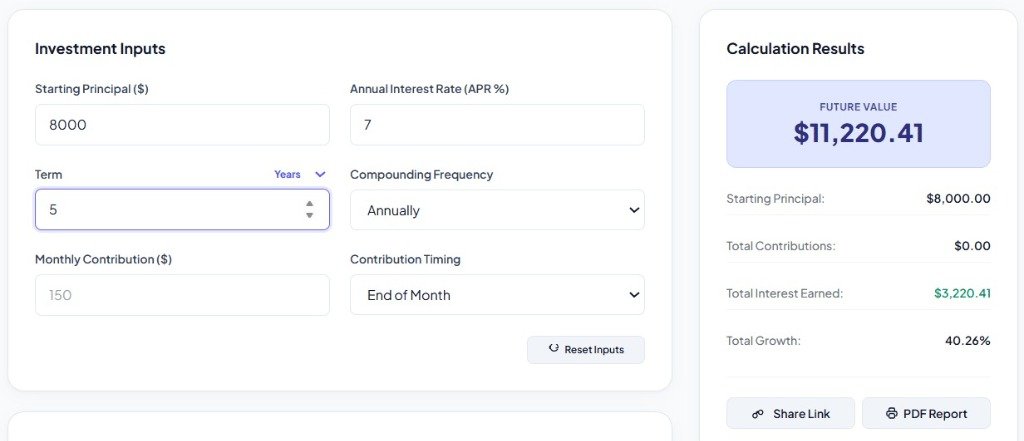
A Future Value or Compound Interest Calculator is a financial tool that helps individuals estimate how much an investment or savings account will be worth in the future based on factors such as the initial investment amount, interest rate, compounding frequency, and investment duration.
Rather than performing complicated financial calculations manually, a Future Value Calculator instantly determines how much money can accumulate over time. This makes it an invaluable tool for investors, financial planners, students, business owners, and anyone interested in long-term financial growth.
This comprehensive guide explains what a Future Value or Compound Interest Calculator is, how it works, why compound interest is important, and how it can help you make better financial decisions.
What Is a Future Value Calculator?
A Future Value Calculator is a financial tool used to estimate the value of an investment at a future date.
It considers factors such as:
- Initial investment (principal)
- Interest rate
- Compounding frequency
- Investment period
- Additional contributions (optional)
The calculator determines how much money your investment may grow over time.
For example:
- Initial investment: $10,000
- Annual interest rate: 8%
- Investment period: 20 years
The calculator estimates the future value based on compound growth.
What Is Compound Interest?
Compound interest is the process of earning interest not only on your original investment but also on previously earned interest.
Unlike simple interest, which only applies to the principal amount, compound interest continually builds upon itself. This creates a powerful snowball effect that accelerates wealth accumulation over time.
The fundamental compound interest formula is:
Where:
- FV = Future Value
- PV = Present Value (initial investment)
- r = Annual interest rate (in decimal format)
- n = Number of compounding periods per year
- t = Investment duration in years
This formula demonstrates how investments grow exponentially rather than linearly.
Understanding Future Value
Future Value (FV) represents the amount an investment will be worth at a specified point in the future.
It answers a simple but important question: "If I invest money today, how much will it be worth later?"
Future value calculations are widely used in:
- Retirement planning
- Investment analysis
- Savings goals
- Business forecasting
- Financial education
Understanding future value helps individuals make informed financial decisions.
How a Future Value Calculator Works
A Future Value Calculator requires several inputs:
Initial Investment
The starting amount invested. Example: $5,000.
Interest Rate
The annual rate of return. Example: 7%.
Time Period
The length of the investment. Example: 15 years.
Compounding Frequency
Interest may be compounded:
- Annually
- Semi-annually
- Quarterly
- Monthly
- Daily
More frequent compounding generally results in greater investment growth.
Additional Contributions
Some calculators allow recurring deposits such as:
- Monthly contributions
- Quarterly investments
- Annual additions
These regular contributions significantly increase future value.
Difference Between Simple Interest and Compound Interest
Simple Interest
Simple interest is calculated only on the original principal.
Formula: Interest = Principal × Rate × Time
Example: $10,000 invested at 5% for 10 years:
- Interest earned: $5,000
- Total value: $15,000
Compound Interest
Compound interest calculates returns on both principal and accumulated interest. The same investment may grow substantially more because earnings generate additional earnings. This makes compound interest far more powerful over long periods.
Why Compound Interest Is So Powerful
Compound interest rewards:
- Time
- Consistency
- Patience
The longer money remains invested, the greater the compounding effect becomes.
For example, if you invest $10,000 at 8% annually:
- After 10 years: Approximately $21,589
- After 20 years: Approximately $46,610
- After 30 years: Approximately $100,627
Notice how growth accelerates dramatically during later years. This is the true power of compounding.
Benefits of Using a Future Value Calculator
Financial Planning
The calculator helps users estimate future savings and investment goals.
Retirement Preparation
Individuals can determine whether their current savings strategy is sufficient for retirement.
Goal Setting
Users can estimate how much they need to invest to achieve specific objectives. Examples include:
- Home purchases
- Education funding
- Travel plans
- Business expansion
Investment Comparison
Investors can compare different rates of return and investment scenarios.
Better Decision Making
Future value calculations provide valuable insights for financial planning.
Common Applications of Future Value Calculators
Retirement Planning
One of the most common uses is estimating retirement savings growth. Investors can determine:
- Required contributions
- Expected retirement funds
- Long-term wealth accumulation
Education Savings
Parents often calculate future education costs and determine how much to save today.
Investment Analysis
Investors use future value calculations to compare stocks, bonds, mutual funds, and real estate investments.
Business Forecasting
Companies project future investment returns and capital growth.
Personal Savings Goals
Individuals use calculators to estimate savings growth for major purchases.
Factors That Influence Future Value
Several variables affect investment growth:
Principal Amount
Larger initial investments generally generate larger future values.
Interest Rate
Higher returns accelerate growth significantly. For example, a small difference between a 5% annual return, 8% annual return, and 12% annual return can produce substantial long-term impacts.
Time Horizon
Time is one of the most powerful factors in compound growth. Longer investment periods generate significantly larger returns.
Compounding Frequency
The more frequently interest is compounded, the faster investments grow. Common frequencies include annual, quarterly, monthly, and daily compounding.
Additional Contributions
Regular deposits dramatically increase future value over time.
Rule of 72
The Rule of 72 provides a quick estimate of how long it takes money to double.
Formula: Years to Double = 72 ÷ Interest Rate
Examples:
- At 6% APR: 72 ÷ 6 = 12 years to double
- At 8% APR: 72 ÷ 8 = 9 years to double
- At 12% APR: 72 ÷ 12 = 6 years to double
This simple rule demonstrates how higher returns accelerate wealth accumulation.
The Importance of Starting Early
Time is one of the most important components of compound interest. Consider two investors: Investor A starts investing at age 25, while Investor B starts at age 35. Even if both invest identical amounts, Investor A accumulates substantially more wealth due to additional years of compounding. This highlights the value of early investing.
Future Value with Regular Contributions
Many investors contribute money regularly. Examples include monthly savings deposits, retirement contributions, and investment account funding. Future Value Calculators incorporate recurring contributions to provide more realistic projections. Even modest monthly investments can grow into substantial sums over several decades.
Future Value vs Present Value
These two concepts are closely related:
Present Value (PV)
The current value of money today.
Future Value (FV)
The projected value of money at a future date.
Financial planning often involves converting between present value and future value calculations. Understanding both concepts improves investment decision-making.
How Businesses Use Future Value Calculations
Businesses frequently use future value analysis for capital budgeting, expansion planning, investment evaluation, equipment purchases, and project forecasting. Accurate projections help organizations allocate resources effectively.
Future Value Calculators in Personal Finance
Personal finance experts recommend using future value calculations when planning for retirement, emergency funds, children's education, wealth accumulation, and major purchases. These calculations help individuals create realistic financial goals.
Common Mistakes Investors Make
Starting Too Late
Delaying investments reduces the benefits of compound growth.
Underestimating Time
Many people fail to appreciate how significantly long-term compounding impacts wealth.
Ignoring Inflation
Future purchasing power may be affected by inflation.
Inconsistent Contributions
Regular investing generally produces better long-term outcomes than sporadic investing.
Unrealistic Return Expectations
Assuming excessively high returns can lead to inaccurate financial projections.
Technology and Modern Financial Calculators
Today's Future Value Calculators offer advanced features such as interactive charts, investment comparisons, retirement planning tools, inflation adjustments, and contribution schedules. These tools make financial planning easier and more accurate.
Advantages of Online Future Value Calculators
Modern calculators provide:
- Instant Results: Calculations are completed within seconds.
- Accuracy: Automated calculations reduce human error.
- Flexibility: Users can test multiple investment scenarios.
- Accessibility: Most calculators are available online at no cost.
- Educational Value: They help users understand financial growth principles.
The Future of Investment Planning Tools
Financial technology continues evolving rapidly. Future developments may include AI-powered financial planning, personalized investment projections, automated savings recommendations, real-time portfolio forecasting, and advanced retirement simulations. These innovations will help individuals make smarter financial decisions.
Conclusion
A Future Value or Compound Interest Calculator is one of the most valuable financial planning tools available today. By estimating how investments and savings will grow over time, it enables individuals and businesses to make informed financial decisions and set realistic goals.
The power of compound interest lies in its ability to generate earnings on both the original investment and accumulated returns. When combined with regular contributions and sufficient time, compounding can transform modest investments into substantial wealth.
Whether you are planning for retirement, saving for education, building an investment portfolio, or simply exploring the growth potential of your money, a Future Value Calculator provides valuable insights into the future value of your financial decisions.
Understanding compound interest is a crucial step toward achieving long-term financial success and maximizing the growth potential of your investments.
Try the Free Future Value / Compound Interest Calculator
Determine your compound growth and regular contributions in real-time with our private, client-side calculator.
Frequently Asked Questions (FAQs)
1. What is a Future Value Calculator?
A Future Value Calculator estimates how much an investment or savings account will be worth at a future date based on interest and time.
2. What is compound interest?
Compound interest is interest earned on both the original investment and previously earned interest.
3. How does a Future Value Calculator work?
It uses factors such as principal amount, interest rate, compounding frequency, and investment duration to calculate future growth.
4. Why is compound interest important?
Compound interest accelerates wealth growth by generating earnings on accumulated returns.
5. What information do I need to use a calculator?
Typically you need: initial investment, interest rate, investment period, and compounding frequency.
6. Does compounding frequency matter?
Yes. More frequent compounding generally results in higher future values.
7. Can I include monthly contributions?
Yes. Many Future Value Calculators allow recurring deposits to be included.
8. What is the Rule of 72?
The Rule of 72 estimates how long it takes an investment to double by dividing 72 by the annual interest rate.
9. Is a Future Value Calculator useful for retirement planning?
Yes. It is one of the most commonly used tools for retirement savings projections.
10. Are online Future Value Calculators accurate?
Yes. Most reputable calculators provide highly accurate results when correct information is entered.