The bench press is one of the most popular and effective strength-training exercises, helping athletes and fitness enthusiasts develop upper-body power, muscle mass, and overall pressing strength. Whether you're a beginner starting your fitness journey or an experienced powerlifter preparing for competition, knowing your maximum lifting capacity is essential for effective training.
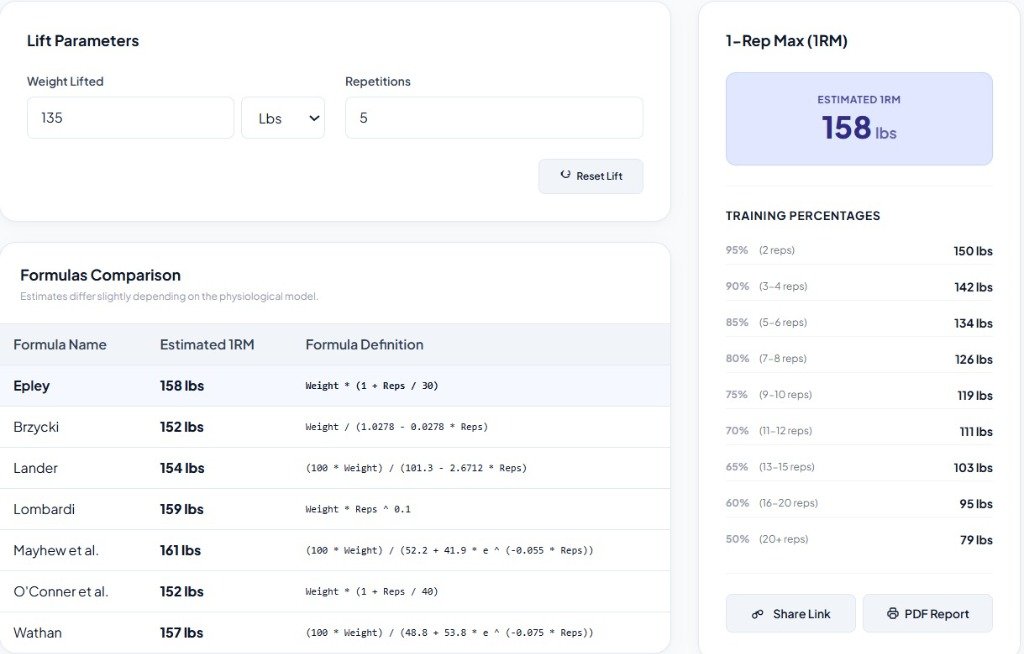
A Bench Press Calculator is a practical tool that estimates your one-repetition maximum (1RM)—the maximum amount of weight you can lift for a single repetition. Instead of attempting a potentially risky maximal lift, the calculator uses the weight you can lift for multiple repetitions to estimate your 1RM. It can also generate recommended training weights for different percentages of your maximum, making it easier to follow structured strength programs.
This guide explains how a Bench Press Calculator works, the formulas commonly used, its benefits, limitations, and how to use it to improve your performance safely.
What Is a Bench Press Calculator?
A Bench Press Calculator estimates your maximum lifting strength based on the weight you lift and the number of repetitions you complete. Rather than testing a true one-rep max—which can increase the risk of injury—the calculator predicts your strength using mathematical formulas developed from exercise science research.
Most calculators estimate:
- One-rep max (1RM): Your absolute single-rep peak strength.
- Training percentages: Submaximal ranges (e.g. 70%, 80%, 90% of 1RM) used in program planning.
- Working weights: The recommended weights for daily set-and-rep goals.
- Relative strength: How your lift relates to your body weight.
- Progress over time: Consistent tracking indicators for strength gains.
Why Use a Bench Press Calculator?
Using a Bench Press Calculator offers several advantages:
- Estimate your 1RM safely: Find your maximum without risking muscle tears or shoulder joint damage under heavy loads.
- Plan strength-training programs: Structure your training cycles using structured strength programs like 5/3/1 or block periodization.
- Choose appropriate working weights: Avoid undershooting or overshooting training targets.
- Monitor progress over time: Track subtle strength increases even if you don't perform maximal lifts.
- Reduce injury risk: Less frequency of maximum loading preserves nervous system and joint health.
- Set realistic fitness goals: Plan measurable strength milestones.
- Prepare for powerlifting competitions: Formulate opener and attempt selections.
What Is One-Rep Max (1RM)?
A one-rep max (1RM) is the maximum amount of weight you can lift for a single repetition with proper form.
For example, if you perform:
If you can lift 80 kg for 8 repetitions, a Bench Press Calculator uses that data to estimate what your theoretical one-rep maximum would be without requiring you to actually lift it.
Information Needed
Most calculators require only two simple values:
- Weight lifted: The total load of the barbell (including the bar itself, usually 20 kg or 45 lbs).
- Number of repetitions completed: The count of clean repetitions executed before reaching failure or terminating the set.
Example: Entering a weight of 90 kg and repetitions of 5 will calculate your estimated 1RM using standard formulas.
Estimate Your One-Rep Max Now
Input your lifting stats and view comprehensive intensity percentage brackets instantly.
Common Bench Press Calculator Formulas
Several well-known mathematical algorithms estimate your one-rep max:
1. Epley Formula
One of the most popular and accurate methods for general fitness:
\[\text{1RM} = w \times \left(1 + \frac{r}{30}\right)\]This formula works best for submaximal sets of up to 10 repetitions.
2. Brzycki Formula
Often preferred by strength athletes and powerlifters because it models a steep drop-off at higher repetitions:
\[\text{1RM} = \frac{w}{1.0278 - 0.0278 \times r}\]Highly reliable when repetitions are kept below 10.
3. Lombardi Formula
Developed by exercise scientist Lombardi, this formula uses a non-linear power model suitable for experienced lifters:
\[\text{1RM} = w \times r^{0.1}\]4. Mayhew et al. Formula
A double-exponential formula frequently applied in collegiate and athletic testing to estimate peak anaerobic power:
\[\text{1RM} = \frac{100 \times w}{52.2 + 41.9 \times e^{-0.055 \times r}}\]5. O'Conner Formula
Another simple linear relationship widely integrated into academic strength training programs:
\[\text{1RM} = w \times \left(1 + \frac{r}{40}\right)\]6. Wathan Formula
A formula that employs a mathematical curve fitting model to predict strength profiles:
\[\text{1RM} = \frac{100 \times w}{48.8 + 53.8 \times e^{-0.075 \times r}}\]7. Lander Formula
A linear formula that models a drop in performance as repetitions increase:
\[\text{1RM} = \frac{100 \times w}{101.3 - 2.6712 \times r}\]How to Use a Bench Press Calculator
- Warm up properly: Perform several light sets to prepare your neuromuscular system before testing.
- Select a working weight: Choose a weight you can lift with good technique for approximately 3 to 8 repetitions.
- Perform the set: Perform as many clean repetitions as possible. Stop the set immediately if your form begins to break down.
- Enter your parameters: input the weight lifted and repetitions completed into the calculator.
- Review your results: Analyze your estimated 1RM, training percentages, and recommended working weights.
Training Percentages
Many structured strength programs prescribe training loads as a percentage of your estimated 1RM. Here is how these percentages typically translate:
- 50% of 1RM: Warm-up, mobility, and technique refinement.
- 60% of 1RM: Dynamic effort training, high-volume sets, and recovery.
- 70% of 1RM: Hypertrophy (muscle building) range; ideal for sets of 8 to 12 reps.
- 80% of 1RM: Basic strength development; typical for sets of 5 reps.
- 85% - 90% of 1RM: Heavy strength training; sets of 2 to 3 reps.
- 90% - 100% of 1RM: Maximal effort lifts; sets of 1 to 2 reps (performed sparingly).
Benefits of a Bench Press Calculator
- Safer than testing a true max: Estimating your 1RM reduces the risk of joint stress and heavy barbell accidents.
- Better program design: Structure your progressive overload accurately.
- Progress tracking: Compare estimated maxes over weeks or months to see if your program is working.
- Goal setting: Set realistic milestones (e.g. hitting a body weight bench press).
Factors That Affect Bench Press Performance
Several variables influence your bench press strength:
- Technique: Proper set up, bar path, and elbow positioning.
- Training experience: Central nervous system adaptations.
- Body weight: Larger lifters generally have mechanical advantages.
- Muscle mass: Cross-sectional area of the chest, shoulders, and triceps.
- Nutrition: Carbohydrate intake and hydration status.
- Sleep & Recovery: Hormonal levels and muscle repair.
- Shoulder health: Rotator cuff strength and stability.
Bench Press Tips
- Maintain proper form: Keep your shoulders retracted and down.
- Leg drive: Keep your feet firmly planted on the floor to drive force from the ground up.
- Control the bar: Control the lowering phase (eccentric) and avoid bouncing the barbell off your chest.
- Use a spotter: Always have a spotter or use safety arms when testing heavy sets.
Common Mistakes
- Flaring the elbows: Creates high shoulder stress; keep elbows tucked at roughly 45 to 75 degrees.
- Bouncing the bar: Uses momentum rather than muscle activation, rendering formulas inaccurate.
- Lifting too heavy too soon: Compromises form and increases injury risk.
- Neglecting accessory work: Triceps, upper back, and rotator cuff training are vital to supporting your bench.
Who Should Use a Bench Press Calculator?
A Bench Press Calculator is suitable for:
- Beginners wanting to find their starting baseline.
- Intermediate lifters structuring hypertrophy and strength blocks.
- Advanced powerlifters checking relative performance.
- Personal trainers calculating client programs.
- Strength coaches managing athletic testing.
Limitations
While useful, a Bench Press Calculator provides an estimate rather than an exact measurement. Actual strength may vary due to fatigue, training status, exercise technique, individual physiology, and formula differences. Testing a true one-rep max under professional supervision may produce a more accurate result for experienced lifters.
Conclusion
A Bench Press Calculator is a valuable tool for estimating your one-rep max, planning workouts, and monitoring progress without the risks associated with maximal lifting. By entering the weight you lift and the number of repetitions completed, you can receive an estimated 1RM and recommended training loads for different fitness goals.
Whether you're training for strength, muscle growth, athletic performance, or general fitness, incorporating a Bench Press Calculator into your routine can help you train more effectively, stay motivated, and make informed decisions about your workouts.
Frequently Asked Questions (FAQs)
1. What is a Bench Press Calculator?
A Bench Press Calculator estimates your one-rep maximum (1RM) using the weight you lift and the number of repetitions completed.
2. What is a one-rep max (1RM)?
A one-rep max is the maximum amount of weight you can lift for one repetition with proper form.
3. Is the calculator accurate?
It provides a close estimate based on established formulas, but actual results may vary depending on factors such as technique and fatigue.
4. Which formula is best?
The Epley and Brzycki formulas are among the most commonly used and generally provide reliable estimates for most lifters.
5. Can beginners use a Bench Press Calculator?
Yes. It allows beginners to estimate strength without attempting potentially unsafe maximal lifts.
6. Can I use pounds or kilograms?
Most Bench Press Calculators support both pounds (lb) and kilograms (kg).
7. How often should I calculate my 1RM?
Many lifters update their estimated 1RM every 4–8 weeks to track progress.
8. Does the calculator work for other exercises?
Many 1RM calculators can also estimate strength for exercises such as the squat, deadlift, overhead press, and barbell row.
9. Why shouldn't I test my true 1RM frequently?
Maximal lifts can increase fatigue and injury risk if performed too often, especially without proper supervision or technique.
10. Can a Bench Press Calculator help with workout planning?
Yes. By estimating your 1RM, it helps determine appropriate training weights for strength, hypertrophy, endurance, and power-focused programs.