Free SEP IRA Calculator Online
Calculate your maximum self-employed SEP IRA contribution limit, tax deductions, and investment growth projections.
Inputs
Results
Related Calculators
SEP IRA Calculator: Estimate Contributions, Retirement Savings, and Tax Benefits
A SEP IRA Calculator is a useful financial planning tool for self-employed individuals, freelancers, independent contractors, and small business owners who want to estimate how much they may be able to contribute to a Simplified Employee Pension Individual Retirement Account. By entering information such as self-employment income, contribution rate, current age, retirement age, expected investment return, and other financial details, you can estimate potential SEP IRA contributions and future retirement savings.
SEP IRAs are designed to provide a relatively simple way for businesses to make retirement contributions for themselves and eligible employees. The Internal Revenue Service allows businesses of different sizes, including self-employed individuals, to establish SEP plans. Contributions are made by the employer to SEP-IRAs established for participants.
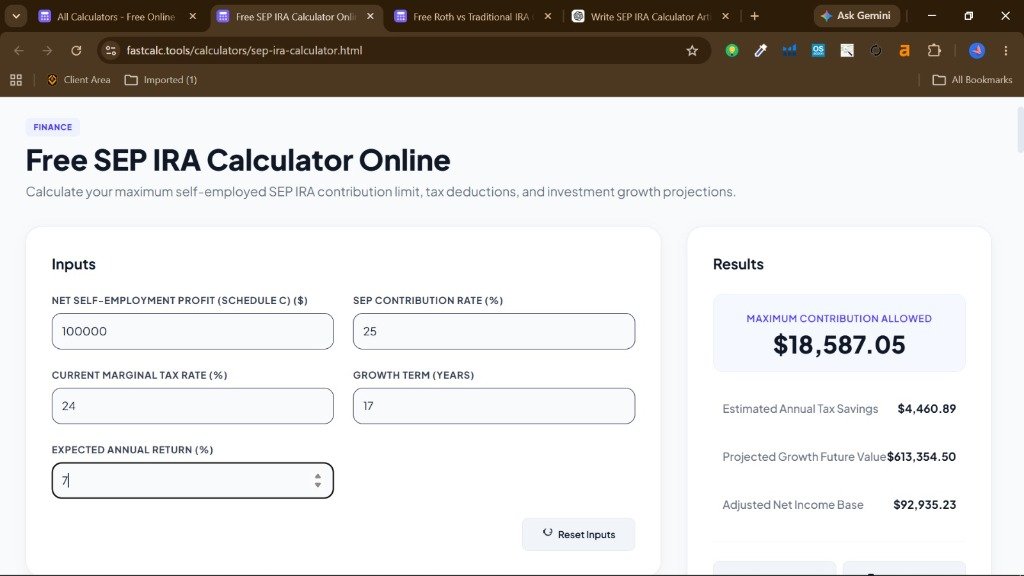
A calculator can make the planning process easier by turning income and contribution assumptions into understandable estimates. However, because self-employed SEP calculations involve special rules, a calculator should be treated as a planning aid rather than a substitute for professional tax advice.
What Is a SEP IRA?
A Simplified Employee Pension Individual Retirement Account (SEP IRA) is a retirement arrangement that allows employers to make contributions to traditional IRAs established for eligible employees. A business owner can also participate in the plan and make contributions for themselves.
SEP IRAs can be particularly useful for businesses that want a retirement plan with relatively straightforward administration. A business of virtually any size, including a self-employed business, can establish a SEP plan.
Unlike a traditional 401(k), a standard SEP generally does not allow employees to make elective salary-deferral contributions. The SEP is primarily funded through employer contributions. The IRS states that elective salary deferrals and catch-up contributions are not permitted under standard SEP plans.
For self-employed individuals, determining the contribution amount is more complicated than simply multiplying business profit by a percentage. Special calculations account for the deductible portion of self-employment tax and the contribution itself.
What Is a SEP IRA Calculator?
A SEP IRA Calculator estimates potential contributions and retirement savings using information about your income, contribution percentage, and retirement goals.
Depending on the calculator, you may enter:
- Net self-employment income
- Business income or compensation
- Contribution percentage
- Current age
- Expected retirement age
- Current retirement savings
- Expected annual investment return
- Expected annual income growth
- Inflation assumptions
- Estimated tax rate
- Employee information, when applicable
The calculator can then estimate your potential annual contribution and, if investment growth is included, the approximate value of your account at retirement.
Because SEP contribution rules can differ depending on whether you are an employee or self-employed business owner, calculators should clearly distinguish between these situations.
How Does a SEP IRA Calculator Work?
A basic SEP IRA Calculator starts with eligible compensation and applies the applicable contribution percentage, subject to the annual IRS limits.
For an eligible employee, the general SEP contribution limit is the lesser of 25% of compensation or the applicable annual dollar limit. For 2026, the maximum SEP contribution is $72,000, and compensation considered for this calculation is capped at $360,000.
For example, suppose an employee earns $100,000 and the employer's SEP contribution rate is 20%.
Estimated contribution:
$100,000 × 20% = $20,000
If the calculated amount is below the annual SEP dollar limit, the percentage-based amount may determine the contribution.
Self-employed individuals require a different calculation. Their plan compensation is based on net earnings from self-employment after certain adjustments, including the deductible portion of self-employment tax and the SEP contribution itself.
A sophisticated SEP IRA Calculator can account for these adjustments rather than simply multiplying Schedule C profit by 25%.
SEP IRA Contribution Limit for 2026
For 2026, the IRS states that contributions to an employee's SEP-IRA generally cannot exceed the lesser of:
- 25% of compensation, or
- $72,000.
The compensation limit for calculating SEP contributions is $360,000 for 2026.
These figures can change because retirement-plan limits are periodically adjusted for cost-of-living increases. Therefore, when using a SEP IRA Calculator, it is important to select the correct tax year.
For example, the maximum SEP contribution increased from $70,000 in 2025 to $72,000 in 2026.
Calculating SEP IRA Contributions for Employees
For an employee who receives a SEP contribution based on a specified percentage, the calculation can be relatively straightforward.
For example:
Annual compensation: $80,000
SEP contribution rate: 15%
Estimated contribution:
$80,000 × 15% = $12,000
If the employer contributes 15% for eligible participants, the same percentage generally needs to be applied consistently according to the terms of the SEP plan.
SEP rules generally require contributions to eligible participants to follow the plan's allocation formula. When an employer makes contributions, the required contributions generally must be made for all eligible participants under the plan.
Calculating a SEP IRA Contribution for Self-Employed Individuals
Self-employed SEP IRA calculations require additional steps.
The IRS explains that a self-employed individual's plan compensation is based on net earnings from self-employment and is adjusted for the deductible part of self-employment tax and the individual's own retirement-plan contribution.
This creates a circular calculation because the contribution affects the amount used to determine the contribution.
For this reason, simply taking:
Net business profit × 25%
may produce an incorrect result for a self-employed person.
The IRS provides special worksheets and tables in Publication 560 for determining the appropriate contribution and deduction.
A calculator designed specifically for self-employed users should account for these rules.
SEP IRA Calculator Inputs
A useful calculator may ask for several pieces of information.
Net Self-Employment Income
This is one of the most important inputs for a self-employed person. The calculator can use this amount as the starting point for estimating plan compensation.
Contribution Rate
Enter the percentage you intend to contribute under your SEP plan. The percentage must remain within applicable SEP rules and the terms of the plan.
Current Age
Your current age helps estimate how many years your money could potentially remain invested before retirement.
Retirement Age
Your expected retirement age determines the estimated investment period.
For example, someone who is 35 and expects to retire at 65 has approximately 30 years for potential investment growth.
Current Retirement Savings
Entering your existing retirement balance can make the projection more useful because the calculator can estimate growth on both existing savings and future contributions.
Expected Investment Return
You can enter an assumed annual investment return to estimate how the account might grow.
Actual investment performance can be substantially different from an assumed rate, so projections should not be interpreted as guaranteed results.
Employee Information
Business owners with employees may need additional information about eligible employees and their compensation. This can help estimate the employer's potential total SEP contribution obligation.
SEP IRA Growth Calculator
A SEP IRA Calculator can also estimate future account growth.
A simplified compound-growth calculation can be represented as:
Future Value = Current Balance × (1 + r)^n + Future Contributions
where:
- r = assumed annual investment return
- n = number of years
- Future contributions represent additional retirement deposits over time.
For example, suppose someone has $50,000 in an existing retirement account and continues making annual contributions. If the investments generate returns over several decades, the account may grow significantly through compounding.
However, investment returns are not guaranteed. Market performance can vary from year to year, and actual retirement balances may be higher or lower than calculator projections.
Tax Benefits of a SEP IRA
One reason SEP IRAs are attractive to many business owners is the potential tax treatment of contributions.
Employer contributions to SEP-IRAs are generally deductible within applicable limits. For self-employed individuals, special rules determine the maximum deductible contribution.
The tax treatment can make SEP contributions useful as part of broader retirement and business tax planning.
However, the exact tax benefit depends on factors such as income, filing status, business structure, contribution amount, and other deductions.
A SEP IRA Calculator can estimate contribution amounts, but it generally cannot determine your complete federal or state tax liability.
SEP IRA vs. Traditional IRA
A SEP IRA is technically a type of traditional IRA arrangement, but the contribution rules can be very different.
For 2026, the standard IRA contribution limit is $7,500, while the SEP contribution limit can be substantially higher, subject to the SEP rules and applicable compensation limits.
A person participating in a SEP can also potentially make regular contributions to a traditional or Roth IRA, subject to the applicable IRA rules. Employer SEP contributions do not count against the regular IRA contribution limit, although contributions made by the individual do count toward the applicable IRA limits.
SEP IRA vs. 401(k)
SEP IRAs and 401(k) plans serve different purposes.
A SEP IRA can be attractive because of its relatively simple structure and potentially high employer contribution limit. A traditional 401(k), on the other hand, can provide employee salary-deferral features and other plan design options.
For 2026, the employee elective-deferral limit for most 401(k) plans is $24,500, separate from the SEP contribution rules.
The right retirement plan depends on factors such as business size, employee demographics, income, desired contribution levels, administrative preferences, and tax objectives.
Can SEP IRA Contributions Change Every Year?
Yes. A business does not necessarily have to contribute the same dollar amount every year.
The IRS states that employers do not have to make SEP contributions every year. However, when contributions are made, the employer must follow the plan's allocation requirements and applicable SEP rules.
This flexibility can be useful for businesses with fluctuating profits.
For example, a business might contribute more during a highly profitable year and less during a year with lower income, provided the plan is operated according to its rules.
When Can SEP IRA Contributions Be Made?
SEP contributions for a particular tax year generally must be made by the employer's tax-return filing deadline, including extensions, to qualify for a deduction for that year.
This timing feature can be useful for business owners who want to determine their contribution after the end of the tax year but before the applicable filing deadline.
Because deadlines can depend on the taxpayer and business structure, it is important to verify the applicable deadline for your specific situation.
SEP IRA Withdrawals and Retirement Planning
A SEP IRA follows many of the same distribution rules as a traditional IRA. Withdrawals are generally taxable as income, and early distributions can be subject to an additional tax unless an exception applies.
SEP-IRA assets can also generally be rolled over to other eligible retirement accounts.
Participants who reach the applicable required minimum distribution age must follow RMD rules.
A SEP IRA Calculator focused on retirement planning can therefore help estimate not only contributions but also the potential accumulation of retirement assets.
Benefits of Using a SEP IRA Calculator
A SEP IRA Calculator can provide several practical benefits:
Quick Contribution Estimates
Instead of manually working through multiple calculations, users can obtain an initial estimate quickly.
Retirement Planning
The calculator can show how annual contributions could potentially accumulate over many years.
Business Planning
Business owners can estimate the potential cost of providing SEP contributions for eligible employees.
Scenario Comparison
Users can compare different contribution rates, income levels, retirement ages, and investment-return assumptions.
Better Understanding
A calculator helps users understand how income and contribution percentages affect retirement savings.
Limitations of a SEP IRA Calculator
Although useful, a calculator has limitations.
The results depend on the information entered. If income, tax assumptions, contribution rates, or investment returns are inaccurate, the estimate may not represent the actual result.
Investment returns are also uncertain. A projected 7% annual return, for example, does not mean the account will actually earn 7% every year.
Tax rules can also change. The IRS periodically adjusts retirement-plan limits for inflation, meaning an older calculation may become outdated.
For self-employed individuals, special contribution calculations make professional tax guidance particularly useful when determining the final deductible contribution.
Who Should Use a SEP IRA Calculator?
A SEP IRA Calculator can be useful for:
- Self-employed professionals
- Freelancers
- Independent contractors
- Sole proprietors
- Small business owners
- Consultants
- Business partnerships
- Entrepreneurs
- Employers consideri