Free Custodial Roth IRA Calculator Online
Calculate contribution limits, tax-free investment growth, and compounding benefits for custodial Roth IRAs for minors.
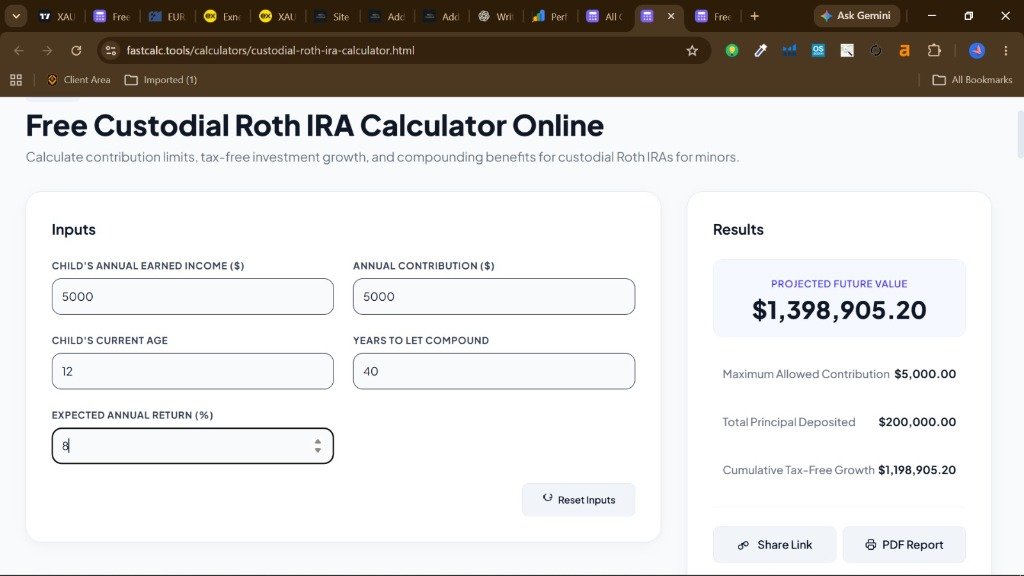
Inputs
Results
Related Calculators
Custodial Roth IRA Calculator: Estimate Your Child’s Future Retirement Savings
A Custodial Roth IRA Calculator is a useful financial planning tool that helps parents, guardians, and family members estimate how much a child could save for retirement through a custodial Roth Individual Retirement Account (Roth IRA). By entering information such as the initial investment, annual contributions, expected investment return, and years until retirement, users can estimate the potential future value of the account.
Starting retirement savings early can provide a significant advantage because investments have more time to grow through compounding. Even relatively small contributions made during childhood or teenage years may grow substantially over several decades, depending on investment performance and contribution levels.
A custodial Roth IRA can be particularly useful for children who earn income from part-time jobs, summer employment, babysitting, tutoring, or other eligible work. However, these accounts have specific eligibility requirements, contribution limits, and tax rules that parents and guardians should understand before opening an account.
This guide explains how a Custodial Roth IRA Calculator works, how to estimate future savings, which factors influence investment growth, and how to understand the potential benefits and limitations of a custodial retirement account.
What Is a Custodial Roth IRA Calculator?
A Custodial Roth IRA Calculator is an online financial calculator designed to estimate the future value of a Roth IRA opened for a minor under the supervision of a parent or another eligible adult custodian.
A Roth IRA is a retirement savings account funded with after-tax money. Qualified withdrawals are generally tax-free, including eligible investment earnings, provided the applicable IRS requirements are satisfied.
Because minors generally cannot independently manage a brokerage account under standard arrangements, a custodial Roth IRA allows an adult custodian to manage the account until the child reaches the applicable age under state law and the financial institution's policies.
The child is the account owner and beneficiary of the funds, while the custodian manages the account on the child's behalf.
The calculator helps estimate how contributions and investment returns may accumulate over time. It can also help families compare different savings strategies, such as contributing a small amount regularly or increasing contributions as the child earns more income.
However, the calculator provides projections rather than guaranteed results. Actual investment performance, fees, contribution changes, and tax rules can affect the final balance.
How Does a Custodial Roth IRA Calculator Work?
A Custodial Roth IRA Calculator uses information about contributions, investment growth, and the investment period to estimate the account's future value.
Most calculators require several basic inputs.
1. Initial Investment
The initial investment is the amount deposited into the custodial Roth IRA at the beginning of the calculation period.
For example, if a parent contributes $500 from the child's eligible earned income arrangement, the calculator can use that amount as the starting balance.
A larger initial investment gives the money more time to potentially grow through compounding. However, any contribution must comply with Roth IRA eligibility and contribution rules.
2. Annual Contribution
Annual contributions represent the amount added to the account each year.
For example, a child might contribute $500, $1,000, or another eligible amount based on their earnings and the applicable annual limit.
Regular contributions can help build a retirement portfolio gradually. The calculator estimates how these additional deposits may accumulate alongside investment returns.
Remember that contributions to a child's Roth IRA cannot exceed the child's eligible compensation for the year or the applicable annual IRA contribution limit, whichever is lower.
3. Current Age
The child's current age helps determine how many years the investment may grow before a selected retirement age.
For instance, a teenager who begins investing at age 15 has more potential investment years than someone who begins at age 25, assuming both use the same retirement age.
A longer investment period can make compounding more powerful, although investment returns are never guaranteed.
4. Retirement Age
Retirement age is the age at which the calculator estimates the account balance.
Users may select age 60, 65, or another future age to compare different investment periods.
Starting early generally provides more time for investment growth. However, the selected retirement age is only a projection target and does not determine when Roth IRA withdrawals automatically become tax-free.
5. Expected Annual Rate of Return
The expected annual rate of return represents the assumed yearly growth rate of the investments inside the account.
For example, a calculator may allow an assumed return of 4%, 6%, or 8%.
These percentages are mathematical assumptions, not promises. Actual investment returns fluctuate, and the account could experience losses.
It is useful to compare conservative, moderate, and optimistic scenarios instead of relying on a single expected return.
6. Contribution Frequency
Some calculators allow users to choose monthly or annual contributions.
Monthly contributions may make it easier to model regular deposits from a child's earnings. Annual contributions can be useful for estimating a single deposit made at the end or beginning of each year.
Contribution timing affects the projected balance because money deposited earlier has more time to potentially earn returns.
How to Calculate the Future Value of a Custodial Roth IRA
A Custodial Roth IRA Calculator typically estimates future savings by combining the growth of the initial balance with the growth of additional contributions.
For a simplified model with a constant annual return, the future value of an initial investment can be calculated using:
\[ FV=P(1+r)^n \]
Where:
- \(FV\) = future value of the initial investment.
- \(P\) = initial investment.
- \(r\) = assumed annual rate of return expressed as a decimal.
- \(n\) = number of years invested.
For recurring annual contributions made at the end of each year, the future value can be estimated using:
\[ FV=C\left( rac{(1+r)^n-1}{r} ight) \]
Where:
- \(C\) = annual contribution.
- \(r\) = assumed annual rate of return.
- \(n\) = number of annual contributions.
The combined estimate is the future value of the initial investment plus the future value of recurring contributions.
If the assumed return is zero, the recurring contribution formula simplifies to the total amount contributed.
These formulas assume a constant return and do not account for fluctuating markets, taxes outside the account, investment fees, or changes in contribution limits. Actual investment results will differ.
Example: Estimating Long-Term Custodial Roth IRA Growth
Suppose a 15-year-old begins investing $1,000 and contributes another $1,000 at the end of each year until age 65.
Assume an illustrative annual return of 7%, compounded annually, with no withdrawals or fees.
The following example estimates the potential account value over different periods.
| Investment period | Total contributions | Estimated future value |
|---|---|---|
| 10 years | $11,000 | About $16,000 |
| 20 years | $21,000 | About $45,000 |
| 30 years | $31,000 | About $106,000 |
| 40 years | $41,000 | About $215,000 |
| 50 years | $51,000 | About $465,000 |
These are rounded mathematical illustrations using the initial $1,000 deposit and annual $1,000 contributions. The figures assume a consistent 7% return, with no inflation adjustment, fees, or withdrawals.
The example demonstrates how a longer investment period can increase the potential value of a retirement account. It does not suggest that a 7% return will occur every year or that the final balance is guaranteed.
A calculator makes it easy to change the annual contribution or expected return to understand how different scenarios affect long-term savings.
Benefits of Opening a Custodial Roth IRA for a Child
A custodial Roth IRA can offer several advantages for eligible children with earned income.
Tax-Free Qualified Withdrawals
Roth IRA contributions are made with after-tax money. Qualified distributions, including eligible investment earnings, are generally tax-free when the applicable IRS requirements are met.
This can be valuable for long-term retirement planning because eligible earnings may accumulate for decades without annual taxation inside the account.
Long-Term Compound Growth
Compounding occurs when investment earnings generate additional earnings over time.
For example, an investment may earn returns on its original contribution as well as on previously accumulated investment gains.
Starting during childhood or adolescence can provide a longer period for this process to work.
Financial Education
A custodial Roth IRA can introduce children to budgeting, investing, saving, and long-term financial planning.
Parents can use the account to explain the relationship between earned income, contributions, investment risk, and financial goals.
Flexible Investment Choices
Depending on the financial institution, a Roth IRA may offer access to mutual funds, exchange-traded funds, stocks, and other permitted investments.
The available options vary by provider. Investments should be selected according to the family's risk tolerance, time horizon, and financial circumstances.
A Head Start on Retirement
Money invested during the early years of life may have decades to grow before retirement.
This early start can reduce the amount of money that may need to be contributed later, although the result depends on investment performance and future contribution patterns.
Custodial Roth IRA Eligibility Requirements
A child cannot generally contribute to a Roth IRA simply because a parent wants to open one. The account must meet the applicable eligibility requirements.
The Child Must Have Earned Income
The child needs eligible compensation from work, such as wages, salary, or qualifying self-employment income.
Examples may include:
- Wages from a part-time job.
- Income from summer employment.
- Compensation for babysitting or tutoring.
- Qualifying income from a small business or freelance activity.
Income from gifts, allowances, investment earnings, or ordinary interest generally does not qualify as earned compensation for IRA contribution purposes.
For self-employment income, appropriate records should be maintained to substantiate the work performed and the income earned.
Contributions Cannot Exceed Eligible Compensation
A child's annual Roth IRA contribution generally cannot exceed their eligible compensation for that year or the annual IRA contribution limit, whichever is lower.
For example, if a child earns $2,000 in eligible compensation during a year, the total contribution to their traditional and Roth IRAs generally cannot exceed $2,000, even if the annual IRS limit is higher.
A parent or another person may provide the money used for the contribution, but the child's eligible compensation must support the contribution.
The Adult Acts as Custodian
A parent or another eligible adult generally manages the custodial account until the child reaches the applicable age under state law and the provider's policies.
The funds belong to the child, not the custodian. The adult must manage the account in accordance with the applicable custodial requirements.
Income Limits May Apply
Roth IRA contributions are subject to income-based eligibility rules. The relevant limits depend on the child's filing status and modified adjusted gross income.
Many children with modest earnings may qualify for direct Roth IRA contributions, but eligibility should be checked for the specific tax year.
Custodial Roth IRA Contribution Limits
The IRS sets annual limits on contributions to traditional and Roth IRAs combined.
The applicable limit may change from year to year. For the 2026 tax year, the general IRA contribution limit is $7,500 for individuals under age 50, subject to the earned-compensation and other eligibility requirements.
For a child, the maximum contribution is generally the lower of:
- The child's eligible compensation for the tax year.
- The applicable annual IRA contribution limit.
For example, if a child earns $3,000 in eligible compensation in 2026, the maximum combined traditional and Roth IRA contribution would generally be $3,000.
If the child earns $9,000, the general annual limit would ordinarily restrict contributions to $7,500, assuming all other eligibility requirements are satisfied.
Parents should verify the applicable IRS limits and income rules for each tax year before making contributions.
Factors That Affect Custodial Roth IRA Growth
Several variables can significantly change the balance estimated by a Custodial Roth IRA Calculator.
Contribution Amount
Higher contributions can increase the projected account balance, provided they remain within the child's eligible compensation and applicable contribution limits.
Families should choose an amount that is realistic and sustainable.
Investment Return
The assumed rate of return has a substantial effect on long-term projections. A higher return generally produces a higher estimated balance, but it also may involve greater risk.
It is better to compare multiple scenarios than to assume the most optimistic result.
Investment Duration
A longer investment period generally gives contributions more time to potentially grow.
Even small contributions may accumulate significantly when invested over several decades.
Contribution Timing
Depositing money earlier in the year may provide more time for potential investment growth than depositing the same amount at the end of the year.
However, the actual result depends on market performance.
Investment Fees
Account fees, fund expense ratios, and transaction costs can reduce returns over time.
When comparing custodial Roth IRA providers, review account fees and the costs of the available investments.
Inflation
Inflation reduces the purchasing power of money over time. A projected balance of $500,000 several decades from now will not necessarily buy as much as $500,000 today.
Some calculators show future dollars only, while others allow users to estimate inflation-adjusted purchasing power.
Custodial Roth IRA vs. Traditional Custodial IRA
A custodial Roth IRA and a custodial traditional IRA can both help an eligible child save for retirement, but they have different tax treatments.
| Feature | Custodial Roth IRA | Custodial traditional IRA |
|---|---|---|
| Contributions | Made with after-tax money | May be deductible, depending on eligibility |
| Qualified retirement withdrawals | Generally tax-free | Generally taxable |
| Investment growth | Tax-deferred within the account | Tax-deferred within the account |
| Child's earned income required | Yes | Yes |
| Adult custodian | Generally required for minors | Generally required for minors |
| Tax treatment of contributions | No deduction for Roth contributions | Deduction may be available |
The best choice depends on the child's tax situation, current income, future expectations, and the family's financial goals.
Because many children have relatively low taxable income, a Roth IRA may be attractive. However, this is not automatically the best option for every situation.
Common Mistakes to Avoid
When opening or managing a custodial Roth IRA, families should avoid several common mistakes.
- Contributing without eligible earned income: Gifts and allowances do not generally qualify as IRA compensation.
- Exceeding contribution limits: Contributions must remain within the child's eligible compensation and applicable annual limit.
- Failing to maintain records: Keep records of wages, self-employment income, contributions, and supporting documents.
- Assuming investment returns are guaranteed: A calculator provides estimates, not promises of future growth.
- Ignoring investment fees: Fees can reduce long-term returns.
- Misunderstanding account ownership: The money belongs to the child, and the custodian must follow applicable rules.
- Confusing contribution withdrawals with earnings withdrawals: Roth IRA withdrawal rules differ for contributions and investment earnings. Tax-free and penalty-free treatment depends on the applicable requirements.
Frequently Asked Questions (FAQs)
1. What is a Custodial Roth IRA Calculator?
A Custodial Roth IRA Calculator estimates how much money a child's retirement account may accumulate based on initial deposits, annual contributions, investment returns, and the investment period.
2. Can a child have a Roth IRA?
Yes. A child with eligible earned compensation can generally contribute to a Roth IRA if the applicable contribution and income requirements are satisfied. A custodial account allows an adult to manage the account while the child is a minor.
3. Does a child need a job to contribute to a custodial Roth IRA?
The child generally needs eligible earned income from work or qualifying self-employment. Gifts, allowances, and investment income do not ordinarily qualify as compensation for IRA contributions.
4. Can parents contribute to a child's Roth IRA?
Parents or other people can provide the money used to fund the child's Roth IRA, but the child's eligible compensation must support the contribution. Contributions cannot exceed the child's eligible compensation or the applicable annual limit.
5. What is the maximum custodial Roth IRA contribution for 2026?
The general IRA contribution limit for 2026 is $7,500 for individuals under age 50. A child's actual maximum is generally the lower of that limit or their eligible compensation, subject to other IRS requirements.
6. How much can a custodial Roth IRA grow in 20 years?
Growth depends on the initial balance, contribution amount, investment return, fees, and contribution timing. Use the calculator to compare scenarios rather than relying on a single assumed return.
7. Are custodial Roth IRA earnings tax-free?
Investment earnings grow within the Roth IRA under its tax rules. Qualified distributions are generally tax-free when applicable requirements are satisfied. Nonqualified withdrawals of earnings may be subject to income tax and potentially an additional tax.
8. Can a child withdraw money from a custodial Roth IRA?
Roth IRA contributions can generally be withdrawn at any time without income tax or the 10% early-distribution additional tax. Withdrawals of earnings are subject to different rules, and the custodial account's legal requirements must also be considered.
9. What happens when the child becomes an adult?
The account generally transfers to the child's control when the applicable custodial termination age is reached, according to state law and the provider's procedures. The child then manages the account under the applicable account terms and tax rules.
10. Is a custodial Roth IRA better than a savings account?
They serve different purposes. A savings account may be more suitable for short-term needs and generally offers more predictable balances, while a Roth IRA is designed for retirement investing and may involve market risk. The right choice depends on the child's financial goals.
11. Can a child contribute to both a traditional IRA and a Roth IRA?
Yes, if eligible. However, the combined contributions to traditional and Roth IRAs generally cannot exceed the applicable annual limit or the child's eligible compensation, whichever is lower.
12. Does a Custodial Roth IRA Calculator account for inflation?
Some calculators include an inflation adjustment, while others display only the projected future balance. If inflation is not included, the result represents future dollars rather than today's purchasing power.
Conclusion
A Custodial Roth IRA Calculator helps families understand how early retirement investing may build long-term wealth for a child. By adjusting the initial investment, annual contributions, expected return, and investment period, parents and guardians can compare different savings strategies and establish realistic financial goals.
A custodial Roth IRA may offer valuable tax advantages and decades of potential investment growth, but eligibility rules are important. Children generally need earned income, contributions must remain within applicable limits, and investment performance is never guaranteed.
Before opening an account, review the IRS requirements, compare financial institutions, consider investment fees and risks, and maintain accurate income records. With careful planning and consistent eligible contributions, a custodial Roth IRA can become a useful part of a child's long-term financial education and retirement strategy.