Free Savings Withdrawal Calculator Online
Calculate how long your savings will last under systematic withdrawal schedules or determine the maximum withdrawal amount.
Inputs
Results
Savings Withdrawal Calculator: A Complete Guide to Managing Your Savings
Managing your savings effectively is an important part of financial planning. Whether you are preparing for retirement, covering monthly expenses, paying for education, or using money saved for a major purchase, understanding how long your savings will last can help you make better financial decisions.
A Savings Withdrawal Calculator is a financial planning tool that estimates how much money you can withdraw from your savings over a specific period. Depending on the calculator, you can enter your current savings balance, planned withdrawal amount, withdrawal frequency, expected interest rate, and investment period to estimate your remaining balance.
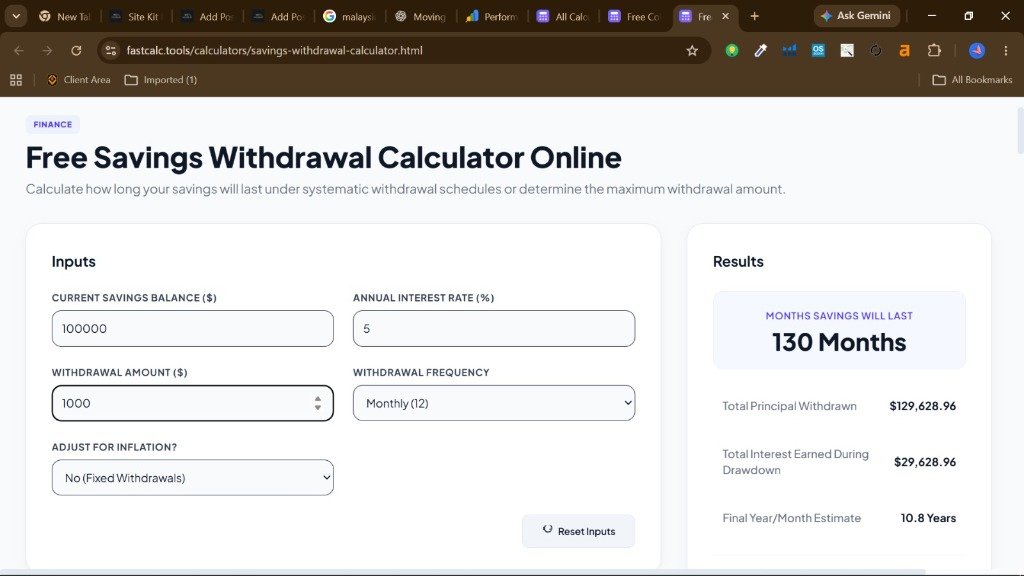
This tool is useful for people who want to withdraw money regularly without exhausting their savings too quickly. It can also help retirees plan their income, families manage emergency funds, and individuals understand the impact of different withdrawal strategies.
In this guide, you will learn how a savings withdrawal calculator works, which inputs matter most, how to calculate withdrawals, and how to develop a strategy that helps your money last longer.
What Is a Savings Withdrawal Calculator?
A Savings Withdrawal Calculator is an online financial tool that estimates the effect of withdrawing money from a savings account or investment fund over time.
Depending on its features, the calculator may estimate how much money remains after withdrawals, how long savings will last, or how much you can withdraw regularly before reaching a target balance.
For example, suppose you have $50,000 in savings and plan to withdraw $500 every month. A calculator can help estimate how long the money may last under different interest-rate assumptions.
If your savings earn interest, the balance may decline more slowly than it would without interest. However, if withdrawals are too large relative to your balance and earnings, your savings may eventually run out.
A savings withdrawal calculator helps you compare different scenarios before deciding how to use your money.
Why Use a Savings Withdrawal Calculator?
Planning withdrawals without calculating their long-term impact can make it difficult to manage your finances. A savings withdrawal calculator provides a clearer picture of how regular withdrawals affect your available funds.
1. Estimate How Long Your Savings Will Last
One of the main benefits is the ability to estimate how long your money can support your planned withdrawals.
This can be particularly useful for retirees, people between jobs, and individuals using savings to cover living expenses.
2. Plan a Monthly Withdrawal Amount
A calculator can help you evaluate different monthly withdrawal amounts according to your savings balance and financial goals.
For example, you can compare withdrawing $300, $500, or $700 per month to understand how each amount may affect your remaining balance.
3. Account for Interest Earnings
Savings accounts may earn interest while your money remains deposited. Including an estimated interest rate can help you understand how earnings affect the balance over time.
Actual rates can change, and the interest offered by a financial institution may be subject to account conditions and fees.
4. Prepare for Retirement
Retirees often depend on savings to supplement pensions, retirement accounts, or other income sources.
A savings withdrawal calculator can help estimate whether a particular withdrawal strategy is consistent with a retirement budget. It should be used alongside a broader retirement plan that considers inflation, taxes, investment risks, and changing expenses.
5. Avoid Withdrawing Too Much
Regularly withdrawing more than your savings can sustainably support may cause your balance to decline faster than expected.
A calculator lets you compare different withdrawal amounts and identify strategies that may help preserve your savings for longer.
How Does a Savings Withdrawal Calculator Work?
A savings withdrawal calculator uses your starting balance, planned withdrawals, interest rate, and time period to estimate the remaining amount.
The exact calculation depends on whether withdrawals happen monthly or annually and whether interest is compounded daily, monthly, or annually.
Starting Savings Balance
This is the total amount of money available before withdrawals begin.
For example, if you have $30,000 in a savings account, enter $30,000 as your starting balance.
Withdrawal Amount
This is the amount you plan to take out during each withdrawal period.
You might withdraw a fixed amount every month or choose an annual withdrawal to cover a major expense.
Withdrawal Frequency
Withdrawal frequency determines how often money is taken from the account. Common options include monthly, quarterly, and annually.
Monthly withdrawals may be suitable for regular living expenses, while annual withdrawals may be useful for tuition payments or planned purchases.
Expected Annual Interest Rate
The annual interest rate represents the estimated return earned on your remaining savings.
A higher interest rate may help offset some withdrawals, but rates can change and are not guaranteed unless the account terms provide otherwise.
Withdrawal Period
This represents the number of months or years over which you plan to withdraw money.
Depending on the calculator, you may enter a fixed period or calculate how long your savings will last until the balance reaches zero.
Inflation and Fees
Some advanced calculators allow you to include inflation, account fees, and taxes. These factors matter because the amount you can actually spend may be lower than the account balance suggests.
Inflation also reduces purchasing power over time, meaning the same withdrawal amount may cover fewer expenses in future years.
Savings Withdrawal Calculator Formula
A basic savings withdrawal calculation estimates the balance remaining after interest is earned and money is withdrawn.
For a simplified model with monthly interest and a withdrawal made at the end of each month, the formula is:
Where:
- \(B_n\) = remaining balance after \(n\) months
- \(P\) = initial savings balance
- \(r\) = monthly interest rate
- \(n\) = number of months
- \(W\) = monthly withdrawal amount
The monthly interest rate can be approximated by dividing the annual nominal interest rate by 12.
If the interest rate is zero, the calculation becomes:
For example, if you start with $12,000 and withdraw $500 monthly without earning interest, the money will last 24 months.
This simplified example assumes no additional deposits, fees, or taxes.
For a nonzero interest rate, the calculator must also account for the interest earned on the remaining balance. If the planned withdrawal exceeds what the account can support, the balance will reach zero before the full period ends.
Example: Calculating Savings Withdrawals
Suppose you have $50,000 in savings and want to withdraw $500 each month. You estimate that your savings will earn 3% annual interest, compounded monthly.
The following table illustrates the key inputs.
| Savings detail | Amount |
|---|---|
| Initial savings balance | $50,000 |
| Monthly withdrawal | $500 |
| Annual interest assumption | 3% |
| Monthly interest assumption | 0.25% |
| Total withdrawals per year | $6,000 |
| Estimated initial annual interest | $1,500 |
The initial annual interest figure is an approximation based on the starting balance. As withdrawals reduce the balance, the interest earned will generally decline as well.
Under these assumptions, the monthly interest helps extend the life of the savings compared with withdrawing $500 per month without interest. However, the account will still decline over time because the monthly withdrawals are substantially greater than the interest earned.
The actual result depends on the timing of withdrawals, interest calculations, and account conditions.
How Much Can You Withdraw From Your Savings?
The amount you can safely withdraw depends on your savings balance, expenses, other income, financial goals, and the length of time the money needs to last.
There is no single withdrawal amount that works for everyone.
Calculate Your Essential Expenses
Begin by identifying your essential monthly costs, including housing, food, utilities, transportation, insurance, and healthcare.
Then consider discretionary expenses such as travel, entertainment, and nonessential purchases.
Understanding your spending needs can help you determine how much money you must withdraw each month.
Consider Other Sources of Income
If you receive a salary, pension, rental income, or other regular payments, you may not need to rely entirely on your savings.
Calculate the difference between your expected expenses and other income to estimate the amount your savings must provide.
Keep an Emergency Reserve
Avoid committing your entire savings balance to regular withdrawals if you may need money for unexpected expenses.
Medical bills, urgent home repairs, and temporary income disruptions can affect your financial stability. Keeping a suitable emergency reserve may help reduce the need for additional withdrawals.
Account for Inflation
Inflation can increase the cost of everyday expenses over time.
If your savings are intended to support you for many years, consider whether your planned withdrawals need to increase to maintain purchasing power.
However, increasing withdrawals can also cause your savings to run out sooner.
Strategies to Make Your Savings Last Longer
A savings withdrawal calculator is most useful when combined with a practical withdrawal strategy.
1. Set a Realistic Withdrawal Budget
Determine how much you actually need to withdraw each month instead of selecting an arbitrary amount.
Review your expenses and distinguish between essential and optional spending. A realistic budget can help prevent unnecessary withdrawals.
2. Withdraw Only What You Need
When practical, avoid withdrawing more money than necessary for your planned expenses.
Smaller withdrawals leave more money in the account to earn interest. Over time, this may help preserve your balance.
3. Compare Different Interest-Rate Scenarios
Savings rates can change. Test your plan using several interest-rate assumptions, including a lower rate.
This helps you understand whether your withdrawal plan remains workable if interest earnings decrease.
4. Review Your Plan Regularly
Update your savings balance, withdrawal amount, interest rate, and expenses periodically.
A plan that works today may need adjustment if your income, financial obligations, or account terms change.
5. Avoid Unnecessary Fees
Account maintenance charges, transaction fees, and other expenses can reduce your savings.
Review your account conditions and compare available options to understand the total cost of keeping your money deposited.
6. Keep Short-Term Needs Accessible
Money intended for upcoming bills and emergencies should generally remain accessible without excessive withdrawal restrictions or penalties.
The appropriate balance between accessibility and potential returns depends on your needs and financial circumstances.
Savings Withdrawal Calculator for Retirement Planning
Retirement is one of the most common reasons people calculate regular withdrawals from their savings.
After retirement, income may come from pensions, retirement accounts, Social Security benefits where applicable, investments, and personal savings.
A savings withdrawal calculator can help estimate how a savings balance changes when you withdraw money regularly.
For example, a retiree may compare a fixed monthly withdrawal with a smaller withdrawal that increases gradually with inflation.
When using the calculator for retirement planning, consider:
- Expected retirement duration.
- Monthly living expenses.
- Pension and other income.
- Healthcare costs.
- Inflation.
- Investment returns and market fluctuations.
- Taxes and withdrawal restrictions.
- Emergency and long-term care expenses.
A basic savings calculator may not account for every retirement factor. For a comprehensive plan, consider the different tax treatment and withdrawal rules that may apply to retirement accounts in your country.
Savings Withdrawal Calculator vs. Savings Growth Calculator
Although both tools help with financial planning, they answer different questions.
| Feature | Savings Withdrawal Calculator | Savings Growth Calculator |
|---|---|---|
| Main purpose | Estimate the impact of taking money out | Estimate how savings accumulate |
| Primary activity | Withdrawals | Deposits and contributions |
| Typical inputs | Starting balance, withdrawals, interest | Starting balance, deposits, interest |
| Main result | Remaining balance or duration | Projected future balance |
| Common use | Retirement and spending plans | Emergency funds and savings goals |
A savings growth calculator is useful when you are building a fund. A savings withdrawal calculator becomes particularly helpful when you begin using that money.
You can use both tools at different stages of your financial journey to understand how your savings may develop over time.
Common Mistakes When Planning Savings Withdrawals
Avoid these common mistakes to improve your financial planning.
- Ignoring interest-rate changes: Assuming your savings will always earn the same rate can produce unrealistic projections.
- Withdrawing too much: Large or frequent withdrawals may reduce your balance faster than expected.
- Forgetting inflation: A fixed withdrawal may gradually cover fewer expenses as prices rise.
- Ignoring fees and taxes: These costs may reduce the amount available for spending.
- Failing to maintain an emergency reserve: Unexpected expenses can force you to withdraw more than planned.
- Using overly optimistic assumptions: Conservative scenarios can help you evaluate how your plan would perform under less favourable conditions.
- Not reviewing your budget: Changes in living costs or income may require adjustments to your withdrawal strategy.
Who Should Use a Savings Withdrawal Calculator?
A savings withdrawal calculator can be useful for different financial situations.
- Retirees: Estimate how long their savings may support regular living expenses.
- Individuals between jobs: Plan withdrawals while looking for new employment.
- Students: Estimate how long an education fund may cover tuition and living costs.
- Families: Manage savings intended for large purchases or household expenses.
- Emergency fund users: Understand the impact of drawing money from a reserve.
- Investors: Compare withdrawal strategies under different return assumptions.
- People planning a career break: Estimate whether available savings can support expenses during a period without regular income.
The calculator is particularly valuable when you want to compare different withdrawal amounts before making a long-term financial commitment.
Conclusion
A Savings Withdrawal Calculator is a useful financial planning tool that helps you estimate how withdrawals affect your savings over time. By entering your starting balance, planned withdrawals, expected interest rate, and withdrawal period, you can better understand how long your money may last.
The most effective approach is to establish a realistic budget, maintain an emergency reserve, account for inflation and fees, and review your plan regularly. Comparing different withdrawal scenarios can also help you identify a strategy that fits your financial goals.
Remember that calculator results are estimates rather than guarantees. Interest rates, account terms, taxes, and personal expenses can change. For retirement or other long-term financial decisions, consider the broader financial picture before settling on a withdrawal amount.
Frequently Asked Questions (FAQs)
1. What is a Savings Withdrawal Calculator?
A Savings Withdrawal Calculator is a financial tool that estimates how withdrawals affect your savings balance over time. It can help calculate the remaining balance or estimate how long your money may last.
2. How do I calculate monthly withdrawals from savings?
Enter your starting savings balance, monthly withdrawal amount, expected interest rate, and withdrawal period. The calculator estimates the remaining balance based on those inputs and its calculation method.
3. How long will my savings last if I withdraw money every month?
The duration depends on your starting balance, withdrawal amount, and interest earnings. Larger withdrawals generally cause savings to run out sooner, while interest earnings may extend the withdrawal period.
4. Does a Savings Withdrawal Calculator include interest?
Many calculators allow you to include an estimated interest rate. Some simpler calculators assume no interest, so check the available inputs and calculation method before relying on the result.
5. Can I use a Savings Withdrawal Calculator for retirement?
Yes. It can help estimate how long your savings may last when you withdraw a regular amount during retirement. However, a comprehensive retirement plan should also consider inflation, taxes, investment risks, pensions, and healthcare costs.
6. What happens if my withdrawal amount is too high?
If withdrawals consistently exceed interest earnings and the amount your savings can support, your balance will decline. Eventually, the money may run out before the planned period ends.
7. Should I include inflation in my withdrawal calculations?
Yes, especially when planning withdrawals over several years. Inflation reduces purchasing power and may require higher withdrawals in the future, although increasing withdrawals can shorten the life of your savings.
8. Can I calculate annual withdrawals instead of monthly withdrawals?
Yes, if the calculator supports annual withdrawal periods. Make sure the interest rate, withdrawal frequency, and calculation assumptions match the schedule you intend to follow.
9. How can I make my savings last longer?
Consider reducing unnecessary withdrawals, creating a realistic budget, reviewing account fees, maintaining an emergency reserve, and comparing different withdrawal scenarios. The right strategy depends on your financial circumstances and goals.
10. Is a Savings Withdrawal Calculator accurate?
It can provide useful estimates when you enter accurate information, but it cannot guarantee future results. Actual interest rates, fees, taxes, and spending needs may differ from your assumptions.
11. Can I use this calculator for an emergency fund?
Yes. It can help estimate how long an emergency fund may cover expenses if your income stops or an unexpected cost occurs. Remember to account for ongoing bills and possible changes in spending.
12. Is a Savings Withdrawal Calculator free?
Many online savings withdrawal calculators are free to use. They allow you to test different starting balances, withdrawal amounts, interest rates, and time periods without performing the calculations manually.