Free High Yield Savings Account Calculator Online
Calculate how compounding interest, APY, and monthly contributions grow your cash balance over time in a high-yield savings account (HYSA).
Inputs
Results
Related Calculators
High Yield Savings Account Calculator: Calculate Your Savings Growth
A High Yield Savings Account Calculator is a useful financial tool that helps you estimate how much money you can earn by depositing funds into a high-yield savings account. By entering your initial deposit, monthly contributions, annual percentage yield (APY), and savings period, you can calculate your potential account balance and total interest earned over time.
High-yield savings accounts are popular among people who want to grow their savings while keeping their money relatively accessible. They typically offer higher interest rates than traditional savings accounts, although rates can change depending on market conditions and the financial institution.
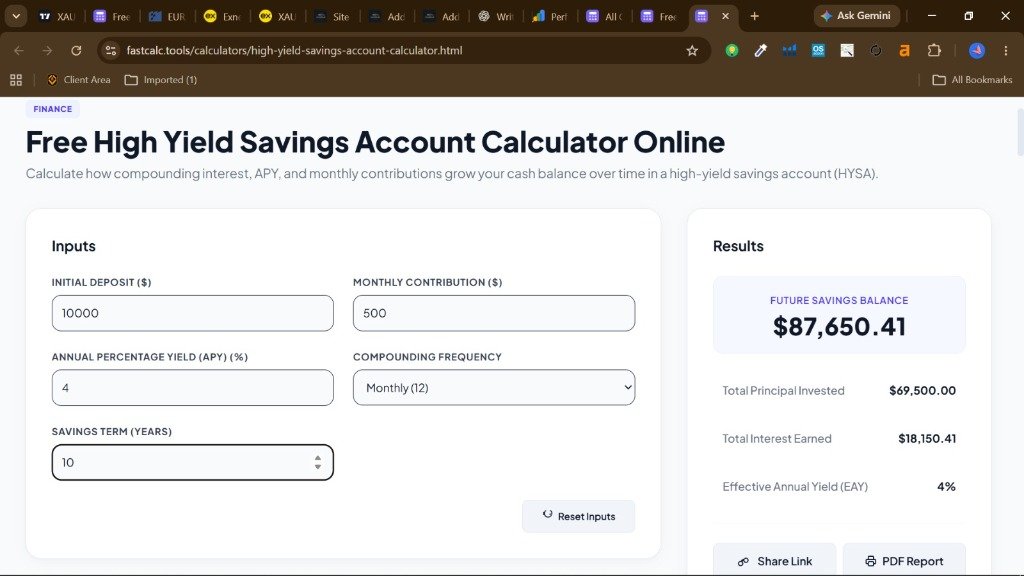
Whether you are building an emergency fund, saving for a home, preparing for a vacation, or setting aside money for future expenses, a High Yield Savings Account Calculator can help you plan your financial goals more effectively.
This guide explains how the calculator works, how to calculate compound interest, which factors affect savings growth, and how to choose a suitable high-yield savings account.
What Is a High Yield Savings Account Calculator?
A High Yield Savings Account Calculator is an online financial calculator that estimates the future value of your savings based on your deposits, interest rate, and investment period.
Unlike a regular savings account that may offer a relatively low interest rate, a high-yield savings account is designed to provide a more competitive return on deposited money.
The calculator allows you to estimate:
- Your initial savings deposit.
- Additional monthly contributions.
- The annual percentage yield (APY).
- The length of your savings period.
- Total interest earned.
- Your estimated ending account balance.
For example, suppose you deposit $5,000 into a high-yield savings account and earn an assumed APY of 4% for three years. If the rate remains unchanged and interest compounds as expected, your savings will grow without requiring additional deposits.
Adding regular monthly contributions can increase the final balance further.
The calculator provides an estimate rather than a guaranteed result because savings rates, deposits, fees, and account terms may change.
How Does a High Yield Savings Account Calculator Work?
A High Yield Savings Account Calculator uses your savings details and an assumed interest rate to estimate the balance you may accumulate over a selected period.
1. Initial Deposit
The initial deposit is the amount of money you put into the savings account at the beginning of the calculation period.
For example, you might start with $1,000, $5,000, or $10,000.
A larger initial deposit generally produces more interest because more money is available to earn returns from the beginning.
If you already have savings, entering your current balance provides a more accurate starting point for your projection.
2. Monthly Contributions
Monthly contributions represent additional deposits made regularly into the account.
For example, you might save $100, $250, or $500 each month.
Regular contributions can help you reach your savings target faster because every additional deposit increases the amount of money earning interest.
When using a calculator, specify whether monthly deposits are made at the beginning or end of each month if that option is available. Beginning-of-month deposits generally earn slightly more interest because they remain in the account longer.
3. Annual Percentage Yield (APY)
The annual percentage yield, or APY, represents the annual return on a deposit when the effect of compounding is included.
For example, an account advertising a 4% APY is designed to earn approximately 4% over a year if the rate and balance remain consistent and the account meets the stated terms.
The actual interest credited may depend on the institution's compounding and payment schedule.
High-yield savings account rates are often variable, meaning the bank can increase or decrease the rate over time.
A calculator that assumes a fixed APY therefore provides a projection, not a guarantee of future earnings.
4. Savings Period
The savings period is the length of time you intend to keep your money in the account.
You can calculate growth over several months, one year, five years, or another period.
A longer savings period generally allows more time for interest to accumulate. However, if the account's APY changes, the actual balance may differ from the calculator's estimate.
5. Compounding Frequency
Compounding occurs when interest earned is added to the account balance and subsequently earns interest itself.
Savings accounts may calculate and credit interest daily, monthly, or according to another schedule specified by the bank.
If the calculator uses APY directly, the compounding effect is already incorporated into that annual rate. Avoid applying an additional compounding adjustment to APY, as this can overstate the projected return.
6. Additional Deposits and Withdrawals
Some calculators allow you to include withdrawals as well as deposits.
Adding monthly contributions can increase your projected balance, while withdrawals reduce the money available to earn interest.
If you plan to use the account for regular expenses, include expected withdrawals where possible to create a more realistic estimate.
High Yield Savings Account Formula
A High Yield Savings Account Calculator uses mathematical formulas to estimate how savings grow over time.
Compound Interest Formula
If you make a single deposit and do not add or withdraw money, the future value can be estimated using:
\[ FV=P(1+r)^t \]
Where:
- \(FV\) = future value of your savings.
- \(P\) = initial deposit.
- \(r\) = effective annual interest rate expressed as a decimal.
- \(t\) = number of years.
When using APY, this formula assumes the APY remains constant for the entire period.
For example, if you deposit $5,000 at a 4% APY for three years:
\[ FV=5000(1.04)^3 \]
\[ FV\approx \$5,624.32 \]
Your estimated interest earnings would be approximately $624.32.
This calculation assumes no additional deposits, withdrawals, or fees.
Formula for Monthly Contributions
If you make regular monthly contributions, the future value can be estimated by combining the growth of your initial deposit with the growth of your contributions.
For an account modeled using a monthly interest rate \(i\), the formula for end-of-month contributions is:
\[ FV=P(1+i)^n+ C\left(\frac{(1+i)^n-1}{i}\right) \]
Where:
- \(P\) = initial deposit.
- \(C\) = monthly contribution.
- \(i\) = effective monthly interest rate.
- \(n\) = total number of monthly periods.
If the calculator converts an annual APY into an equivalent monthly rate, it can use:
\[ i=(1+\text{APY})^{1/12}-1 \]
This approach maintains consistency with the effective annual yield.
Actual bank calculations may differ slightly because of daily balance calculations, the timing of deposits, and the institution's interest-crediting policies.
Example: Calculate High Yield Savings Growth
Suppose you open a high-yield savings account with an initial deposit of $5,000. You then contribute $200 at the end of each month.
Assume the account earns a constant 4% APY, with no withdrawals or fees.
The following table illustrates how your savings could grow over time.
| Savings period | Total deposits | Estimated balance | Estimated interest |
|---|---|---|---|
| 1 year | $7,400 | $7,621 | $221 |
| 3 years | $12,200 | $13,186 | $986 |
| 5 years | $17,000 | $19,123 | $2,123 |
| 10 years | $29,000 | $34,849 | $5,849 |
These figures are approximate illustrations based on a constant 4% APY, an initial $5,000 deposit, and monthly contributions of $200 made at the end of each month.
The calculation assumes the equivalent monthly rate is derived from the APY and excludes fees, taxes, withdrawals, and future rate changes. Actual results may differ.
The example shows how regular deposits and compound interest can work together to increase your savings balance.
Benefits of Using a High Yield Savings Account Calculator
A savings calculator can help you make better financial decisions by showing how different saving strategies may affect your future balance.
1. Estimate Future Savings
You can calculate how much money you might accumulate over a particular period. This helps you decide whether your current savings plan is sufficient for your goals.
2. Compare Different Interest Rates
You can test different APYs to understand how a higher or lower savings rate affects interest earnings.
For example, comparing accounts offering different rates can show how much additional interest you might earn, assuming the rates remain unchanged.
3. Set Realistic Savings Goals
If you need a specific amount for a house deposit, emergency fund, or major purchase, the calculator can help you estimate how much you need to save each month.
4. Understand Compound Interest
The calculator demonstrates how interest accumulates over time and how previously earned interest can contribute to future growth.
5. Evaluate Monthly Contributions
You can increase or decrease your monthly deposits to determine how your savings plan affects your target balance.
6. Compare Savings Accounts
A calculator can help compare hypothetical rates and contribution strategies. However, you should also consider account fees, minimum balance requirements, withdrawal restrictions, and deposit protection.
High Yield Savings Account vs. Traditional Savings Account
Both high-yield and traditional savings accounts provide a place to keep money while potentially earning interest. Their main difference is often the interest rate and account features.
| Feature | High-yield savings account | Traditional savings account |
|---|---|---|
| Interest rate | Often more competitive | May be lower |
| Interest earnings | Potentially higher | Depends on the rate |
| Access to funds | Usually accessible | Usually accessible |
| Interest rate changes | Often variable | May also be variable |
| Fees | Depends on the provider | Depends on the provider |
| Best use | Growing accessible savings | Everyday or general savings |
A high-yield account may be attractive when your goal is to earn more interest without taking investment-market risk.
However, not every high-yield account is automatically better. Compare the account's current APY, eligibility requirements, fees, access arrangements, and deposit insurance coverage before opening an account.
Factors That Affect High Yield Savings Growth
Several factors determine how much interest you earn.
Annual Percentage Yield
A higher APY generally produces more interest when the balance and savings period are the same.
However, variable rates may change, so a high introductory rate should not be assumed to last indefinitely.
Initial Deposit
A larger starting balance usually earns more interest because more money is deposited from the beginning.
Monthly Contributions
Consistent deposits increase the account balance and help accelerate progress toward your savings target.
Time Period
Longer savings periods generally allow more interest to accumulate, assuming a positive rate and no withdrawals.
Withdrawals
Withdrawals reduce the balance and the amount available to earn interest in the future.
Account Fees
Monthly maintenance fees and other charges can reduce your overall savings. Some accounts waive fees if you meet certain conditions.
Inflation
Inflation reduces the purchasing power of money over time. Even when your account balance grows, your savings may buy less in the future if prices rise faster than your after-tax interest earnings.
Taxes
In the United States, interest earned on a high-yield savings account is generally taxable income at the federal level and may also be subject to state or local taxes. Your actual after-tax return depends on your tax situation.
How to Choose the Best High Yield Savings Account
Selecting an appropriate account involves more than finding the highest advertised interest rate.
Compare APYs
Check the current APY offered by several financial institutions. Since rates can change, verify the latest rate and whether any promotional conditions apply.
Review Account Fees
Look for monthly maintenance fees, excessive withdrawal charges where applicable, and other costs that could reduce your earnings.
Check Minimum Deposit Requirements
Some accounts require an opening deposit or a minimum balance to qualify for the advertised APY.
Verify Deposit Insurance
For US accounts, check whether the bank is insured by the Federal Deposit Insurance Corporation (FDIC) or whether an eligible credit union is insured by the National Credit Union Administration (NCUA). Coverage is subject to applicable rules and limits.
Consider Access to Your Money
Check how you can deposit and withdraw funds, whether an ATM card is available, and how long transfers typically take.
Review the Bank's Terms
Understand how interest is calculated and credited, whether the rate is variable, and what conditions apply to earning the advertised APY.
How to Reach Your Savings Goals Faster
Using a High Yield Savings Account Calculator alongside a realistic savings strategy can help you make steady progress toward your financial objectives.
- Automate your savings: Set up recurring transfers so that part of your income goes into savings regularly.
- Increase contributions when possible: Even small increases in monthly deposits can improve your projected balance over time.
- Avoid unnecessary withdrawals: Keeping money in the account allows more funds to continue earning interest.
- Review your APY periodically: Compare your current rate with other available accounts and check whether your bank has changed its terms.
- Build an emergency fund: Consider setting aside enough accessible savings to cover unexpected expenses according to your circumstances.
- Keep savings separate from spending money: A dedicated savings account can make it easier to track progress and avoid using funds intended for future goals.
Common Mistakes to Avoid When Calculating Savings
Several common mistakes can make savings projections misleading.
- Assuming the APY will never change: Most high-yield savings accounts have variable rates.
- Confusing APR with APY: APY accounts for the effect of compounding, while APR may not.
- Ignoring fees: Charges can reduce the actual amount you earn.
- Forgetting to include contributions: Omitting regular deposits can underestimate future savings.
- Overlooking withdrawals: Money taken out no longer earns interest in the account.
- Ignoring taxes: Taxable interest can reduce your net return.
- Expecting guaranteed results: A calculator uses assumptions, and actual account balances depend on real deposits, rates, and terms.
Review your inputs carefully and use reasonable assumptions to produce a useful estimate.
Frequently Asked Questions (FAQs)
1. What is a High Yield Savings Account Calculator?
A High Yield Savings Account Calculator estimates the future value of your savings using your initial deposit, monthly contributions, APY, and savings period. It also helps estimate the interest earned over time.
2. How much interest can I earn from a high-yield savings account?
Your interest earnings depend on your balance, APY, account terms, and the length of time your money remains deposited. Enter these details into a calculator to estimate your potential earnings.
3. How does APY affect savings growth?
APY represents the annual percentage yield, including the effect of compounding. A higher APY generally produces greater earnings when the balance, time period, and other conditions are the same.
4. Is interest compounded daily or monthly?
The calculation and crediting schedule depends on the financial institution. Some banks calculate interest daily and credit it monthly. Check your account agreement for the exact method.
5. Can I add monthly contributions to the calculator?
Yes. Many savings calculators allow you to enter recurring monthly deposits. Including these contributions can provide a more realistic estimate of your future balance.
6. Are high-yield savings accounts safe?
Eligible deposits at insured US banks and credit unions are protected subject to applicable FDIC or NCUA coverage rules and limits. Savings accounts are generally not exposed to stock-market fluctuations, but you should verify the institution's insurance status and account terms.
7. Can the APY on a high-yield savings account change?
Yes. Many high-yield savings accounts offer variable rates. A bank may increase or decrease the APY, so future earnings may differ from the calculator's projection.
8. Do I have to pay taxes on high-yield savings interest?
In the United States, savings account interest is generally taxable income for federal tax purposes and may also be taxable at the state or local level. Your tax obligations depend on your circumstances.
9. How much should I save each month?
The appropriate amount depends on your income, expenses, financial obligations, and savings goals. A calculator can help you estimate the monthly contribution needed to reach a particular target by a chosen date.
10. What is the difference between APY and interest rate?
The interest rate describes the rate used to calculate interest, while APY reflects the annual yield after accounting for compounding. APY is often the more useful figure when comparing savings accounts.
11. Can I lose money in a high-yield savings account?
Your balance may be reduced by fees, withdrawals, or applicable taxes. Eligible deposits at insured US institutions are protected within the relevant coverage limits. Unlike investments such as stocks, a savings account does not ordinarily fluctuate with the stock market.
12. Does a High Yield Savings Account Calculator account for inflation?
Some calculators include an inflation adjustment, while others show only the projected account balance. If inflation is excluded, the result represents future dollars rather than today's purchasing power.
13. Is a high-yield savings account better than investing in stocks?
These options serve different purposes. A high-yield savings account is generally suitable for accessible savings and short-term goals, while stocks offer growth potential with greater market risk. The appropriate choice depends on your time horizon, financial goals, and risk tolerance.
Conclusion
A High Yield Savings Account Calculator is a practical tool for estimating how your money can grow through interest and regular deposits. By adjusting your starting balance, monthly contributions, APY, and savings period, you can compare different strategies and plan for financial goals more effectively.
High-yield savings accounts can be useful for emergency funds, short-term purchases, and other savings objectives where accessibility matters. However, variable interest rates, account fees, taxes, and inflation can affect your actual results.
Before opening an account, compare current APYs, review the terms, verify deposit insurance, and choose a contribution amount that fits your budget. With consistent saving and realistic expectations, you can use a high-yield savings account to build a stronger financial foundation.