Free College Savings Calculator Online
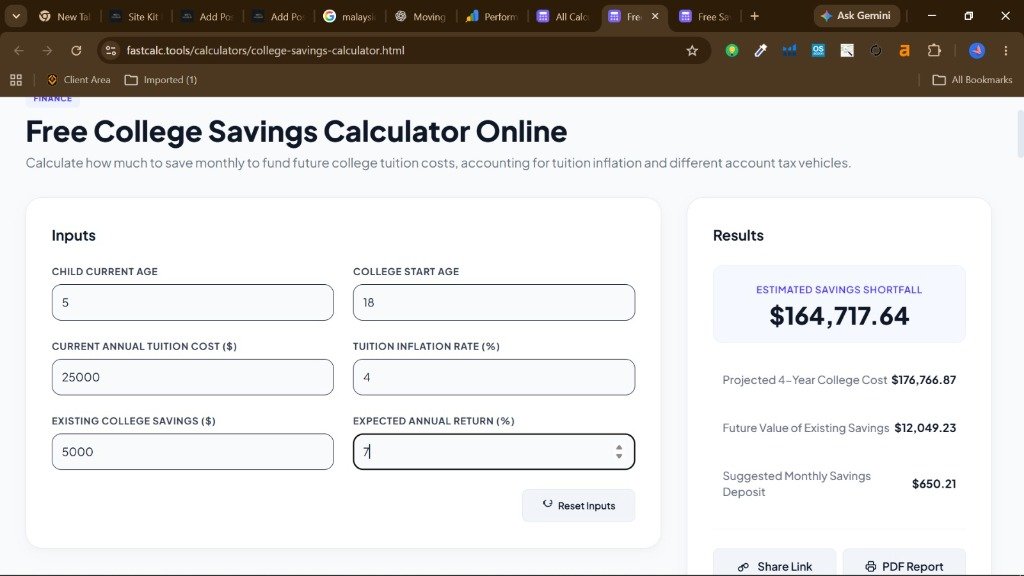
Calculate how much to save monthly to fund future college tuition costs, accounting for tuition inflation and different account tax vehicles.
Inputs
Results
Related Calculators
College Savings Calculator: A Complete Guide to Planning for Education Costs
Planning for college expenses is an important part of preparing for your child's future. The cost of higher education can include tuition fees, accommodation, books, transportation, meals, and other personal expenses. Without a proper savings strategy, these costs may create financial pressure for families when a student is ready to attend college.
A College Savings Calculator helps parents, guardians, and students estimate how much money they need to save to cover future education expenses. By entering details such as current savings, expected college costs, years until enrollment, monthly contributions, and estimated investment returns, users can develop a realistic education savings plan.
Whether your child is a newborn, a primary school student, or a teenager approaching college age, starting early can make a meaningful difference. Regular contributions, careful budgeting, and a suitable investment strategy can help you prepare for future education expenses.
In this guide, you will learn how a college savings calculator works, how to estimate college costs, how compound growth affects savings, and which strategies can help you reach your education funding goals.
What Is a College Savings Calculator?
A College Savings Calculator is a financial planning tool that estimates how much money you can accumulate for future college expenses. It uses information about your current savings, regular contributions, investment returns, and the number of years remaining before college begins.
The calculator can help answer important questions, including:
- How much should I save each month for college?
- How much will my existing savings grow before enrollment?
- What could college cost in the future?
- How much money might my investments generate?
- Will my current savings plan cover the expected expenses?
- How much additional money do I need to reach my target?
For example, parents with a child who is eight years old may have approximately ten years to prepare for college enrollment at age eighteen. A college savings calculator can estimate the potential growth of monthly contributions over that period.
The results depend on the assumptions entered into the calculator. Investment returns are not guaranteed, and actual college expenses may differ from estimates. However, the tool provides a useful starting point for building an education savings strategy.
Why Is a College Savings Calculator Important?
College expenses can increase over time because of tuition inflation, housing costs, and changes in the overall cost of living. Saving without a specific target can make it difficult to determine whether you are making enough progress.
A college savings calculator provides a structured way to evaluate your financial readiness.
1. Estimate Future Education Expenses
The calculator helps you estimate the potential cost of college when your child is ready to enroll. By considering the number of years remaining and the expected annual increase in education costs, you can establish a more realistic savings target.
2. Set Monthly Savings Goals
Instead of saving irregular amounts, you can calculate a monthly contribution that fits your budget. Consistent contributions can make a large future expense easier to manage.
3. Understand the Power of Compound Growth
When savings earn investment returns, those returns may generate additional returns over time. This process is known as compound growth.
Starting early gives your savings more time to grow, although investment performance will vary.
4. Compare Different Savings Strategies
You can adjust the monthly contribution, expected return, or savings period to understand how different strategies may affect the final balance.
This helps you evaluate whether increasing contributions or starting earlier could improve your results.
5. Identify Potential Funding Gaps
If your projected savings are lower than your expected college costs, you can estimate the difference and adjust your plan before enrollment.
Possible adjustments include increasing contributions, extending the savings period where practical, reviewing expenses, or exploring scholarships and other funding options.
How Does a College Savings Calculator Work?
A college savings calculator uses your financial information and future education estimates to project how much money you may need and how much you could accumulate before college begins.
Important Inputs in a College Savings Calculator
- Current savings: This is the amount of money you have already saved for education. A higher starting balance may reduce the amount you need to contribute in the future.
- Monthly contribution: This is the amount you plan to save every month. Regular deposits can gradually build a substantial education fund.
- Years until college: This represents the time remaining before your child starts college. More time generally provides additional opportunities for contributions and investment growth.
- Expected annual return: This is the estimated yearly percentage earned on your savings or investments. Actual returns can vary and may be negative.
- Estimated college costs: Enter the current annual cost of tuition and other education expenses. You can then account for expected increases over time.
- Years in college: This is the expected duration of the degree or programme, such as two, four, or more years.
- Annual education inflation: This estimates how much college expenses may increase each year. Including inflation can help you prepare for future costs rather than relying only on today's prices.
Many college savings calculators use these inputs to estimate future expenses, projected savings, and any funding shortfall.
College Savings Calculator Formula
A college savings calculator may use compound growth calculations to estimate the future value of existing savings and regular contributions.
The basic formula for the future value of a starting balance is:
Where:
- \(FV\) = future value of savings
- \(P\) = initial savings balance
- \(r\) = annual rate of return
- \(n\) = number of years
For monthly contributions, a calculator can use the following formula when the return is compounded monthly and deposits are made at the end of each month:
Where:
- \(P\) = initial savings
- \(i\) = monthly rate of return
- \(N\) = total number of monthly periods
- \(C\) = monthly contribution
If the monthly return is zero, the future value simplifies to the initial savings plus all contributions.
These formulas provide estimates rather than guarantees. Actual results depend on investment performance, fees, taxes, contribution timing, and the calculator's assumptions. Compound growth occurs when returns are earned on both the original balance and previously accumulated returns.
Example: Calculating College Savings
Suppose parents want to prepare an education fund for their child. They currently have $5,000 saved and plan to contribute $200 every month for the next ten years.
For illustration, assume an annual return of 5%, compounded monthly, with contributions made at the end of each month.
| Savings detail | Amount |
|---|---|
| Initial savings | $5,000 |
| Monthly contribution | $200 |
| Savings period | 10 years |
| Assumed annual return | 5% |
| Total additional contributions | $24,000 |
| Total money contributed, including initial savings | $29,000 |
| Estimated future savings | Approximately $37,200 |
| Estimated investment growth | Approximately $8,200 |
These figures are illustrative estimates, not guaranteed investment results. They exclude fees, taxes, and changes in the contribution amount.
The example shows how regular contributions and potential compound growth can help build an education fund over time.
How Much Should You Save for College?
The amount you should save depends on the type of college your child may attend, the expected duration of study, your current financial position, and the proportion of expenses you want to cover from savings.
A useful starting point is to estimate the full cost of education and then determine how much you can realistically save.
Estimate the Total Cost of College
College expenses extend beyond tuition. Your estimate should consider:
- Tuition and mandatory academic fees.
- Accommodation and housing.
- Food and groceries.
- Books and learning materials.
- Transportation.
- Computers and other study equipment.
- Health insurance or medical expenses where applicable.
- Personal expenses and an emergency allowance.
If your child plans to study away from home, accommodation and transportation may significantly affect the total budget.
Decide How Much You Want to Cover
You may not need to save the entire cost of college. Some families intend to cover a specific percentage from savings while relying on scholarships, grants, family income, or other funding sources for the remainder.
For example, you might aim to save 50% of estimated expenses and develop a separate plan for the balance.
However, scholarships and financial aid are not guaranteed. Avoid relying on funding that has not yet been confirmed.
Calculate Your Monthly Savings Target
Once you estimate the future cost, subtract your projected savings at enrollment to identify any funding gap.
If the projected balance falls short of your goal, increase monthly contributions if your budget allows, begin saving earlier when possible, or reassess the target and available funding options.
A calculator can help you compare these scenarios and determine a contribution level that is more manageable for your household.
How College Cost Inflation Affects Your Savings
College expenses may increase between the time you start saving and the time your child enrolls. Therefore, using current tuition fees alone can underestimate the amount you will need in the future.
A college savings calculator that includes education inflation can help account for this difference.
The formula for estimating a future annual college cost is:
Where:
- \(FV\) = estimated future annual cost
- \(C\) = current annual college cost
- \(g\) = assumed annual education cost inflation
- \(n\) = years until college begins
For example, if annual college expenses currently cost $20,000 and you assume 3% annual inflation over ten years, the projected first-year cost would be approximately $26,878.
This estimate does not represent a prediction for a particular college. Actual tuition increases and living expenses may be higher or lower.
Remember to estimate the full duration of education, because the cost of the second, third, and fourth years may increase further.
Best Strategies for Building a College Savings Fund
A calculator helps you establish a target, but following a consistent savings strategy is essential to making progress.
1. Start Saving Early
Beginning early allows you to spread contributions over a longer period. You may be able to reach your target with smaller monthly deposits than if you begin saving shortly before college enrollment.
Time also gives savings more opportunity to benefit from compound growth, although returns are never guaranteed.
2. Automate Monthly Contributions
Set up a recurring transfer to your designated education savings account after receiving your income.
Automated contributions can help establish consistency and reduce the temptation to spend money that was intended for education.
Choose an amount that fits your budget without compromising essential expenses or emergency savings.
3. Increase Contributions Gradually
If your income increases, consider directing a portion of the additional money toward your college savings goal.
You can also contribute occasional bonuses, gifts, or other available funds. Small increases made consistently may improve your projected balance over time.
4. Review Your Savings Plan Annually
Education expenses, family income, investment performance, and savings priorities can change.
Review your plan at least once a year. Update the current savings balance, monthly contribution, expected college costs, and remaining time before enrollment.
A revised calculation can show whether you remain on track or need to adjust your strategy.
5. Consider Suitable Savings and Investment Options
Different accounts offer different levels of risk, flexibility, access, and potential growth.
Depending on your country and circumstances, options may include savings accounts, fixed-term deposits, education savings programmes, or investment accounts.
In the United States, some families consider 529 education savings plans. These have specific rules concerning eligible expenses, tax treatment, and withdrawals. Other countries may offer different education funding arrangements.
Review fees, withdrawal conditions, tax implications, and investment risks before selecting an account.
6. Maintain an Emergency Fund
Avoid putting every available dollar into long-term education savings if doing so leaves your household without money for unexpected expenses.
An emergency fund can help you manage financial setbacks without interrupting your college contributions or withdrawing education savings at an inconvenient time.
7. Explore Scholarships and Grants
Scholarships and grants can reduce the amount a family needs to fund from personal savings. Research eligibility requirements, application deadlines, academic criteria, and other conditions early.
Treat these awards as a potential source of support rather than guaranteed income until they have been confirmed.
Common Mistakes to Avoid When Planning College Savings
Several mistakes can make it more difficult to reach an education savings target.
- Ignoring inflation: Using today's tuition fees without estimating future increases may result in an insufficient savings goal.
- Starting too late: Delaying contributions reduces the time available to accumulate savings and potentially earn returns.
- Using unrealistic investment assumptions: High projected returns can make a savings plan appear more achievable than it really is. Test several scenarios, including lower returns.
- Forgetting additional expenses: Tuition is only one part of the cost. Housing, food, transportation, books, and personal expenses should also be considered.
- Saving inconsistently: Skipping contributions regularly may reduce the final balance. Choose an affordable amount that you can maintain.
- Failing to review the plan: A calculation made years ago may no longer reflect your family's current financial position or expected education costs.
- Overlooking fees and taxes: Depending on the account and country, fees and taxes can affect the amount available for education.
College Savings Calculator vs. Student Loan Calculator
A college savings calculator and a student loan calculator serve different purposes.
| Feature | College Savings Calculator | Student Loan Calculator |
|---|---|---|
| Main purpose | Estimate future education savings | Estimate borrowing costs and repayment |
| Primary inputs | Current savings, contributions, time, returns | Loan amount, interest rate, repayment period |
| Main result | Projected savings and funding gap | Estimated payment and total repayment |
| Best used for | Planning before college | Evaluating borrowing and repayment |
| Main consideration | Savings growth and education costs | Interest charges and debt obligations |
Using a college savings calculator early may help reduce the amount you need to borrow later. However, the appropriate balance between savings, scholarships, family contributions, and borrowing depends on your circumstances.
Who Should Use a College Savings Calculator?
A college savings calculator can benefit anyone planning for future education expenses.
- Parents: Estimate how much to save for a child's future education.
- Expectant parents: Begin a long-term savings plan before college approaches.
- Guardians and relatives: Estimate contributions toward a child's education fund.
- Teenagers: Develop personal savings goals before entering college.
- Students planning further education: Estimate how much they need to save before enrolling in a degree or training programme.
- Families comparing colleges: Evaluate how different tuition costs and study durations affect the overall savings target.
The calculator is particularly useful when you want to compare different savings strategies before committing to a specific monthly contribution.
Conclusion
A College Savings Calculator is a practical tool for preparing for the future cost of higher education. By combining current savings, regular contributions, estimated investment returns, education inflation, and the number of years until enrollment, it helps you develop a clearer financial plan.
The most effective approach is to start early, set a realistic target, make consistent contributions, and review your progress regularly. Remember to include tuition, housing, books, transportation, and other expenses when estimating the total cost of college.
Although no calculator can predict future costs or investment returns with complete accuracy, it can help you compare scenarios and identify potential funding gaps. With thoughtful planning and consistent saving, you can work toward making higher education more financially manageable.
Frequently Asked Questions (FAQs)
1. What is a College Savings Calculator?
A College Savings Calculator is a financial tool that estimates how much money you may accumulate for future education expenses based on your current savings, monthly contributions, investment returns, and time until college enrollment.
2. How do I calculate how much to save for college?
Estimate future tuition and other education expenses, subtract the amount you expect to have saved by enrollment, and calculate the contributions needed to cover the remaining gap. Include expected education inflation and consider potential investment growth.
3. How much should I save each month for college?
Your monthly savings target depends on your child's age, expected college costs, current savings, investment assumptions, and the amount you want to cover. A college savings calculator can help estimate an affordable monthly contribution.
4. When should I start saving for college?
Starting as early as practical gives your savings more time to accumulate. Even modest contributions made consistently can help build an education fund over the years.
5. Does a College Savings Calculator include compound interest?
Many calculators include compound growth based on an assumed rate of return. This allows you to estimate how your starting balance and regular contributions might grow over time.
6. What is education inflation?
Education inflation refers to increases in education-related costs over time. It can affect tuition, fees, accommodation, and other expenses. Including an inflation estimate helps you calculate a more realistic future savings target.
7. Can a College Savings Calculator guarantee that I will have enough money?
No. The calculator provides estimates based on the information and assumptions you enter. Actual education costs, investment returns, fees, and family circumstances may differ from your projections.
8. Can I use a College Savings Calculator for more than one child?
Yes. You can calculate a separate savings target for each child, taking into account their current ages, expected enrollment dates, and anticipated education expenses. This helps you compare funding needs across different timelines.
9. What happens if my college savings are insufficient?
You can consider increasing contributions, revising your target, researching scholarships and grants, comparing more affordable institutions, or exploring other funding options. Reviewing your plan early gives you more time to evaluate alternatives.
10. Should I invest my college savings?
That depends on your time horizon, risk tolerance, financial circumstances, and available account options. Investments may offer growth potential but can lose value. Consider the risks, fees, tax rules, and withdrawal requirements before choosing an approach.
11. Does a College Savings Calculator account for scholarships?
Some calculators allow you to include scholarships, grants, or other funding sources, while others focus only on savings and investment growth. If your calculator does not include these amounts, subtract confirmed funding separately when estimating your remaining college expenses.
12. Is a College Savings Calculator free to use?
Many online college savings calculators are free. They generally allow users to adjust their savings balance, monthly contributions, investment assumptions, and education costs to compare different scenarios.