What Is a Tax ID? Is It the Same as an EIN? (Complete Guide)
Demystifying Taxpayer Identification Numbers (TIN), Employer Identification Numbers (EIN), Social Security Numbers, and state business tax identifiers for individuals and business owners.
Quick Answer: Is a Tax ID the Same as an EIN?
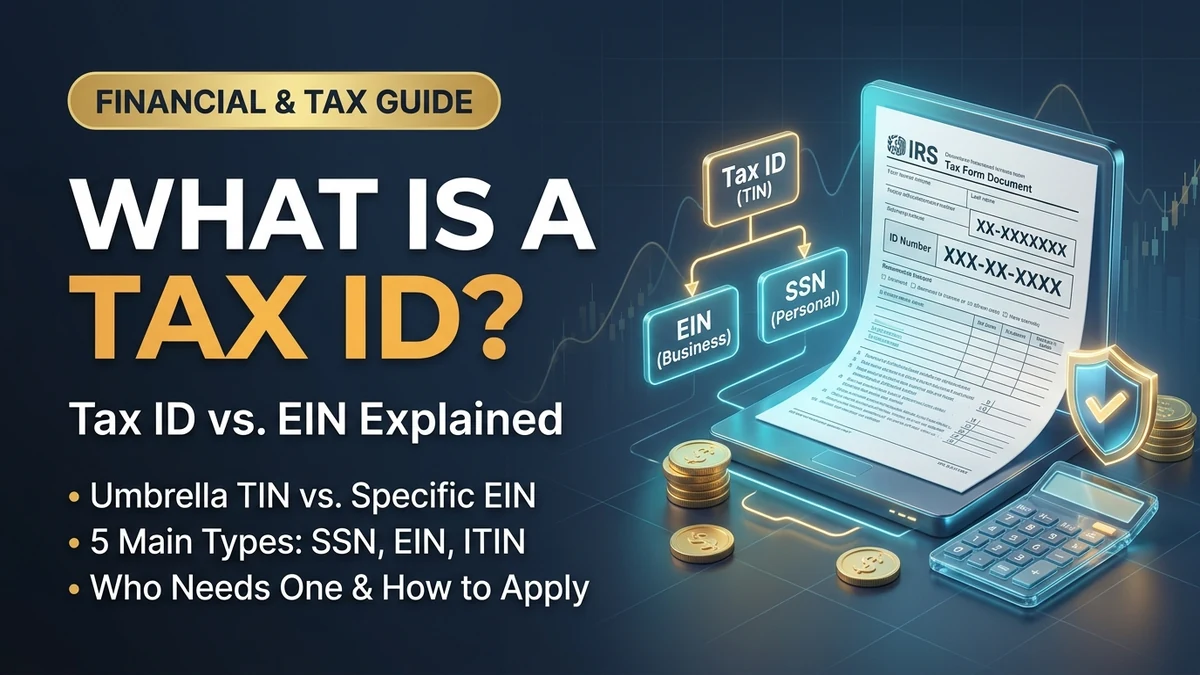
A Tax ID (officially termed a Taxpayer Identification Number or TIN) is a nine-digit tracking number assigned by the Internal Revenue Service (IRS) or state revenue departments to identify individuals, businesses, estates, and trusts. While many taxpayers ask what is tax id and whether it is identical to an Employer Identification Number (EIN), the two terms are not synonymous: a Tax ID is an overarching parent category, whereas an EIN is one specific type of Tax ID designated primarily for employers, corporations, partnerships, and multi-member entities. Every EIN is a Tax ID, but not every Tax ID is an EIN.
Whether you are launching an LLC, working as an independent contractor, or setting up payroll, you can forecast your net earnings and tax liabilities instantly using the suite of financial tools at FastCalc.tools, including our dedicated business and salary calculators.
Table of Contents
- 1. The Umbrella Hierarchy: Tax ID vs. EIN
- 2. The 5 Federal Tax ID Types Explained
- 3. Federal Tax ID vs. State Tax ID
- 4. When Do You Legally Need an EIN?
- 5. Privacy Benefits for Sole Proprietors & 1099s
- 6. How to Apply for Each Tax ID (100% Free)
- 7. How to Look Up or Recover a Lost Tax ID
- 8. Master Tax ID Comparison Matrix
- 9. Frequently Asked Questions
The Umbrella Hierarchy: What Is a Tax ID vs. What Is an EIN?
To clearly comprehend what is tax id in the eyes of federal law, consider it an umbrella classification. The Internal Revenue Code (IRC § 6109) mandates that every taxpayer—individual citizen, non-resident alien, corporation, partnership, or nonprofit—possess a unique identifying number for annual return processing, information reporting, and tax collection. This general identifier is universally referred to as a Taxpayer Identification Number (TIN) or simply a "Tax ID."
An Employer Identification Number (EIN), on the other hand, is a specific subcategory nested under that broader umbrella. If the term "vehicle" represents a Tax ID, an "EIN" is akin to a commercial cargo truck—engineered specifically for corporate transactions, employee payroll, and distinct legal entities. Other vehicles under the same umbrella include Social Security Numbers (passenger sedans) and Individual Taxpayer Identification Numbers (specialized utility vehicles).
When evaluating what is tax id versus an employer number, the critical distinction lies in hierarchy: an EIN is always a Tax ID, but personal Tax IDs like an SSN or ITIN can never serve as an employer identification number for incorporated enterprises. Misinterpreting this relationship frequently causes confusion when business founders fill out commercial vendor forms, apply for wholesale licenses, or open corporate bank accounts.
The IRS Taxpayer Identification Number (TIN) Family
Personal tax returns, W-2 employment, dependent claims, and personal investments.
Corporations, LLCs, partnerships, trusts, estates, non-profits, and employer payroll.
Pending domestic child adoptions (ATIN) and registered paid tax preparers (PTIN).
The 5 Federal Tax ID Types Issued by the IRS and SSA
Understanding what is tax id across personal and commercial spheres requires reviewing the five core numbers recognized by the federal government. Each series follows strict formatting conventions, serves distinct administrative functions, and is governed by explicit eligibility criteria.
1. Social Security Number (SSN)
Format: 000-00-0000Issued exclusively by the Social Security Administration (SSA), the SSN is the most common Tax ID in the United States. Available to U.S. citizens, permanent residents (green card holders), and authorized temporary non-citizen workers, the SSN tracks wages, calculates future retirement and disability benefits, and serves as the taxpayer's personal identifier on individual federal tax returns (Form 1040).
2. Employer Identification Number (EIN)
Format: 00-0000000Also known colloquially as a "Federal Tax ID" or "FEIN," the Employer Identification Number is issued by the IRS to business entities, employers, trusts, estates, and tax-exempt organizations. Unlike personal numbers, an EIN establishes a business entity as a distinct legal taxpayer under the Internal Revenue Code. It allows companies to hire employees, report payroll withholding (Form 941), issue 1099 statements, open commercial bank accounts, and secure corporate credit lines.
3. Individual Taxpayer Identification Number (ITIN)
Format: 900-00-0000 (Starts with 9)The ITIN is a nine-digit tax processing number issued by the IRS specifically for individuals who have tax reporting or payment obligations under U.S. law but are not legally eligible to receive an SSN from the SSA. This includes foreign investors, non-resident alien students or scholars receiving taxable stipends, non-resident property sellers subject to FIRPTA withholding, and foreign spouses or dependents of U.S. citizens. Crucially, an ITIN does not grant legal work authorization or Social Security benefit eligibility.
4. Adoption Tax ID (ATIN)
9 DigitsA temporary nine-digit identification number issued by the IRS to prospective adoptive parents who are in the ongoing process of adopting a domestic child who has not yet received an SSN. It allows the parents to claim the child as a dependent and take the Child Tax Credit on their tax returns.
5. Preparer Tax ID (PTIN)
Format: P00000000Mandatory identifier issued by the IRS for all professional paid tax return preparers. Beginning with the letter "P" followed by eight digits, the PTIN must be renewed annually and entered on every federal return prepared for compensation to maintain regulatory compliance.
Federal Tax ID vs. State Tax ID: What's the Difference?
Beyond federal reporting, business founders frequently ask what is tax id at the state level. While a Federal Tax ID (the EIN) is issued by the IRS for nationwide tax tracking, state revenue agencies manage separate identification systems to regulate state-specific taxes.
A State Tax ID (often designated as a State Employer Account Number, Sales Tax License, or Franchise Tax Number) is issued by your state's Department of Revenue (DOR) or Department of Labor. In some states, your state number is identical to your nine-digit federal EIN with a state prefix or suffix added; in other states (such as California or New York), the state assigns a completely separate 7-to-10 digit registration number.
| Feature / Requirement | Federal Tax ID (EIN) | State Tax ID Number |
|---|---|---|
| Issuing Authority | Internal Revenue Service (IRS) | State Department of Revenue / Taxation |
| Scope of Jurisdiction | United States nationwide | Individual state boundaries |
| Primary Uses | Federal income tax, FICA, FUTA, W-2/1099 filings, banking | State sales tax collection, state payroll withholding (SIT), SUTA |
| Application Prerequisite | Requires Responsible Party SSN or ITIN | Usually requires an existing Federal EIN first |
| Multiple Numbers Needed? | Single EIN covers federal operations nationwide | Separate ID required in each state with nexus or employees |
When Do You Legally Need an EIN?
For entrepreneurs deciding what is tax id appropriate for their venture, the IRS establishes clear guidelines under Treasury regulations. While a freelance copywriter operating as an unincorporated sole proprietorship can legally operate with an SSN, specific organizational milestones trigger a mandatory statutory requirement to obtain an EIN.
Hiring W-2 Employees
The moment you hire your first employee, you must obtain an EIN to remit payroll taxes, Social Security, Medicare, and Federal Unemployment Tax (FUTA).
Operating as a Corporation or Partnership
All multi-member business entities, C-corporations, S-corporations, and general partnerships are required by federal law to file corporate returns under a unique EIN.
Filing Federal Excise Tax Returns
Businesses dealing with alcohol, firearms, commercial highway transportation, fuel, or wagering must file Form 720 excise tax returns under an EIN.
Establishing a Keogh or Solo 401(k) Plan
Tax-deferred retirement plans for self-employed individuals require a dedicated EIN to register the plan trust and file annual Form 5500 filings.
Estates, Trusts & Nonprofits
Estates with gross income over $600, irrevocable trusts, and tax-exempt 501(c)(3) charities must maintain an EIN to file fiduciary income returns (Form 1041).
Opening a Business Bank Account
Even if not required by the IRS for single-member LLCs, virtually every FDIC-insured bank demands an EIN under federal anti-money laundering (KYC) compliance.
Privacy & Identity Theft Protection: Why Sole Proprietors & 1099s Get an EIN
Independent contractors exploring what is tax id best suited for privacy often elect to obtain a separate business number even when not legally required to do so. Under standard commercial practices, clients hiring freelance specialists, gig workers, and consultants must collect a completed Form W-9 before remitting payment to verify whether an end-of-year Form 1099-NEC is required.
If you operate as an unincorporated freelancer without an EIN, you must write your personal Social Security Number on Part I of Form W-9. That document is frequently emailed across unencrypted servers, stored in vendor accounting files, and viewed by accounts payable clerks across dozens of corporate clients. Distributing your SSN in this manner significantly elevates your exposure to identity theft and fraudulent credit inquiries.
By obtaining an EIN for your sole proprietorship, you can furnish your business Tax ID on all W-9 requests instead of your SSN. If a client's accounting database is compromised, your personal credit profile and Social Security records remain completely shielded. Furthermore, providing an EIN immediately signals professional legitimacy to corporate procurement departments, distinguishing you from casual hobbyists. You can estimate your self-employment tax liabilities using our free self-employment tax calculator.
How to Apply for Each Tax ID (100% Free Government Process)
Once you determine what is tax id needed for your entity, securing the credential through official channels is free, straightforward, and protected by federal law. Taxpayers should exercise caution when searching online, as numerous third-party intermediary websites charge $50 to $300 for an EIN that the IRS provides at zero cost.
Applying for an EIN (Online Instant Issue)
The fastest way to obtain an EIN is directly through the official IRS EIN Assistant website (irs.gov/ein). The application takes approximately 10 to 15 minutes to complete online and issues your official EIN immediately upon submission.
- Available Monday through Friday, 7:00 a.m. to 10:00 p.m. Eastern Time.
- Requires the legal name and SSN or ITIN of the "Responsible Party" (the principal owner or officer).
- International applicants without an SSN/ITIN cannot apply online; they must submit Form SS-4 by telephone (267-941-1099) or by international mail.
Applying for an ITIN (Form W-7 Application)
Unlike an EIN, an ITIN cannot be issued instantly online. Applicants must complete IRS Form W-7 (Application for IRS Individual Taxpayer Identification Number) and attach it to an original, valid federal income tax return (Form 1040-NR or Form 1040).
- Must include certified original proof of identity and foreign status documents (such as an unexpired foreign passport or consulate certification).
- Applications can be submitted by mail to the IRS ITIN Operation in Austin, Texas, through an IRS-authorized Certifying Acceptance Agent (CAA), or in person at designated IRS Taxpayer Assistance Centers (TACs).
- Processing typically takes 7 to 11 weeks during the standard tax filing season.
Applying for an SSN (Social Security Administration)
SSNs are managed exclusively by the Social Security Administration, not the IRS. Most U.S. citizens receive an SSN at birth via the hospital enumeration process. If applying as an adult immigrant or naturalized citizen, you must submit Form SS-5 along with original immigration and identity documentation at a local Social Security office.
How to Look Up or Recover a Lost Tax ID
If you misplace your paperwork and need to recall what is tax id assigned to your enterprise, there are several straightforward recovery pathways. Because the IRS does not maintain a public online searchable database of private company EINs, you must retrieve the number through verified documentation or secure agency channels.
1. Review IRS Notice CP 575 or 147C
When the IRS originally assigned your EIN, they issued an official confirmation letter (Notice CP 575). If this document is lost, you can contact the IRS to request an EIN Verification Letter (Letter 147C).
2. Inspect Prior Tax Returns & 1099s
Look at previously filed business tax returns (Form 1120, 1120-S, or 1065) or Form 1099-NEC statements received from enterprise clients. The 9-digit EIN is always printed at the top.
3. Contact Your Business Bank
Call the financial institution where you hold your commercial checking account. Your banker can verify your identity and read back the EIN on file from your original account opening paperwork.
4. Call the IRS Business Line
Call the IRS Business & Specialty Tax Line toll-free at 1-800-829-4933 (7:00 a.m. to 7:00 p.m. local time). Once an agent verifies your authorized officer status, they will disclose your EIN over the phone.
Master Tax ID Comparison Matrix: SSN vs. EIN vs. ITIN
To ensure total clarity regarding what is tax id across different taxpayer entities, the comparison table below summarizes the key technical specifications, eligible recipients, and operational limits of the primary federal tax identifiers:
| Tax ID Type | Issuing Agency | Standard Format | Primary Purpose | Permits US Employment? |
|---|---|---|---|---|
| Social Security Number (SSN) | Social Security Admin (SSA) | 000-00-0000 | Individual tax filing, social security benefits, employee payroll | Yes (Subject to status) |
| Employer ID Number (EIN) | Internal Revenue Service (IRS) | 00-0000000 | Business taxes, hiring staff, commercial banking, business credit | N/A (Business Entity) |
| Individual Taxpayer ID (ITIN) | Internal Revenue Service (IRS) | 900-00-0000 | Federal tax filing for foreign nationals ineligible for an SSN | No |
| Adoption Tax ID (ATIN) | Internal Revenue Service (IRS) | 900-00-0000 | Temporary child dependent claim during ongoing domestic adoption | No |
| Preparer Tax ID (PTIN) | Internal Revenue Service (IRS) | P00000000 | Mandatory regulatory registration for paid commercial tax preparers | N/A (Professional Reg) |
Frequently Asked Questions About Tax IDs & EINs
Is a Tax ID number the exact same thing as an EIN?
No, they are not identical. A Tax ID (Taxpayer Identification Number or TIN) is an overarching category that encompasses all federal tax numbers. An Employer Identification Number (EIN) is one specific type of Tax ID used primarily for business entities, corporations, partnerships, and employers. Every EIN is a Tax ID, but not every Tax ID is an EIN.
Can a sole proprietor operate with just a Social Security Number?
Yes, a sole proprietor with no employees and no excise tax obligations can legally use their personal Social Security Number (SSN) as their Tax ID. However, many sole proprietors obtain an EIN to protect their privacy on Form W-9 and establish business bank accounts without exposing their personal SSN.
How much does it cost to get an official EIN from the IRS?
An EIN is 100% free when obtained directly from the IRS website (IRS.gov). The IRS online application provides your EIN immediately upon completing the interview. Beware of commercial filing services that charge $50 to $300 for this free government service.
What is the difference between an ITIN and an SSN?
An SSN is issued by the Social Security Administration to U.S. citizens and authorized non-citizens for work and social security benefits. An ITIN (Individual Taxpayer Identification Number) is issued solely by the IRS to foreign nationals and resident aliens who have tax filing obligations but are not eligible for an SSN. ITINs do not authorize employment or social security benefits.
Does a single-member LLC need an EIN?
A single-member LLC with no employees and no excise tax liabilities is treated as a disregarded entity by the IRS and can theoretically use the owner's SSN. However, nearly all commercial banks require an EIN to open an LLC business checking account, and having an EIN preserves the separation between business and personal assets.
How can I look up or recover a lost EIN?
You can locate your lost EIN by reviewing your original IRS confirmation notice (CP 575 or Letter 147C), checking previously filed tax returns or Form W-9, contacting your business bank, or calling the IRS Business & Specialty Tax Line toll-free at 1-800-829-4933.
Key Takeaways for Taxpayers & Business Owners
In summary, recognizing what is tax id and how each category functions enables individuals and business owners to maintain seamless compliance with state and federal authorities. While your personal Social Security Number remains your primary individual tax anchor, acquiring an Employer Identification Number provides essential corporate separation, commercial banking capabilities, and privacy protection for modern entrepreneurs.
To calculate your annual personal tax liabilities, project your quarterly estimated tax payments, or estimate your employee take-home pay, explore our comprehensive suite of financial calculators at FastCalc.tools, including our federal income tax calculator and after-tax paycheck calculator.