Do Amish People Pay Taxes? The Truth About IRS, Social Security & Exemptions
Separating tax myths from statutory law: discovering which federal, state, and local taxes Old Order Amish citizens pay, and the strict religious conditions governing their Social Security exemption.
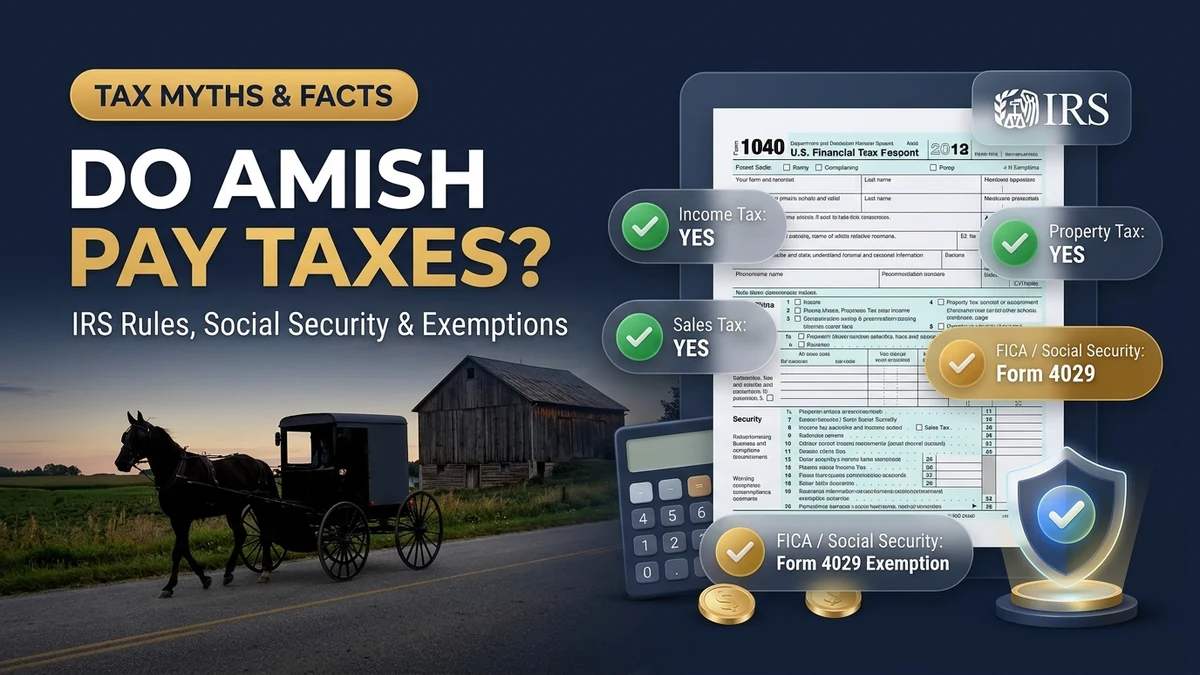
Direct Answer: Do Amish People Pay Taxes?
Yes, Amish people pay most federal, state, and local taxes, contrary to widespread myths. While the question do amish pay taxes is commonly met with misconceptions of blanket tax immunity, members of the Old Order Amish and Mennonite communities pay federal income tax, state income tax, local property tax, sales tax, and school taxes. The sole major exemption they qualify for under federal law (Internal Revenue Code § 1402(g)) is an exemption from Social Security and Medicare taxes (FICA and self-employment taxes), and this exemption only applies if they are self-employed or work for an Amish employer, because their religious beliefs forbid accepting government entitlements or public assistance.
Whether you are managing agricultural income, calculating commercial wages, or evaluating statutory deductions, you can model your tax brackets and net take-home earnings with the interactive suites at FastCalc.tools.
Public debate frequently centers on do amish pay taxes when neighbors notice their self-contained lifestyles, horse-drawn buggies, and absence of electrical grid connections. Because the Old Order Amish decline modern government safety nets and refrain from military service as conscientious objectors, an enduring folklore persists that they inhabit a tax-free sanctuary. In reality, the Internal Revenue Service enforces federal tax compliance across all U.S. citizens regardless of religious creed, with exemptions tightly limited by constitutional jurisprudence and statutory waivers.
Table of Contents
- 1. Federal & State Income Taxes
- 2. The Social Security Exemption (Form 4029)
- 3. Employment & United States v. Lee (1982)
- 4. Property Taxes & The Public School Paradox
- 5. Sales, Fuel & Commercial Excise Taxes
- 6. Why Amish Conscientiously Refuse Welfare
- 7. Master Comparison: What Amish Pay vs. Waive
- 8. Frequently Asked Questions
Federal & State Income Taxes: Full Statutory Liability
To provide a definitive answer regarding do amish pay taxes, one must examine federal income tax filings under Form 1040. Under Internal Revenue Code § 1, every individual U.S. citizen whose gross income exceeds the standard deduction threshold must submit an annual federal tax return. Amish individuals—whether operating dairy farms, custom woodworking shops, construction crews, or quilt shops—file Form 1040 annually and calculate their liability according to standard progressive tax brackets.
Amish taxpayers report agricultural earnings on Schedule F (Profit or Loss From Farming), commercial trade income on Schedule C (Profit or Loss From Business), and capital gains from real estate sales on Schedule D. They claim allowable business deductions, equipment depreciation, and the standard deduction. Like any other business owners, Amish craftsmen keep rigorous double-entry bookkeeping records or engage trusted certified public accountants (CPAs) to prepare their annual filings, ensuring full compliance with federal statutory guidelines. If you want to review current bracket thresholds and marginal rates, test your figures on our free federal income tax calculator.
The same statutory obligations apply at the state level. In states hosting the largest Amish populations—including Pennsylvania, Ohio, Indiana, New York, and Wisconsin—Amish residents pay mandatory state personal income taxes and local Earned Income Taxes (EIT) levied by municipalities and school jurisdictions. State revenue departments offer no blanket religious exemptions on earned income. State tax auditors conduct regular reviews of commercial Amish enterprises, verifying that quarterly estimated tax payments and withholding declarations match reported revenues.
The Critical Employer Distinction: United States v. Lee (1982)
A pivotal nuance that answers do amish pay taxes on payroll depends directly on who signs the worker's paycheck. Many casual observers assume every Amish person never pays a penny into Social Security. That assumption is legally incorrect.
The legal milestone clarifying do amish pay taxes when employed by commercial enterprises was resolved by the 1982 Supreme Court case United States v. Lee (455 U.S. 252). Edwin Lee, an Amish farmer and carpenter in Pennsylvania, employed several fellow Amish church members in his business but refused to withhold or pay Social Security taxes, arguing that doing so violated his First Amendment religious liberties.
The Supreme Court ruled unanimously against Lee. Chief Justice Warren Burger wrote that while religious beliefs are protected, the government's compelling interest in maintaining a stable, universally administered social security system supersedes religious objections in commercial employment relationships. Congress subsequently amended the tax code in 1988 under IRC § 3127 to create a narrow employer exception:
Scenario A: Amish Worker for Amish Employer
If both the employee and the employer are approved members of the religious group and both have approved Form 4029 waivers on file:
Exempt from FICA (Social Security & Medicare)Scenario B: Amish Worker for Non-Amish Employer
If an Amish individual works for a non-Amish commercial business (such as an RV manufacturing plant, modular home builder, or commercial construction firm):
Must Pay 100% of Standard FICA TaxesThe non-Amish employer is legally required to withhold 7.65% FICA from the Amish employee's paycheck and pay the 7.65% matching share, even though the employee will never claim the resulting benefits. Evaluate your wage deductions using our after-tax paycheck calculator.
Property Taxes & The Public School Paradox
Local school funding provides another striking example of do amish pay taxes through substantial county and municipal assessments. Because agriculture and rural craftsmanship form the cornerstone of Amish life, families frequently own large tracts of fertile farmland, residential homesteads, barns, and commercial workshops. Real estate holdings are often multi-generational, spanning dozens to hundreds of contiguous acres assessed at current fair market agricultural and commercial property valuations.
In rural counties across Lancaster County (PA), Holmes County (OH), and LaGrange County (IN), Amish property owners receive identical county property tax assessments as their non-Amish neighbors. In most U.S. jurisdictions, between 50% and 70% of real estate property tax collections are directly allocated to public school districts. Failure to pay local real estate taxes leads to standard municipal tax liens and sheriff sales, with county treasurers treating Amish properties under the identical legal standards applied to any default in the general public.
Here lies what legal scholars term the "Amish School Paradox": Amish children do not attend public schools. Following the historic 1972 Supreme Court decision in Wisconsin v. Yoder (406 U.S. 205), Amish communities educate their children in private, community-built, one-room parochial schools funded entirely through voluntary church subscriptions, ending formal schooling after the eighth grade. Despite receiving zero financial benefit from public school facilities, sports complexes, or buses, Amish property owners pay thousands of dollars annually in public school property taxes, effectively subsidizing public educational opportunities for non-Amish children in their surrounding townships. Estimate residential and commercial tax rates using our property tax calculator.
Sales, Fuel & Commercial Excise Taxes
When evaluating whether do amish pay taxes on commercial activity, state sales and excise levies demonstrate full statutory compliance. Whenever an Amish person walks into a local hardware store, dry goods emporium, or farm machinery dealership, they pay the standard state and local retail sales tax on every taxable transaction. No religious exemption card or statutory carve-out exists under state sales tax codes for individual retail buyers.
Similarly, when Amish entrepreneurs operate commercial enterprises—such as cabinet manufacturing, bakeries, or harness fabrication—they must register with their state Department of Revenue, obtain a sales tax license, collect sales tax from retail buyers, and remit those funds monthly or quarterly to state treasuries. Amish businesses undergo standard state sales tax audits and are subject to the same penalties and interest assessments if discrepancies arise.
Furthermore, Amish families pay federal and state excise taxes. While they do not own motor vehicles, they utilize substantial quantities of diesel, kerosene, and propane to run stationary hydraulic power units, refrigeration systems, water heaters, and barn lighting. Those fuel purchases include all applicable state and federal motor fuel and energy excise levies. In several counties, Amish buggy owners also pay local wheel taxes or buggy license fees designed to offset horse-drawn road wear caused by iron horseshoe shoes and steel-rimmed buggy wheels on municipal asphalt.
Why Amish People Conscientiously Refuse Government Welfare
Entrepreneurs assessing how do amish pay taxes across different business structures can compare their mutual aid traditions to modern safety nets. The Amish moral obligation to waive federal insurance is mirrored by an equally rigid refusal to accept public financial assistance:
Master Comparison: Taxes Amish Pay vs. Taxes Amish Waive
In addition to real estate taxes, understanding do amish pay taxes on corporate income reveals that incorporated Amish businesses face identical corporate tax rates. The comprehensive matrix below details the statutory status of every major tax category under U.S. jurisprudence:
| Tax Category | Amish Obligation Status | Statutory Basis / Legal Authority | Notes & Limitations |
|---|---|---|---|
| Federal Income Tax | PAID (100%) | IRC § 1 (Form 1040) | Standard individual marginal brackets, deductions, and capital gains rules apply. |
| State & Local Income Tax | PAID (100%) | State Revenue Codes | Paid in PA, OH, IN, NY, and all states levying personal and business income tax. |
| Local Property / Real Estate Tax | PAID (100%) | County / Township Ordinances | Assessed on farmland, homes, and shops. Fully funds public schools and county infrastructure. |
| State & Local Sales Tax | PAID (100%) | State Sales Tax Statutes | Paid on retail merchandise, equipment, and materials. Collected by Amish retailers. |
| Social Security (Self-Employed) | EXEMPT (With Waiver) | IRC § 1402(g) (Form 4029) | Exempt from 15.3% SECA taxes upon filing IRS Form 4029. All future benefits waived. |
| FICA (Amish Employee of Amish Firm) | EXEMPT (With Waiver) | IRC § 3127 | Both employer and employee must be members of the qualifying sect with Form 4029 approved. |
| FICA (Amish Employee of Non-Amish Firm) | PAID (Mandatory) | U.S. v. Lee, 455 U.S. 252 | Commercial non-Amish employers must withhold FICA. Amish worker cannot opt out. |
| Fuel & Excise Taxes | PAID (100%) | Federal & State Fuel Levies | Paid at standard rates on diesel, kerosene, and propane used in farm and shop equipment. |
Frequently Asked Questions About Amish Tax Obligations
Do Amish people pay federal income taxes?
Yes. Amish citizens are subject to standard federal income tax rules under Internal Revenue Code § 1. They file Form 1040 annually and pay the exact same tax rates as all other American citizens on their taxable earnings, business profits, and capital gains.
Why are Amish people exempt from Social Security and Medicare taxes?
Under Internal Revenue Code § 1402(g), members of recognized religious sects that have conscientiously held tenets against public or private insurance programs can apply for an exemption by filing IRS Form 4029. In doing so, they completely waive all future rights to receive Social Security, Medicare, and disability payments.
Does an Amish employee pay Social Security if working for a non-Amish company?
Yes. Under the landmark U.S. Supreme Court ruling in United States v. Lee (1982), non-Amish employers must withhold FICA (Social Security and Medicare) taxes from Amish workers. The religious exemption only applies when an Amish person is self-employed or employed by a fellow Amish church member who has also filed Form 4029.
Do Amish people pay property taxes for public schools?
Yes. Amish property owners pay full local real estate and property taxes, which fund public school districts, county infrastructure, and emergency services. This is true even though Amish families send their children to private, community-funded one-room parochial schools and do not utilize the public education system.
Do Amish people pay sales tax on store purchases?
Yes. Amish individuals pay standard state and local sales taxes on retail purchases, construction lumber, fabrics, tools, and farm supplies. When running commercial retail businesses, Amish shopkeepers collect sales tax from customers and remit it directly to state revenue agencies.
Can Amish individuals receive government stimulus checks, food stamps, or Medicaid?
While legally eligible for certain universal relief programs if they pay income taxes, traditional Amish church discipline strictly forbids accepting government welfare, Medicaid, SNAP food stamps, unemployment checks, or government subsidies. In instances where stimulus payments were mailed automatically, community members generally endorsed the checks back to the U.S. Treasury.
Key Takeaways: Demystifying Amish Taxation
In summary, asking do amish pay taxes uncovers a nuanced reality where Amish citizens contribute heavily to public coffers while conscientiously waiving all rights to government assistance. They pay full federal income tax, state income tax, property tax (including heavy public school levies), and retail sales tax. Their sole exception—Social Security and Medicare—is a reciprocal statutory agreement requiring an absolute waiver of federal entitlement payouts, backed by centuries-old mutual aid networks that care for the sick and elderly without public expense.
To calculate your personal income tax brackets, evaluate your self-employment tax burden, or forecast your after-tax paycheck under federal and state rules, explore the interactive calculation tools at FastCalc.tools, including our federal income tax calculator and self-employment tax calculator.
The Social Security Exemption: IRS Form 4029 & IRC § 1402(g)
The most persistent rumors surrounding do amish pay taxes involve Social Security and Medicare exemptions under IRS Form 4029. This is the one major area of the tax code where qualifying Amish individuals enjoy a legally codified exemption from federal payroll taxes. Understanding this exception requires examining both theology and legislative history.
The Old Order Amish hold a religious conviction based on 1 Timothy 5:8 ("Anyone who does not provide for their relatives, and especially for their own household, has denied the faith and is worse than an unbeliever"). They view commercial life insurance, annuities, and government entitlement pensions as a dereliction of christian duty. To an Amish community, transferring the responsibility of elder care, healthcare, or disability support to the secular federal government represents a fundamental lack of faith in the church community.
IRS Form 4029: The Religious Exemption & Benefit Waiver
In 1965, Congress recognized this longstanding conscientious objection by enacting IRC § 1402(g). Under this statute, members of a recognized religious sect can apply for an exemption from Self-Employment Contributions Act (SECA) and Federal Insurance Contributions Act (FICA) taxes by filing IRS Form 4029.
Filing Form 4029 is not a "free pass." The applicant irrevocably surrenders all rights to ever receive monthly Social Security retirement payments, disability insurance, or Medicare benefits under Title II and Part A of Title XVIII of the Social Security Act.