Understanding your paycheck is one of the most important aspects of personal financial planning. Whether you're starting a new job, negotiating a salary, or budgeting for monthly expenses, knowing how much money you'll actually take home after taxes and deductions is essential. A Connecticut Paycheck Calculator helps employees estimate their net pay by accounting for federal taxes, Connecticut state income tax, Social Security, Medicare, and other deductions. In this comprehensive guide, we'll explain how a Connecticut paycheck calculator works, what affects your take-home pay, Connecticut tax rates, common payroll deductions, and why using a paycheck calculator can simplify your financial planning.
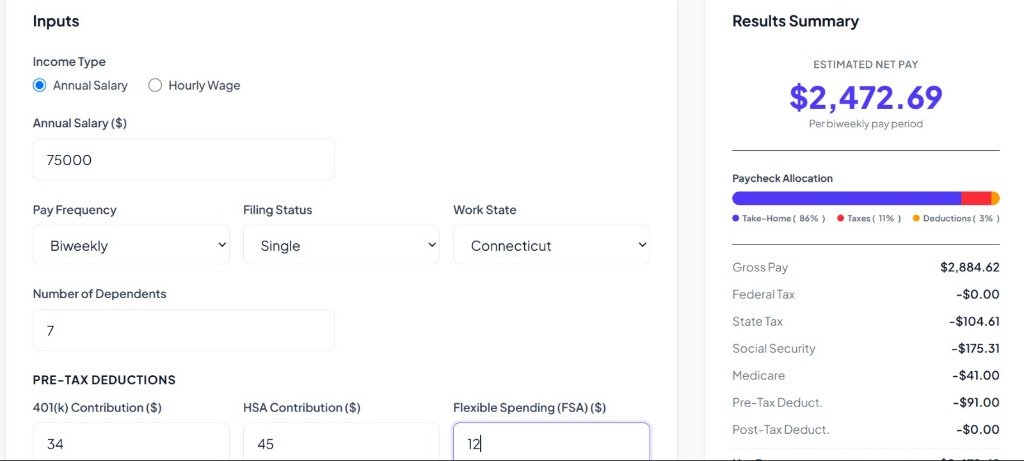
This guide explains how Connecticut paychecks are calculated, what deductions affect your earnings, and how you can maximize your take-home pay.
What Is a Connecticut Paycheck Calculator?
A Connecticut Paycheck Calculator is an online tool designed to estimate the amount of money you'll receive in your paycheck after all mandatory and voluntary deductions. Instead of manually calculating taxes, the calculator automatically estimates deductions based on your:
- Gross salary
- Pay frequency
- Filing status
- State of residence
- Federal tax withholding
- Retirement contributions
- Health insurance deductions
- Other payroll deductions
The result is your estimated net pay, also known as your take-home pay.
Why Use a Connecticut Paycheck Calculator?
Many employees only know their annual salary, but what truly matters is how much money reaches their bank account each payday. A paycheck calculator helps you:
- • Estimate weekly or monthly income
- • Plan your household budget
- • Understand payroll deductions
- • Compare job offers
- • Calculate overtime earnings
- • Estimate tax withholding
- • Prepare for annual tax filing
- • Plan retirement contributions
- • Review payroll accuracy
- • Manage financial goals
Whether you're a salaried employee or hourly worker, the calculator provides valuable insights into your earnings.
Calculate Your Connecticut Take-Home Pay Now
Estimate your net paycheck after Connecticut state tax and pre-tax deductions.
How Does a Connecticut Paycheck Calculator Work?
The calculator starts with your gross pay, which is your earnings before taxes and deductions. It then subtracts:
Federal Income Tax
Federal income tax depends on your filing status, progressive tax bracket, W-4 elections, and any additional withholdings specified.
Social Security Tax
Most employees pay Social Security tax. The standard rate is 6.2% on wages up to the annual taxable wage cap. Employers contribute an equal 6.2% matching share.
Medicare Tax
Medicare tax helps fund healthcare for eligible Americans. The standard employee rate is 1.45%. High-income earners may owe an Additional Medicare Tax of 0.9% on wages over specific thresholds.
Information Needed to Calculate Your Paycheck
A Connecticut paycheck calculator typically requires:
- Annual salary or hourly wage and hours worked
- Pay frequency and federal filing status
- Connecticut withholding allowances and benefits deductions
The more accurate your inputs, the more reliable your estimated take-home paycheck will be.
Understanding Gross Pay vs. Net Pay
Gross Pay is your total earnings before any taxes or voluntary deductions are removed (e.g., $70,000 annual salary yields roughly $5,833 monthly gross pay).
Net Pay is the final take-home salary deposited directly into your bank account after federal taxes, state taxes, Social Security, Medicare, insurance premiums, and retirement plan contributions are subtracted.
Connecticut Income Tax Overview
Connecticut levies a progressive income tax on residents and wages earned within the state. This means that lower income levels pay lower starting tax rates, while higher-income brackets are subjected to higher marginal tax rates. Your employer calculates the exact state withholding using CT-W4 guidelines and official Connecticut payroll tables.
Hourly vs. Salary Employee Calculation
Hourly employees calculate earnings by multiplying the hourly wage by regular hours worked, adding 1.5 times regular pay for any overtime hours. Salaried employees, on the other hand, receive a fixed annual income divided equally across their regular pay schedule (e.g., an $80,000 annual salary translates to roughly $3,076 per biweekly pay period before tax adjustments).
Bonuses and Pay Frequencies
Your paycheck frequency (weekly, biweekly, semi-monthly, or monthly) directly controls the amount of gross wages and deductions per paystub. Bonuses, holiday incentives, commissions, and other supplemental income may be taxed or withheld differently than standard wages.
Common Payroll Deductions & Mistakes
Standard paycheck deductions include retirement plans (like 401k/403b), health insurance premiums, Health Savings Accounts (HSA), Flexible Spending Accounts (FSA), union dues, and group life insurance. Employees should audit their pay stubs regularly to check for incorrect withholding categories, wrong pay rates, or missing overtime pay.
Tips to Maximize Take-Home Pay
To improve your paycheck, consider contributing to pre-tax retirement accounts, utilizing pre-tax HSA or FSA options, and reviewing your W-4 status regularly. Always consult a qualified tax professional for personalized tax advice.
Is the Calculator 100% Accurate?
A paycheck calculator provides an estimate based on the values you input. Actual paycheck amounts may vary due to employer-specific payroll schedules, benefit structures, local tax exceptions, garnishments, or mid-year tax updates.
Frequently Asked Questions
1. What is a Connecticut Paycheck Calculator?
A Connecticut Paycheck Calculator estimates your take-home pay after federal taxes, Connecticut state income tax, Social Security, Medicare, and other deductions.
2. Is the calculator free to use?
Yes. Most online Connecticut paycheck calculators are free and provide instant estimates.
3. Does the calculator include Connecticut state taxes?
Yes. It estimates Connecticut state income tax along with applicable federal payroll taxes.
4. Can hourly employees use the calculator?
Absolutely. Hourly workers can enter their hourly wage and hours worked to estimate their paycheck.
5. Does the calculator include overtime pay?
Most paycheck calculators allow you to include overtime hours for a more accurate estimate.
6. Can I calculate biweekly or monthly pay?
Yes. Most calculators support weekly, biweekly, semi-monthly, and monthly pay schedules.
7. Does retirement contribution affect my paycheck?
Yes. Traditional pre-tax retirement contributions generally reduce your taxable income and may increase your take-home pay.
8. Can bonuses be included?
Yes. Many paycheck calculators allow you to estimate the impact of bonuses, commissions, or other supplemental income.
9. Why is my actual paycheck different from the estimate?
Differences may result from employer-specific deductions, updated tax tables, benefit elections, garnishments, or payroll adjustments.
10. Who should use a Connecticut Paycheck Calculator?
Anyone who wants to estimate their take-home pay, including employees, job seekers, freelancers comparing employment options, employers, HR professionals, and payroll administrators.